Chiang Mai Temples: A Realistic First-Time Route
Choose Chiang Mai temples by location, visit time and travel effort, separating a walkable Old City route from the mountain trip to Doi Suthep.


For most first visits, one Old City temple explored properly and one mountain temple are enough. Wat Chedi Luang or Wat Phra Singh fits a walk inside the moat; Doi Suthep is a separate outing with a winding drive, stairs and a broader city view.
Go early, group nearby temples and stop before the heat turns carved details into a blur. Add Wat Umong or another quieter site only when its setting offers a genuine contrast to the halls and chedis already on the route.
A practical “core three” (so you don’t overdo it)
If you want an Old City temple walk that feels meaningful, pick one core Old City temple you will explore properly, one contrasting in-town site and Doi Suthep only if the mountain journey deserves its own half-day. Wat Chedi Luang brings scale and a ruined chedi into the center of the route. Wat Phra Singh offers a different active-monastery setting on the western side of the Old City. Wat Sri Suphan or Wat Umong can supply the contrast, depending on whether craft or forest atmosphere matters more.
Tourism Authority of Thailand currently lists Wat Chedi Luang as open daily from 08:00 to 17:00. Treat that as a checked planning reference, not a lifetime guarantee; ceremonies, holidays and site rules can change access. Re-check shortly before the visit, particularly if one building or an evening event is the entire reason for going.
| Temple choice | Best fit | Time and transport cost | Main trade-off |
|---|---|---|---|
| Wat Chedi Luang | First Old City walk and historical scale | Easy to combine with central lanes | The complex can be busy and exposed in midday heat |
| Wat Phra Singh | Western Old City route and active temple context | Walkable from other moat-side sights | Adding it to every central temple can create repetition |
| Wat Sri Suphan | Craft-focused contrast south of the moat | Needs a deliberate Wualai detour | Access rules for particular sacred spaces must be respected |
| Wat Umong | Forest setting and a slower Suthep-side loop | Usually needs road transport | Weak fit for a packed Old City morning |
| Wat Phra That Doi Suthep | Mountain temple, viewpoint and major half-day | Winding road, stairs or tram and return transport | Visibility varies and the journey is the real commitment |
The quick shortlist logic

For most first visits, you do not need ten temples. You need one temple that belongs naturally in the Old City walking loop, one site that provides a different setting or craft story, and the discipline to stop before temple fatigue erases the differences.
Choose Wat Chedi Luang when a central route and monumental remains matter. Choose Wat Phra Singh when the western Old City already fits the day. Add Wat Sri Suphan when the Wualai area or craft demonstrations are part of the trip. Choose Wat Umong instead when shade, forest and a slower visit matter more than another ornate hall.
Doi Suthep should not be treated as the automatic third temple. It is a separate mountain decision. The road, viewpoint uncertainty, steps, weather and return ride create more impact on the itinerary than the count of temple buildings at the top. Read the Doi Suthep guide before placing it beside a full Old City morning.
A workable Old City temple route
Start early on the western or central side of the moat, depending on the hotel. Give the first major temple 45–75 minutes rather than rushing through its doorway. Move through shaded lanes to one second site, then stop for water or breakfast before deciding whether a third visit would add anything.
An easy sequence is Wat Phra Singh followed by lanes toward Wat Chedi Luang. The exact walk should bend around heat, road crossings and anything genuinely interesting along the way; it is not a race between pins. If the day begins near Tha Phae, reverse the logic and approach the central sites from the east rather than paying for a ride just to start at a predetermined gate.
Do not attach Wat Sri Suphan merely because it appears close on a map. It sits south of the moat and works better when Wualai, the Saturday Walking Street area or a craft-focused stop already belongs in the day. Wat Umong is farther west again and should usually be paired with the Suthep side rather than used as the final add-on after several hours inside the Old City.
The Old City walking guide provides a fuller route with shade and rain adjustments. Use it to decide where the temple walk ends, not only where it begins.
Doi Suthep is a mountain half-day
Wat Phra That Doi Suthep combines religious importance, an elevated setting and the effort of reaching the mountain. Shared transport, a hired driver or a tour can all work, but the return must be understood before departure. Travelers sensitive to winding roads should avoid treating the drive as a minor transfer.
At the upper temple, the stairs are part of the familiar arrival, while an electric tram can reduce that barrier when operating. Neither option removes all walking, uneven surfaces or crowd pressure. Visibility over Chiang Mai changes with haze, cloud and seasonal smoke, so the viewpoint should be considered a possible reward rather than a guaranteed panorama.
Wat Pha Lat and the Monk’s Trail can add a forest dimension, but they introduce different footwear, navigation, humidity and trail-condition questions. Do not combine a hike, the upper temple and an ambitious city afternoon unless the group is accustomed to that pace. When the trail is the priority, let it replace—not join—another major stop.
Dress and behavior without anxiety
These are active religious places, not decorative attractions. Wear clothing that covers shoulders and knees, and carry a light layer or wrap if the rest of the day requires different clothes. Remove shoes where instructed. Look for signs before photographing interiors, ceremonies, monks or worshippers.
Do not climb on sacred structures, block a doorway for a photograph or stand between a worshipper and an image. Keep voices low in prayer halls and move aside when a ceremony begins. A few observant minutes usually explain more than a long list of etiquette rules.
Women should be attentive to local signs and conventions around spaces or interactions involving monks. Rules can differ by temple and building. Follow the instruction present on site rather than assuming one online summary applies everywhere.
Donation boxes, ticket counters and paid areas are not interchangeable. If a fee is posted, treat it as admission; if a donation is invited, decide without turning the moment into a negotiation. Carry small cash so a simple payment does not become a search for change.
How to pace temple visits
- Go early enough that the first major visit happens before the strongest heat, but do not assume every hall opens at dawn.
- Carry water and use shaded breaks between sites rather than waiting until someone feels unwell.
- Wear footwear that is easy to remove but secure enough for uneven pavements and stairs.
- Group visits geographically; temples are strongest as part of a coherent walk, not scattered one-offs.
- Give children or less interested companions a clear stopping point and a non-temple activity later.
- In rain, reduce the number of sites and protect the journey across slippery courtyards and steps.
Temple fatigue is real. The moment carved roofs, murals and chedis begin to merge into one memory, stop. A market lunch, craft workshop or hotel break will make the temples already visited easier to remember.
Accessibility, heat and family choices
“Accessible” cannot be assumed from a road entrance. Thresholds, steps, shoe-removal areas, uneven courtyards and crowded halls create different barriers. Ask about the exact building or viewpoint that matters, and understand that a vehicle reaching the gate does not guarantee step-free access throughout the complex.
For limited mobility, choose one in-town temple with the simplest arrival and allow time to rest. At Doi Suthep, confirm the tram’s current operation and the remaining walking before relying on it. A private driver can reduce waiting but cannot remove site-level barriers.
Families usually do better with one major temple and a short visual task: find a particular roof detail, compare guardian figures or notice how worshippers use different spaces. Long historical explanations in the heat are rarely the best way to create interest. Finish while the visit still feels intentional.
Photography should follow the visit
Take the establishing photograph, then put the camera down long enough to understand the space. Check signs before photographing people or interiors. Avoid posing in ways that trivialize sacred images or interrupt worship, even if another visitor is doing it.
Morning and late-afternoon light can be softer, but do not build the entire route around a photograph when opening access, weather and ceremonies matter more. At mountain sites, haze can flatten the view; the temple still needs to justify the journey without the skyline.
Understand what the core temples add
The central temples are not interchangeable backdrops. Give each one a job before deciding whether it belongs in the route.
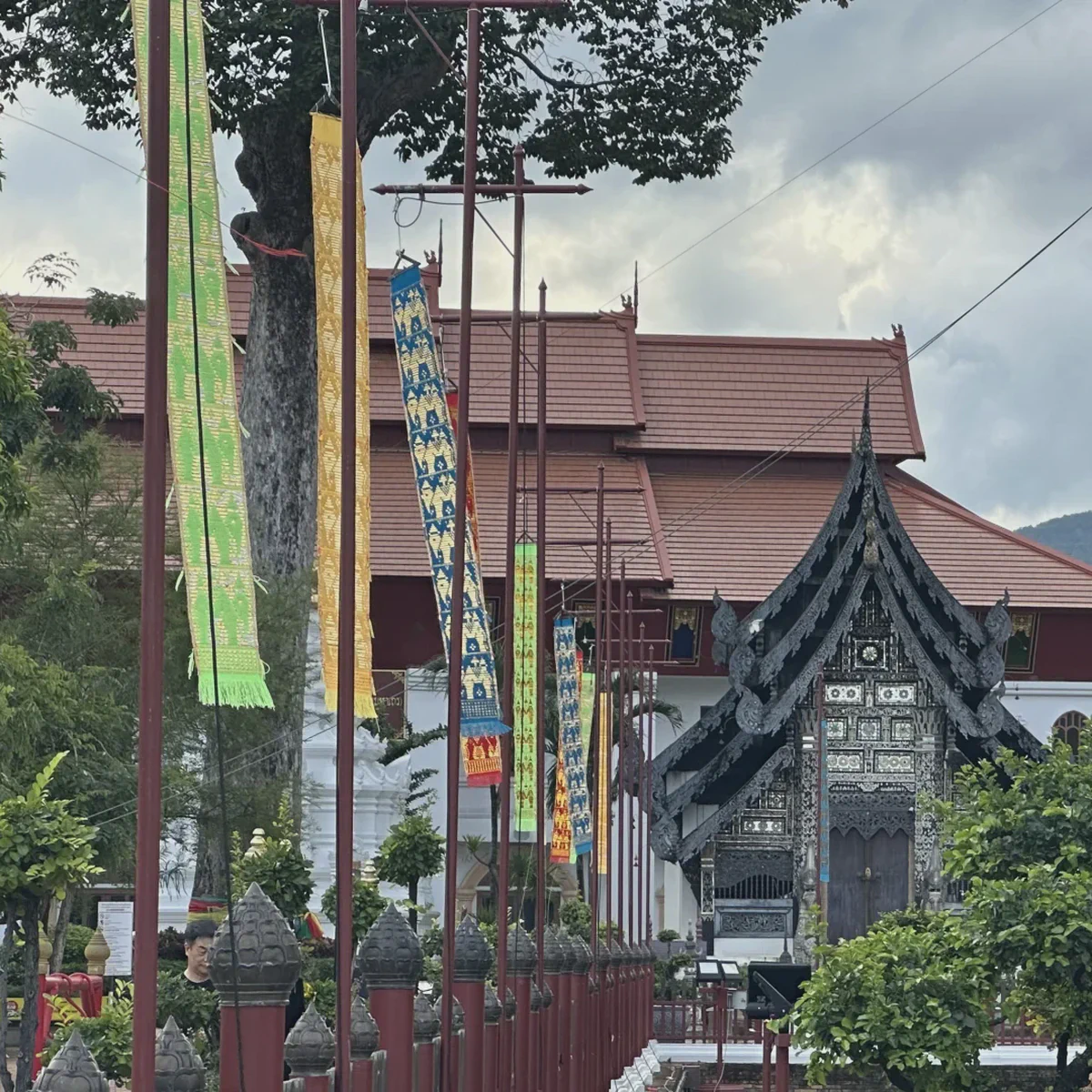
Wat Chedi Luang provides scale, rupture and city history. Its large damaged chedi makes the passage of time visible, while the active monastery around it prevents the site from feeling like an isolated ruin. Choose it as the main first-visit anchor when you want one compound to explain the Old City’s layers.
Wat Phra Singh provides a more complete living-monastery experience and a western anchor for Ratchadamnoen Road. It is the stronger second major stop when religious art, working halls and the movement of worshippers matter. Choose it after Wat Chedi Luang when you want contrast between a monumental ruin and an active temple rather than another long checklist of buildings.
Wat Phan Tao works as a contrast near Wat Chedi Luang. Its scale and timber architecture make it more useful as a nearby addition than as a reason to cross the city alone.
Wat Sri Suphan belongs to a Wualai and craft route south of the moat. Current site rules and access to particular sacred areas should be read on arrival. Pair it with the Saturday area or a confirmed metalwork activity instead of tacking it onto an already long central walk.
Wat Umong belongs to the forested western side. Use it on a Suthep-side or Baan Kang Wat day, not as the fourth temple after crossing the Old City. The journey and setting are part of its value.
This role-based approach prevents a common list-page problem: naming fifteen temples without explaining which two create a coherent first morning.
Monk chats, ceremonies and ordinary worship
Some Chiang Mai monasteries offer scheduled opportunities to speak with monks, but the current day, language and format need direct confirmation. Treat a monk chat as a conversation with boundaries, not a free performance. Arrive with respectful questions, avoid assuming one monk speaks for all Thai Buddhism and accept that religious duties may change the schedule.
Ceremonies can enrich a visit and also close a building or make photography inappropriate. Stand back, follow local movement and do not insert yourself into a procession. If a hall is busy with worship, the correct adjustment may be to wait or visit another part of the compound.
Ordinary actions often explain more than an architectural checklist: where shoes are left, how offerings are prepared, how people sit and how a working monastery separates visitor circulation from residential space. Watch quietly before asking what a sign already answers.
A route for different amounts of time
With ninety minutes, visit Wat Chedi Luang and one nearby contrast. With half a day, connect Wat Phra Singh, a shaded pause and Wat Chedi Luang, then finish at lunch. With a full temple-focused day, split the work: Old City in the morning, a long midday recovery, then Doi Suthep by road later only if weather, energy and transport remain favorable.
Do not combine the Old City, Wat Umong, Wat Sri Suphan and Doi Suthep simply because a private car can connect them. The vehicle solves distance, not attention. Three different geographic clusters are still three different experiences.
What to decide before you go
Answer four questions:
- Which single Old City temple owns the longest visit?
- What second site offers a genuine contrast rather than more of the same?
- Is Doi Suthep worth a separate mountain half-day for this group?
- What time or fatigue signal will end the temple route?
If those decisions are clear, the visit can stay respectful and memorable without becoming a checklist. If they are not, choose Wat Chedi Luang or Wat Phra Singh, explore it properly and leave the rest for another day.
For the broader choice set, return to things to do in Chiang Mai; for a route that protects heat and recovery, use the three-day itinerary.
Research notes
Official planning references
We use these primary references for the time-sensitive details relevant to this guide. Rules, prices and operating hours can change, so confirm the live information before you travel.
- Tourism Authority of Thailand — Wat Phra That Doi Suthep
Details to check: Used as the authoritative reference for the Doi Suthep ‘big viewpoint temple’ option (checked 2026-08-25).
- Tourism Authority of Thailand — Wat Chedi Luang Varavihara
Details to check: Opening hours reference for a core Old City temple option (checked 2026-08-25).
- ThaiHolidayGuide — Wat Phra Singh, Chiang Mai
Details to check: Practical visitor info (typical hours/entry note) for a core Old City temple option (accessed 2026-08-25).
Guide reviewed 31 August 2026. Confirm live rules, prices and operating details with the linked authority before travel.