
Sticky Waterfall Chiang Mai Day Trip
Plan a Bua Tong Sticky Waterfall trip from Chiang Mai with return transport, realistic timing, footwear and weather-sensitive safety in mind.


The Bua Tong Sticky Waterfall is worth the trip if you want an active half-day rather than another viewpoint. The pale limestone genuinely provides unusual grip, but the whole waterfall is not friction-proof: dark or green algae patches, muddy approaches and loose flip-flops are where confidence turns into a fall.
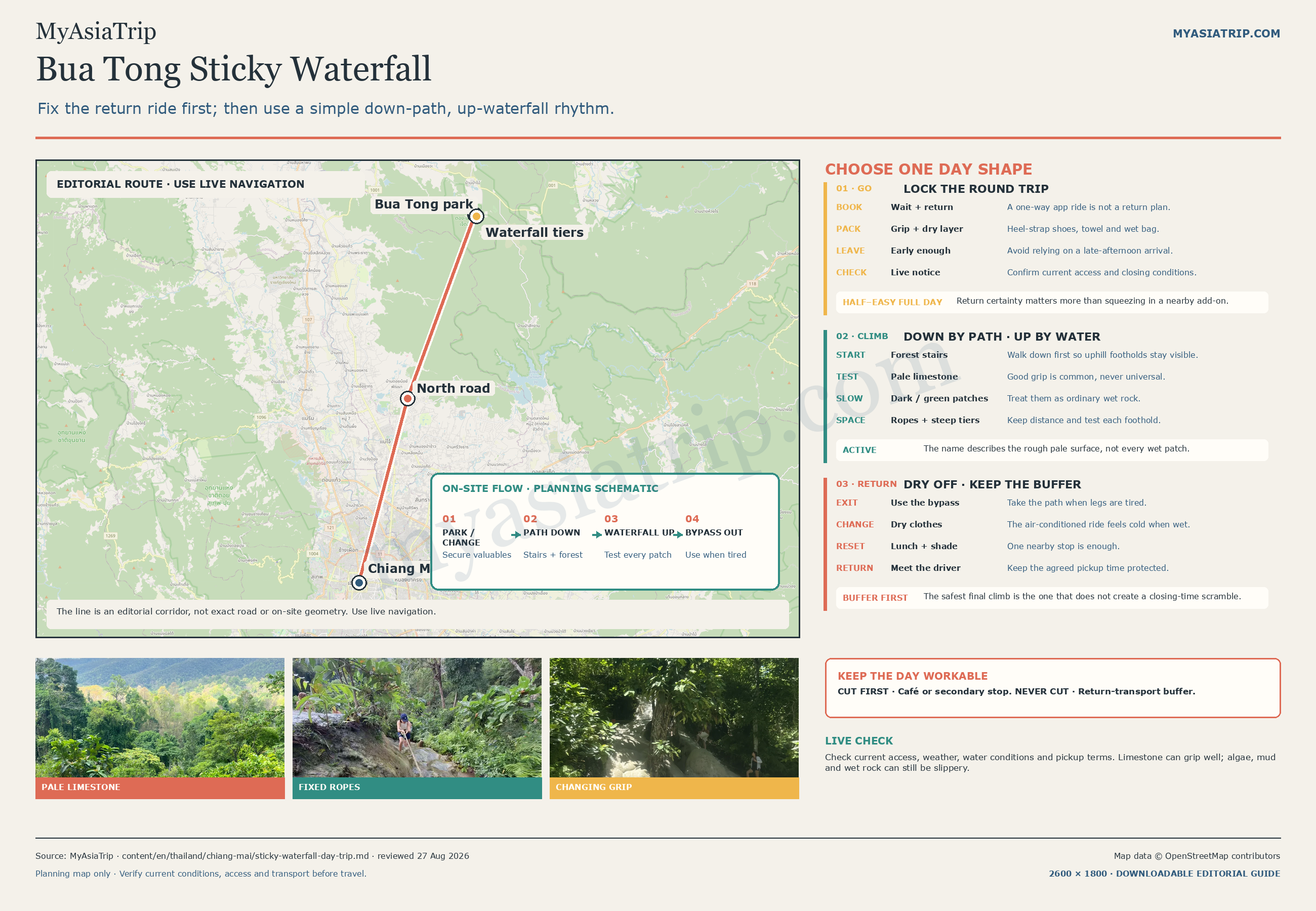
Arrange a round-trip vehicle before leaving Chiang Mai, allow about 1.5–2 hours at the falls, and bring secure footwear plus dry clothes for the ride home. This is a playful climb, not a technical one, but it still rewards slow feet and sensible decisions.
Hours, entry, and the one thing to plan
Current listings cluster around an opening window of roughly 08:00/08:30 to 16:30/17:00, and entry is generally listed as free. Because the published closing time is not perfectly consistent, do not plan a late-afternoon arrival. Reach the park by early afternoon at the latest and check the current notice on the day.
The real planning issue is the return transport. Bua Tong is roughly 50–60 km north of central Chiang Mai. A ride-hailing driver may accept the outbound trip, but another car may not be available when you finish. Book a driver to wait, hire a vehicle for a fixed block, join a tour or self-drive only if you are already confident on local roads.
Choose your transport first

For a day trip, transport is the decision that controls everything else. Pick one:
- Tour if you want zero return-transport anxiety.
- Private driver or chartered songthaew if you want a flexible pace; confirm waiting time and the total fare before leaving.
- Self-drive only if you are confident with local roads and are comfortable driving back in wet clothes or after a tiring climb.
Do not use Bua Tong as one stop in an overloaded northern loop. One nearby lunch or café is enough. An elephant café is not an automatic ethical add-on simply because it is nearby; assess any animal interaction separately.
Private driver or chartered songthaew
This is the most flexible choice for couples, families and small groups. Agree on pickup, waiting time, final return, overtime and whether the quoted vehicle has air-conditioning. Tell the driver that people may return wet so there is no surprise about towels or seat protection.
Confirm where the vehicle will wait and save the driver’s number. A driver who remains nearby removes the need to search for signal and availability at the end. Do not pay the entire amount early unless the booking terms clearly require it and you understand the arrangement.
Group tour
A tour solves the return and can offer company for a solo traveler. Ask whether Bua Tong is the main activity or one short stop inside a long route. Check the time at the waterfall, group size, lunch, changing opportunity and any animal venue added to the itinerary.
Avoid a package that uses convenience to bypass welfare questions. Bathing, close feeding or photographs with elephants are separate activities requiring separate judgment. The elephant welfare guide gives a stronger filter than a tour’s “ethical” label.
Self-drive
A car gives control over timing, dry clothing and lunch. It also leaves the driver responsible for the return after climbing in heat and water. Only self-drive when the licence, insurance, road confidence and attention are already in place.
A scooter exposes wet or tired riders to more risk and offers little space for dry gear. It is not the sensible first-time solution simply because the route appears straightforward. If anyone is uncertain, hire the complete return instead.
A realistic pace (so it still feels like a day off)
- Leave Chiang Mai early enough to arrive before the hottest and busiest part of the day.
- Walk down by the stairs or forest path first, then climb the waterfall upward. Going up makes foot placement easier to see.
- Allow 1.5–2 hours if you want to climb more than once without rushing.
- Stop for lunch and shade before the return drive.
An early start is not only about crowd avoidance. It protects enough time to inspect the surface, change clothes and leave without watching the clock. A focused morning can return to Chiang Mai for a quiet afternoon; a midday departure often pushes the climb into greater heat and turns the ride home into the only evening plan.
On arrival, use the toilets and identify the changing area, vehicle and path before entering the water. Walk down on the bypass route to see the tiers, then climb upward according to confidence. There is no requirement to complete every section. Repeat the enjoyable lower portion rather than forcing the steepest tier for a photograph.
Plan a final fifteen to thirty minutes for drying, changing, finding the driver and checking that nothing was left beside the water. That buffer is part of the visit, not wasted time.
What “sticky” does and does not mean
Mineral deposits create unusual texture and grip across much of the pale rock. That explains the name; it does not make every line safe. Darker algae, leaf litter, mud, polished footholds and transition zones can behave differently from the rough cream-colored surface.
Test each foot before moving weight, keep three points of contact on steeper sections and use fixed ropes as assistance rather than a guarantee. Do not follow another climber blindly: height, shoes, balance and the exact line all change what feels secure.
Going upward usually makes footholds easier to see and the body easier to control. Use the side path or stairs to descend where possible, then climb only the tiers that feel comfortable. There is no prize for reaching the highest section.
Photographs flatten slope and hide water movement. Put the phone away while climbing, and ask a companion to photograph from a stable place rather than turning around on wet rock.
Weather changes more than water volume
Rain can affect the road, forest path, mud around the waterfall and the confidence of the return driver as well as the rock itself. A shower does not automatically close the site, but recent heavy rain deserves a fresh check with the park or operator.
In hotter weather, exposed waiting and the return vehicle can be more tiring than the water feels. Carry drinking water and eat before energy falls. In cooler or wet conditions, dry clothing and a light layer make the long air-conditioned ride back much more comfortable.
Do not use a city forecast as the only source for a rural outing. Ask the driver or operator about conditions at Bua Tong and preserve the right to cancel when access or footing is poor.
Families and mixed-confidence groups
Set the turnaround point before entering. One adult should remain close enough to assist a child rather than climbing ahead for photographs. Keep a reunion place outside the water because voices disappear beneath the noise.
Mixed-confidence groups do not need to follow the same tier. One person can use viewpoints and forest paths while others climb, provided the waiting time and meeting point are agreed. If the non-climber would spend two hours guarding bags, choose a different shared outing.
For older travelers or previous injuries, inspect the bypass path and lowest section before committing. The ability to walk on ordinary ground does not predict comfort on flowing, uneven limestone. A shorter nature visit remains valid even when nobody climbs.
Who will enjoy it—and who may not
Bua Tong suits travelers who enjoy scrambling, water and a playful physical challenge. Older children may love it when closely supervised. Adults who are comfortable testing footholds can choose their own level without technical equipment.
It is less suitable for fresh injuries, poor balance, fragile knees, fear of falling or anyone who expects a conventional swimming area. The name “waterfall” can suggest a pool day, but the distinctive activity is climbing wet limestone. A companion can enjoy the forest and viewpoints without climbing, yet the outing may still feel long if the group’s only plan is the water.
For limited mobility, request current details about parking, paths, toilets, steps and accessible viewpoints. Do not infer step-free access from a photograph of the upper area. Rain and mud can change the easiest route on the day.
Families should set clear boundaries before children enter the flow: which tier, which adult stays closest and where the group reunites. Water noise makes shouted instructions unreliable. One adult should remain able to help rather than filming from a distance.
Where the grip changes

The rough, pale mineral surface is the “sticky” part. Treat any dark, green or slimy patch as ordinary wet rock: test your footing and move around it rather than assuming the name of the waterfall protects you.
Use the fixed ropes on steeper sections, keep space between climbers and face the slope if you need to descend a steep section. The bypass path is the better descent when your legs are tired. Children need an adult close enough to help, not instructions shouted from another tier.
Test each foothold before transferring full weight. Keep three points of contact where the angle increases and do not follow directly below another climber who may slip. Give slower visitors room rather than overtaking in a narrow line.
The strongest grip is not uniform. Leaves, algae, mud and polished sections can interrupt the rough mineral texture. Fixed ropes are aids, not guarantees; check your feet instead of pulling the body upward entirely by the arms.
If rain becomes heavy, thunder approaches or water conditions look different from those at arrival, leave the climb. Staff instructions and barriers override any plan or older visitor report. The right response to changing conditions is an early finish, not an attempt to get value from the drive.
Waterfall etiquette and environmental care
Use changing and toilet areas rather than soap or shampoo in the water. Pack out wrappers and wet-item bags, and do not leave footwear on a path where someone can trip. Keep music quiet enough that other visitors and staff can communicate.
Avoid climbing outside permitted areas or creating a new route around a queue. Vegetation and pale mineral formations are part of the site, not a private obstacle course. Follow signs about restricted tiers and do not move ropes or barriers.
Photograph from a stable position. Asking someone to repeat a climb while tired increases risk, and a phone held in one hand removes a useful contact point. Use a waterproof pouch, but remember that a protected phone can still be dropped downstream.
What to pack
- Secure water shoes or sandals with a heel strap. Loose flip-flops are poor on the muddy entry and can twist or float away. Barefoot gives good feedback on the limestone but offers less protection on paths and debris.
- Quick-drying clothes, a towel and a complete dry layer for the air-conditioned ride home.
- A waterproof pouch for your phone and a separate bag for wet clothing.
- Water and a simple snack; do not depend on a particular vendor being open.
- Sun and insect protection for time away from the water, plus any personal medicine.
- Small cash, a charged phone and an offline copy of the driver or tour details.
Leave jewellery and unnecessary valuables at the hotel. Pack dry clothing in its own sealed bag and place wet items separately for the return. A light towel is useful; a large cotton towel becomes another heavy, damp object.
Choose clothing that stays secure when wet and does not restrict a high step. Apply sunscreen before entering but avoid leaving oily residue on shared surfaces. If using insect repellent, follow its instructions and wash hands before handling food.
Food and useful add-ons
Treat lunch as recovery rather than another attraction. A nearby restaurant or a pre-agreed stop on the return is enough. Confirm dietary needs before a tour departs and carry a backup snack when an allergy or strict diet makes roadside options uncertain.
If you want a second stop, choose one that does not create a long detour or another ethical problem. A calm meal, local café or straightforward temple can work. Avoid filling the route with sales stops merely because the vehicle has been hired for the day.
Keep the evening in Chiang Mai flexible. Wet footing and the road can be more tiring than expected. A shower, rest and dinner near the hotel are a better pairing than a prepaid class with a hard start time.
Cut list (when the day gets slow)
If you start late, cut the café or secondary attraction—not the transport buffer. The worst version of this day is a rushed final climb followed by searching for a ride near closing time.
For a longer nature day, compare this trip with Doi Inthanon. Bua Tong is the better choice when you want less road time and more play; Doi Inthanon is the better choice for mountain scenery and a full-day route.
Before departure, confirm current access and hours, the complete return, weather, footwear and a dry-clothes plan. On site, stop when grip, confidence or energy changes. Bua Tong is memorable because the movement feels unusual—not because every traveler proves they climbed every tier.
Compare Bua Tong with the other Chiang Mai day trips and use Getting Around Chiang Mai to solve the round-trip vehicle before accepting an outbound ride.
Research notes
Official planning references
We use these primary references for the time-sensitive details relevant to this guide. Rules, prices and operating hours can change, so confirm the live information before you travel.
- ThaiHolidayGuide — Bua Tong Sticky Waterfall
Details to check: Typical opening hours and entry-fee notes (reviewed Jun 2026; accessed 2026-08-25).
Guide reviewed 30 August 2026. Confirm live rules, prices and operating details with the linked authority before travel.