


Getting Around Chiang Mai
Compare walking, red trucks, ride-hailing, airport buses, drivers and scooters for realistic Chiang Mai trips with heat and luggage in mind.


Getting around Chiang Mai is easy when you use different transport for different jobs. Walk inside the Old City or one compact part of Nimman, use Grab or a red songthaew when the heat wins, and book the return journey before leaving town for a waterfall or mountain. The mistake is assuming one app, one payment method or one vehicle will work everywhere.
Keep some small Thai-baht notes even if you normally pay by card or phone. App payment, QR payment and card acceptance vary by driver and small business, and cash is still the least stressful fallback at roadside stops, markets and trail entrances.
The simple strategy

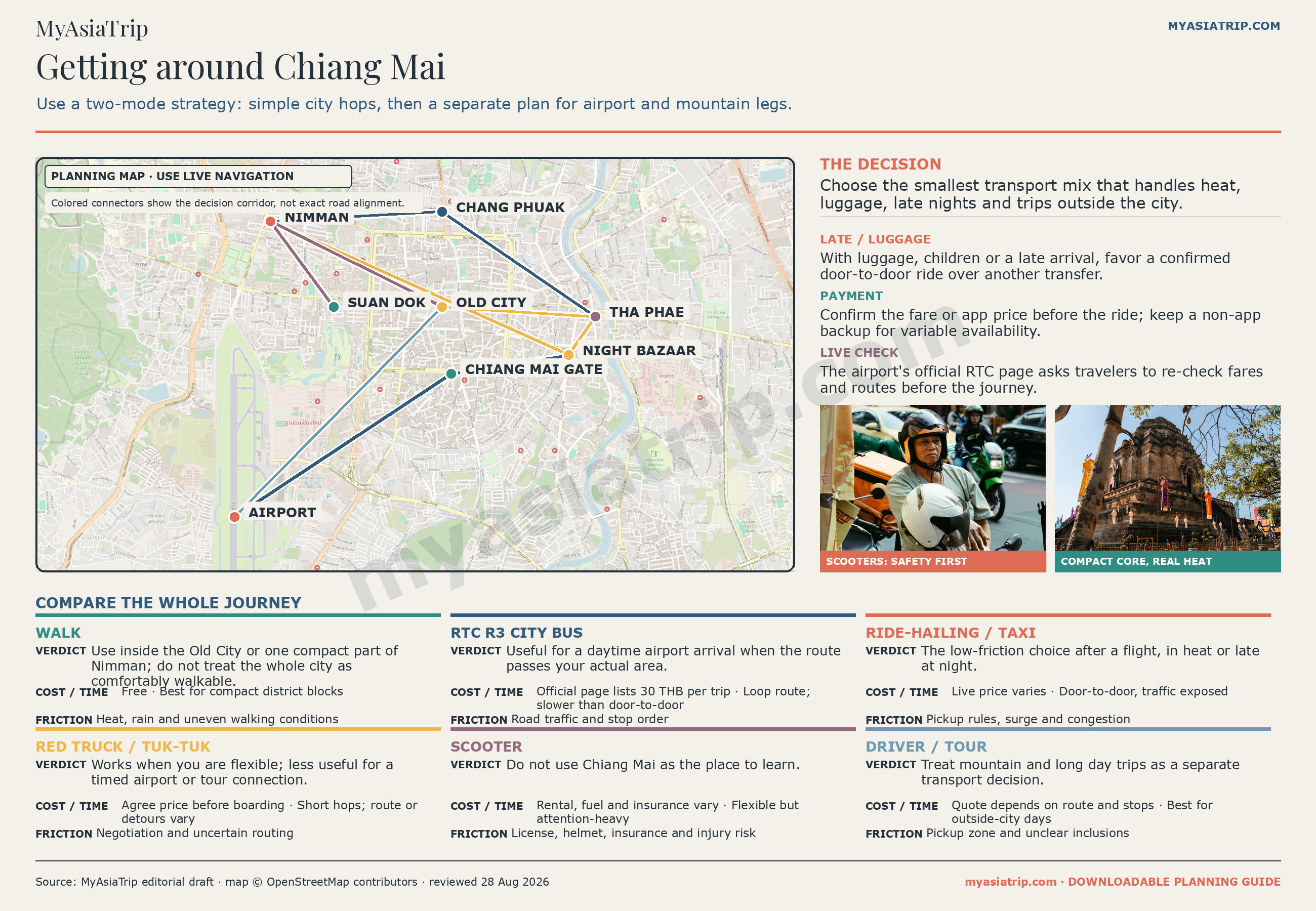
Most first-timers do best with a two-mode plan:
- In-town short hops: walk within one neighborhood, then use Grab, Bolt or a red songthaew when the next stop is no longer a pleasant walk.
- Airport and day trips: use a vehicle that solves the whole journey, including luggage, waiting time and the return leg.
Install both Grab and Bolt before the trip and make sure you have mobile data on arrival. Availability and quoted prices can differ at the same moment. Do not build a time-critical airport journey around whichever app was cheaper yesterday.
Mode comparison (decision table)

| Mode | Best for | Friction to expect | Payment and booking check |
|---|---|---|---|
| Grab or Bolt | Heat, luggage and door-to-door trips | Driver availability and price swings | Confirm the pickup point and payment method in the app |
| Red songthaew | Flexible city hops and small groups | Shared routing, waiting and negotiation | State the destination and agree the total fare before boarding |
| Tuk-tuk | A short evening hop | Noise and an open-sided ride | Agree the route and total fare first |
| RTC bus / airport shuttle | Daytime airport trips on a suitable route | Waiting and a last walk with luggage | Carry small cash and confirm the live route at the airport |
| Scooter | Experienced, licensed riders | Weather, traffic and injury exposure | Check licence validity, helmet and insurance exclusions |
| Private driver | Waterfalls, mountain days and families | Higher whole-vehicle cost | Confirm stops, waiting, overtime and return time in writing |
| Group tour | A long day with no transport planning | Fixed pace and pickup zone | Confirm what is included and how large the group is |
Airport transfers
After a flight, choose by luggage and mental energy rather than chasing the lowest fare.
- Airport taxi: the airport currently lists a flat-rate taxi counter at Entrance 1. This is the useful fallback when your phone is not connected or you do not want to find an app pickup point.
- Grab: the airport lists designated pickup and drop-off points by the domestic-terminal car park. Follow the location shown in the app rather than waiting at the first exit you see.
- RTC city bus: the airport lists a 30 THB flat fare, with R3 red and yellow loops serving Nimman, the Old City, Tha Phae and Night Bazaar areas.
- Airport shuttle: the airport separately lists A1 and A2 routes at 40 THB and A3 at 60 THB. A1 serves Nimman and the moat; A2 serves the Night Bazaar and Chang Khlan hotel area.
These airport pages explicitly tell passengers to reconfirm routes and fares. Treat the bus as a good option only when the stop is genuinely close to your accommodation; a cheap fare loses its appeal if the final walk involves heat, traffic and a suitcase.
Save the hotel name, address and phone number in both English and Thai before landing. Different properties can have similar names, and a map pin is easier to verify than a spoken description after a late flight. If using an app, compare the vehicle size with your luggage rather than choosing the cheapest car automatically.
For departure, schedule more margin than the map’s short distance suggests. Rain, school traffic and pickup confusion can slow a simple airport run. A prearranged taxi is often worth the small premium for an early flight; confirm the pickup with the hotel the evening before and keep a second option available.
The public bus is best for daylight arrivals with light luggage and accommodation near a verified stop. It is less attractive after a long international journey, for a family managing several bags or when the final walk crosses busy roads. Transport value includes the condition in which you arrive at reception.
Choose the airport mode by the final 500 meters
An airport bus works when three conditions are true: the route is operating, the stop is close to the real hotel entrance and every traveler can manage luggage from the stop. Map the stop-to-door walk before boarding. A low fare followed by an uneven fifteen-minute walk is poor value after a long flight.
An official taxi is the simplest low-decision option. Use the airport counter, state the exact hotel and keep the dispatch slip or vehicle details. A ride-hailing car provides app tracking and payment choice, but the traveler must reach the current designated pickup point rather than asking the driver to stop wherever baggage claim happens to exit.
For a group, compare one van or larger vehicle with two cars. Count luggage, child restraints and the chance that the party arrives separately. For a very late arrival or early departure, ask the hotel to confirm a transfer in writing and keep the official taxi option as backup.
The airport is geographically close to the city; terminal and road friction still require time. On departure, airline check-in, baggage, immigration for international flights, security and any tax-refund process belong to the buffer. A short drive does not justify a late terminal arrival.
City transport by trip type
Walking: use neighborhood-sized loops
The Old City and Nimman are walkable when you define a compact loop, not when you treat all of central Chiang Mai as one pedestrian district. Morning is easiest. By midday, heat, broken pavement and repeated road crossings can turn a short map route into a tiring one.
Walk between nearby temples or cafés, then take a vehicle when the next stop crosses the moat or moves to another district. Carry water and use controlled crossings where available. At night, choose lit routes and avoid staring at the map while standing in the road.
Strollers and wheelchairs face interrupted pavements, thresholds and parked vehicles. A short ride between two accessible anchors can be more realistic than a continuous route. Ask venues about their entrance and toilet specifically; “central location” says nothing about step-free access.
Crossings are often the limiting factor, not distance. Pavements narrow or disappear, motorcycles use small lanes and major junctions can split a route that looks continuous on a map. Do not treat a five-kilometer walking estimate as a pleasant city stroll simply because the terrain is flat.
At night, choose lit streets and a pickup point where a car can actually stop. During market closures, the shortest route on the map may run through the slowest crowd. Hotel staff can usually identify the working vehicle edge more accurately than a generic pin.
Red songthaews without confusion
A red songthaew is a shared pickup with bench seating rather than a private taxi by default. Tell the driver the destination before boarding and agree on the fare. The route may bend to collect or drop other passengers, which is fine for a flexible city hop but poor for a time-critical appointment.
Show a recognizable landmark or Thai map label instead of only an English hotel name. Ask whether the fare is per person or for the group. Pay at the end unless the driver requests another arrangement, and carry small notes so neither side has to search for change.
For a dedicated mountain or out-of-town journey, negotiate the whole vehicle, waiting time and return separately. Do not assume the normal shared city logic covers a waterfall several hours away.
Ride-hailing and taxis
Grab and Bolt make door-to-door trips easy, but a precise pickup point still matters. Move to a safe, visible frontage where the driver can stop without blocking traffic. Check the number plate and destination before entering, and use the in-app trip-sharing tools when useful.
Prices and availability change with rain, dinner time and major events. Compare both apps, but do not keep canceling drivers to save a trivial amount. A hotel, restaurant or attraction desk can call a conventional taxi or local driver when apps are thin.
Confirm whether payment is cash, card or another method shown in the app. Foreign visitors cannot assume they can use every Thai QR-payment system. Keep enough cash to complete the ride if a card authorization fails.
For families, request an appropriate vehicle and child restraint rather than assuming the driver carries one. Standard app cars may not fit four people plus large luggage. A prearranged van can be simpler even when the per-trip number looks higher.
Cash, apps and group travel
Chiang Mai is digitally convenient, but not consistently cashless. Keep enough cash for a ride, a market meal and one unexpected fee. This matters more outside the main malls and at the end of the evening, when finding another ATM or persuading a driver to accept a different payment method is the last thing you want.
For a family or group, compare the whole-vehicle price, not the headline per-person fare. Grab may show vans or larger vehicles at some times, while red songthaews and locally arranged minibuses can be practical for six to ten people. Confirm seating, luggage space, air-conditioning and whether the quoted price covers waiting and the return.
Split cash into a small daily amount and a separate reserve rather than opening a large wallet beside the road. ATMs can charge fees and may not be beside a rural stop. Carrying one ride, one meal and one unexpected entrance fee in cash is usually enough without overdoing it.
Mobile data is transport infrastructure. Install apps, verify accounts and download offline map areas before the first day. Carry a small battery pack on long outings. A beautiful viewpoint is a poor place to discover that the return plan exists only in a phone at two percent.
Scooter reality check
Scooters can make Chiang Mai feel easy, but the downside is real. If you are not already confident on a scooter in traffic, Chiang Mai is not the place to “learn quickly.” If you do rent, treat it as a safety decision first: proper license, helmet quality, insurance coverage, and avoiding night rides.
An international driving permit does not replace the correct motorcycle entitlement from home. Read the rental and travel-insurance terms; some policies exclude engine sizes, unlicensed riding or any motorcycle injury. Photograph the vehicle at pickup, test brakes and lights, and reject a poor helmet rather than treating it as part of the bargain.
Weather changes the risk. Paint, leaves and road surfaces become slick in rain, while smoke or mist can reduce visibility on mountain roads. Secure bags so they cannot affect steering and never use a phone in hand while moving. A taxi fare is cheaper than turning a holiday into an insurance dispute.
Parking is another practical cost. Use legal, visible spaces and do not block temple or business access. If drinking, leave the scooter where permitted and take another mode home. Convenience does not override judgment.
Tuk-tuks, bicycles and other short trips
Tuk-tuks are useful for a direct evening hop and for travelers who enjoy an open-sided ride. Agree on destination and total fare before starting. They expose passengers to heat, rain, noise and traffic air, so they are less comfortable for a long cross-city journey or delicate luggage.
Bicycles suit quiet early loops for confident city riders, but central traffic and inconsistent cycling space require attention. Wear a helmet, use lights and avoid building a route around major roads. A leisurely hotel bicycle is not automatically the right vehicle for a mountain or airport road.
Hotel shuttles can be valuable when their timetable aligns with your day. Ask where they stop, whether reservations are required and what happens on the return. Free transport is only convenient when it goes where and when you need it.
Day-trip transport
For big days out, the return journey matters more than the outbound ride. A driver may accept a one-way trip to Bua Tong Sticky Waterfall, but that does not guarantee another car will be waiting outside the city when you finish wet and tired.
- Tour: simplest logistics, but less control over stops and time.
- Private driver: the best balance for couples, families and groups; agree waiting and overtime before leaving.
- Self-drive: only if you are already comfortable with Thai traffic, mountain roads and the attention a long return requires.
For Doi Inthanon, a driver or tour should cover the movement between sights inside the park, not merely drop you at the entrance. For Doi Suthep, agree whether a taxi waits, returns at a set time or leaves you to find a shared songthaew downhill.
Get a private-driver agreement in a message: pickup, vehicle, passenger count, stops, included waiting, overtime rate, tickets, meals and final return. Clarify whether the driver is transport only or also a licensed guide. Pay through a method you understand and keep the contact until the trip is complete.
For a group tour, inspect the pickup zone and the minutes allocated to the priority stop. A tour with more attractions can mean less time outside the vehicle. Keep an easy dinner after any mountain or intercity day because return estimates are not flight schedules.
Transport for families and groups
Do not count only seats. Count full-size bags, strollers, wheelchairs, child restraints and whether each passenger can climb into the vehicle. A songthaew that technically holds the group may be awkward with luggage or a traveler who cannot use the rear step.
Ask for child seats explicitly and confirm the model or age range when safety depends on it. “Family vehicle” is not evidence that an appropriate restraint will be fitted. If the operator cannot provide one, decide whether to bring a suitable travel seat or use another provider.
For eight or ten people, a locally arranged minibus can reduce splitting and simplify rural returns. Get the complete price, air-conditioning, seat belts, luggage space, waiting and driver hours in writing. The cheapest per-person quote is not better if half the bags occupy the aisle.
Assign one person to hold the driver contact and one backup. Share the hotel pin with everyone. If the group separates at a market, nobody should depend on the one phone that left in the first vehicle.
Common route mistakes
- Old City to Nimman on foot at noon: the map is flatter and shorter than the experience. Ride between the districts, then walk locally.
- One-way app ride to a rural attraction: solve the return before accepting the outbound price.
- Scooter as a budget default: licence, insurance, weather and experience matter more than the rental rate.
- Airport bus without the last walk: map the stop-to-door route with luggage.
- Market pickup inside a closure: choose a lit road beyond the pedestrian zone before the crowd builds.
- Private driver without inclusions: confirm waiting, parking, tickets, overtime and final drop-off.
- Depending on foreign QR payment: keep cash and another method available.
Every good transport choice removes a future negotiation. The small amount of planning belongs before the airport exit, mountain road or final drink—not when the group is already tired.
Late-night and personal-safety habits
Choose a visible pickup point, verify the vehicle and avoid entering an unmarked car offered by a stranger. Share the trip through the app or message the plate to a companion. Sit where you feel comfortable and end the ride if the route or behavior feels wrong.
Keep enough battery and cash for the final ride. After a market closes, move away from the densest gate to a place where a driver can stop safely, but stay in a lit area with other people. Travelers alone may prefer an app record or hotel-arranged driver to a negotiation after drinking.
Do not ride a scooter after alcohol, even for a short distance. Chiang Mai’s compact center can make risk feel smaller than it is. Leave the vehicle legally parked and collect it later.
A transport plan for a three-day visit
On arrival, use the Chiang Mai airport-to-city guide to choose an airport taxi, app car or verified bus according to luggage and energy. Spend the first city day walking one Old City cluster with one or two short vehicle hops. Use a round-trip car or shared transport for Doi Suthep, then recover around Nimman.
For the major day out, choose a tour or driver that covers the complete return and internal movements. Treat Pai as an intercity journey rather than a casual ride outside town; the Chiang Mai–Pai route guide covers the winding road, luggage and return timing. On the final evening, keep the airport departure plan separate from whatever transport worked casually during the trip. Reconfirm the pickup and preserve a backup.
The system is simple: walk locally, ride between neighborhoods and arrange rural returns before leaving town. With cash, data and a charged phone, Chiang Mai transport remains flexible without pretending every journey is frictionless.
Match the transport pattern to where you stay and test it against the sequence in the three-day Chiang Mai itinerary before paying for a private driver.
Research notes
Official planning references
We use these primary references for the time-sensitive details relevant to this guide. Rules, prices and operating hours can change, so confirm the live information before you travel.
- Chiang Mai International Airport — RTC Chiang Mai City Bus
Details to check: RTC city bus fare and R3 red/yellow loop stop list (checked 2026-08-26).
- Chiang Mai International Airport — Airport Shuttle Bus
Details to check: Current A1, A2 and A3 airport shuttle routes and listed fares (checked 2026-08-26).
- Chiang Mai International Airport — Grab pickup and drop-off points
Details to check: Designated airport pickup arrangement for Grab services (checked 2026-08-26).
- Chiang Mai International Airport — Airport Taxi
Details to check: Flat-rate airport taxi counter location and service pattern (checked 2026-08-26).
Guide reviewed 30 August 2026. Confirm live rules, prices and operating details with the linked authority before travel.