
Best Day Trips from Chiang Mai
Compare Chiang Mai day trips by road time, physical effort and recovery cost before booking Doi Inthanon, Sticky Waterfall or Chiang Rai, with clear fit criteria.


Choose a Chiang Mai day trip by the fatigue it creates, not by how many stops appear in the tour description. Pick Bua Tong when you want an active half-day, Doi Inthanon when mountain scenery deserves a full day, and Doi Suthep when you only want to leave the city for a morning. Chiang Rai is a long road day; an overnight stay is usually the more humane choice.
On a three-day Chiang Mai trip, do one major day out. Back-to-back vans turn the city’s relaxed pace into two early pickups and a recovery day.
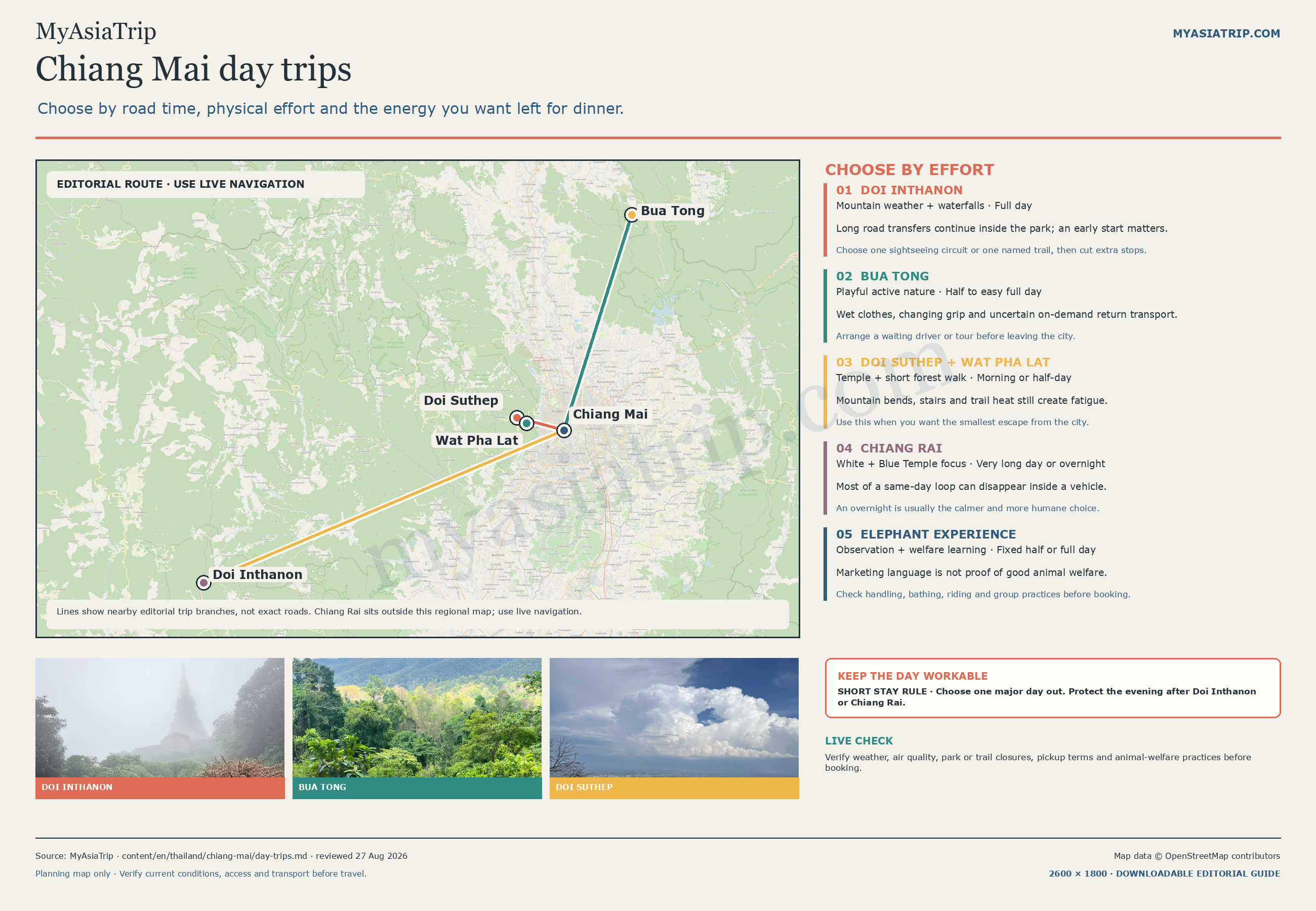
Pick day trips by what you actually want

| Trip | Best for | Approximate shape of the day | Cost you feel |
|---|---|---|---|
| Doi Inthanon | Mountain weather, waterfalls and a trail | Full day with several road transfers inside the park | Long driving and an early start |
| Bua Tong Sticky Waterfall | Playful climbing and a less formal nature day | Half to easy full day, depending on lunch and add-ons | Wet clothes, slippery patches and return transport |
| Doi Suthep and Wat Pha Lat | Temple, viewpoint or a short forest hike | Morning or half-day | Mountain road, stairs or trail heat |
| Chiang Rai | White and Blue Temple sightseeing | Very long same-day road loop or a better overnight | Most of the day can disappear inside a vehicle |
| Elephant experience | Observation and animal-welfare learning | Usually a fixed half- or full-day pickup | Welfare claims require more work than booking claims |
Pai does not belong in this day-trip table. The mountain road and the town both deserve an overnight; compare the minivan, private-car and motion-sickness trade-offs in the Chiang Mai to Pai transport guide before adding it to the route.
The rule that keeps your trip enjoyable
Do one big day trip on a short Chiang Mai visit. If you choose Doi Inthanon, do not add a late cooking class or ambitious night market afterwards. If you choose Bua Tong, you may still enjoy dinner in town, but a second distant attraction usually adds more driving than value.
The number of advertised stops is a poor quality measure. A waterfall, summit, pagoda, trail and village can all fit on paper while leaving ten hurried minutes at each place. Choose the one anchor you would be disappointed to miss, then judge the route around it.
Compare the real shape of each day
Doi Inthanon: the full mountain day
Doi Inthanon is the right choice when cooler mountain air, forest and waterfalls matter more than a relaxed morning in town. It requires an early departure and repeated driving between sights inside the park. A tour can make that structure painless, while a private driver gives you the freedom to cut a stop when mist, traffic or fatigue slows the route.
Choose one style before booking. The low-effort version combines the summit area, a short forest boardwalk, the twin pagodas and one waterfall. A walking version builds the day around a named trail and treats the other sights as optional. Do not accept “nature trail” as enough detail; ask which trail, how long it takes and whether a local guide is included.
The payoff is a genuine change of climate and landscape. The cost is that dinner plans become fragile. Read the detailed Doi Inthanon planning notes before booking and keep the evening near your hotel.
Bua Tong: active, wet and easier to shorten
Bua Tong Sticky Waterfall works when the physical activity is the attraction. The mineral surface offers grip in many places, but this is still moving water over uneven rock. Expect wet clothing, awkward footing and a less polished day than a temple tour.
Its advantage is flexibility. With secured return transport, you can visit as a focused half-day, eat nearby and return before the city evening. It suits older children and adults who enjoy climbing; it is a poor choice for someone who dislikes getting wet or needs predictable, level access.
Bring secure footwear, dry clothes and a waterproof bag for valuables. The detailed Bua Tong planning notes explain route, safety and return decisions in depth.
Doi Suthep and Wat Pha Lat: the efficient mountain morning
Doi Suthep gives a first-time visitor the highest return for the least time outside the city. Take a vehicle to Wat Phra That Doi Suthep for the religious landmark and viewpoint, or hike the Monk’s Trail to Wat Pha Lat for a forest-temple experience. Combining them can work, but road transport between the two is often kinder than forcing the full climb.
Go early, carry covered clothing and decide how you will return. Afterward, recover around Nimman rather than crossing the entire city for another major attraction. This is the best “day trip” for a three-day itinerary when you want the afternoon back.
Chiang Rai: only if the road day is acceptable
Chiang Rai’s headline temples are tempting, but a same-day return makes the intercity road the dominant activity. A tour removes transport work, yet it cannot remove the distance. If the White Temple and one other stop are a high priority, accept a long, structured day and investigate actual time at each place.
An overnight is usually better for families, slower travelers and anyone who wants Chiang Rai to feel like a destination rather than a photo interval. Compare buses, shared transfers and private cars in the Chiang Mai to Chiang Rai guide.
Elephant experience: apply a higher booking threshold
Do not choose an elephant venue only because it fits the pickup window. “No riding” does not make scheduled bathing, touching or close feeding welfare-friendly. An observation-led program where elephants can disengage is the more defensible default.
This option requires more screening than a waterfall or temple. Ask about barriers, visitor numbers, contact, animal choice and off-display conditions before paying. Use the ethical elephant experience checklist, and be willing to skip the activity if the answers remain vague.
Other day trips: when they earn the road
Mae Kampong appeals to travelers who want a mountain-village setting, cafés, water and an overnight atmosphere. Its popularity can make a short central visit feel more managed than secluded. Go early, understand where vehicles stop and consider staying overnight if quiet evening and morning hours are the actual attraction.
Chiang Dao is a district-scale nature choice rather than one pin. Caves, mountain views, walking and hot-spring or village stops can form a route, but the distance deserves a long day or overnight. Do not add it as the “less touristy” appendix to Doi Inthanon; it points in another direction and needs separate current access research.
Mae Sa Valley and Mae Rim offer gardens, waterfalls, family activities and commercial attractions. They work best when one site is the anchor and the driver understands the route. The density of roadside businesses makes it easy to collect mediocre stops simply because they are nearby. Apply a separate welfare screen to every animal venue.
Mon Cham can provide mountain air, views and an overnight change of pace, but traffic and commercialization shape busy periods. A photograph of valley mist does not explain road time, parking or midday heat. Choose it when the landscape and a slower meal justify the transfer, not as another compulsory viewpoint.
San Kamphaeng and Bo Sang belong to a craft and workshop day east of the city. Ask what will actually be demonstrated, whether visitors make something and whether sales stops dominate. A good workshop adds process; a sequence of showrooms is mainly shopping with transport attached.
Mae Kampong, Chiang Dao and family-oriented Mae Rim can each support a full day because the journey and pace are meaningfully different. Smaller stops work better as part of one coherent route; making a separate transfer for each usually adds more road time than experience.
Half-day, full-day or overnight?
A half-day should have one destination within a manageable return and enough flexibility to eat in town. Doi Suthep and Bua Tong can fit this shape depending on transport and activity. A full day earns its length through a meaningful landscape, trail or distant city, not a long list of roadside breaks. An overnight becomes preferable when the best experience happens before day visitors arrive or after they leave.
Use three tests:
- How many consecutive hours are inside the vehicle?
- Which single experience would still justify the day if two optional stops disappeared?
- Does the return leave enough margin before a flight, fixed dinner or next early start?
If the anchor cannot be named, the tour is probably selling quantity. If the return threatens another booking, the itinerary is too brittle.
Private driver, tour or independent route?
A private driver buys route control, bathroom breaks and an easier exit, but not automatically interpretation. Confirm whether the person is a driver or licensed guide and agree to stops, waiting, overtime, meals and tickets in writing.
A group tour buys one reservation and a known return structure. Inspect the pickup zone, vehicle, maximum group size and time at the anchor. A low price can be reasonable when the route is simple; it is weak value when sales stops and hotel collections consume the day.
Independent travel is strongest on a route with reliable public transport and a clear last mile. It is weaker at waterfalls, trail exits and spread-out parks. Saving money on the outbound leg is not useful if the return depends on finding a vehicle where none is based.
Match the trip to your body and group
For families, the most important variables are consecutive vehicle hours, toilet access, safe seating and whether the activity remains enjoyable when a child needs to stop. A private driver costs more but can protect breaks and allow a clean early return. Ask for child restraints explicitly; never assume the vehicle will carry them. The Chiang Mai with kids guide compares city and nature options by age, heat and exit flexibility.
For limited mobility, replace labels such as “easy” with specifics: number of steps, slope, distance from parking, trail surface, seats and accessible toilets. Doi Suthep has a tram option at the upper temple, but other parts of the route may still involve thresholds and uneven ground. Waterfalls and forest trails need more scrutiny.
Motion-sensitive travelers should avoid stacking winding mountain roads with a heavy lunch and a late night. Take the usual medication before the road begins, keep water accessible and request a forward seat when possible. Doi Inthanon and Chiang Rai may look very different, but both ask the body to spend many hours in a vehicle.
Solo travelers often get the best value from a well-defined small-group tour. Couples and families should compare the combined tour price with a private vehicle. Larger groups need to confirm actual seat layout, luggage space and air-conditioning rather than assuming a “van” will be comfortable.
Transport notes

Tours are easy, private drivers are flexible, and self-drive is only worth it when you are already comfortable with Thai roads and a long return.
- Confirm whether the driver remains with you or only provides a one-way transfer.
- Ask whether park tickets, local trail guides, meals and overtime are included.
- For a group, compare the total vehicle price with per-person tour tickets.
- Carry cash for small entrance points and places where an app or card is not useful.
- Take motion-sickness medication before departure if winding mountain roads affect you.
See Getting Around Chiang Mai for airport, city and private-driver strategy.
What to ask before paying
Request an itinerary with approximate pickup, road time, stop duration and return—not only a list of attractions. Confirm the maximum group size, vehicle, seat belts, language, meal, drinking water, entrance fees and any local guide charge. For private transport, ask whether parking, fuel and overtime are in the quote.
Then inspect the cancellation terms. Mountain weather, trail closures and heavy rain can alter the day; a useful policy explains the replacement or refund rather than promising that every stop always operates. Save the operator’s contact, carry a charged phone and share the route with someone not on the trip.
Hotel pickup also has boundaries. A central Chiang Mai address may be included while a resort outside town attracts a supplement or meeting point. A wide pickup window can turn an early start into an hour of waiting, so ask when your specific area is normally collected.
Build in recovery
Keep the preceding night sensible and the return evening flexible. Prepare cash, layers, footwear and medication before bed so the early morning does not begin with a search through luggage. Eat breakfast even when the tour includes lunch; mountain and road days often delay the first substantial meal.
On return, choose dinner close to the hotel or order something simple. A night market can wait. If a day trip needs a second alarm, a cross-city restaurant reservation and another prepaid activity to feel “efficient,” the itinerary is already too tight.
For a four- or five-day Chiang Mai stay, one full day out plus one Doi Suthep morning can work with recovery between them. For three days, choose the excursion that reveals the landscape or activity you care about most, then let Chiang Mai itself occupy the remaining time.
Final decision checklist
- What is the one anchor of the day?
- How many total road hours are acceptable to everyone traveling?
- Does the vehicle remain available for movements and the return?
- Are all tickets, guides, meals and overtime clear?
- Does the activity fit the least mobile or most motion-sensitive person?
- What will be cut if weather or traffic consumes an hour?
- Is the evening genuinely free for recovery?
Answer those questions before comparing the number of stops. The best Chiang Mai day trip is not the longest route; it is the one that gets you back tired in a satisfying way rather than merely exhausted.
Research notes
Official planning references
We use these primary references for the time-sensitive details relevant to this guide. Rules, prices and operating hours can change, so confirm the live information before you travel.
- Department of National Parks (DNP) — Doi Inthanon National Park
Details to check: Official reference for the national park day-trip option (checked 2026-08-25).
- ThaiHolidayGuide — Bua Tong Sticky Waterfall
Details to check: Typical opening hours and visit logistics notes for Sticky Waterfall (reviewed Jun 2026; accessed 2026-08-25).
- GreenBus Thailand — Bus Schedule (Latest Update: July 15, 2026)
Details to check: Operator timetable reference for the Chiang Rai day-trip/overnight option (checked 2026-08-25).
Guide reviewed 31 August 2026. Confirm live rules, prices and operating details with the linked authority before travel.