


Chiang Mai to Chiang Rai Transport
Compare the bus, shared transfer, private car and day tour from Chiang Mai to Chiang Rai by terminals, luggage, pace, return and check-in timing.


Chiang Rai is close enough to tempt a day trip, but the return road journey leaves much less time at the temples than the map suggests. Take the public bus for the lowest cost and the most independence, a shared transfer when hotel pickup matters, or a private car when luggage, children or flexible stops justify the price.
If Wat Rong Khun and one other headline sight are enough, a long day trip can work. Stay overnight when you want slower visits, an easier morning and enough time in Chiang Rai to make the intercity journey feel worthwhile.
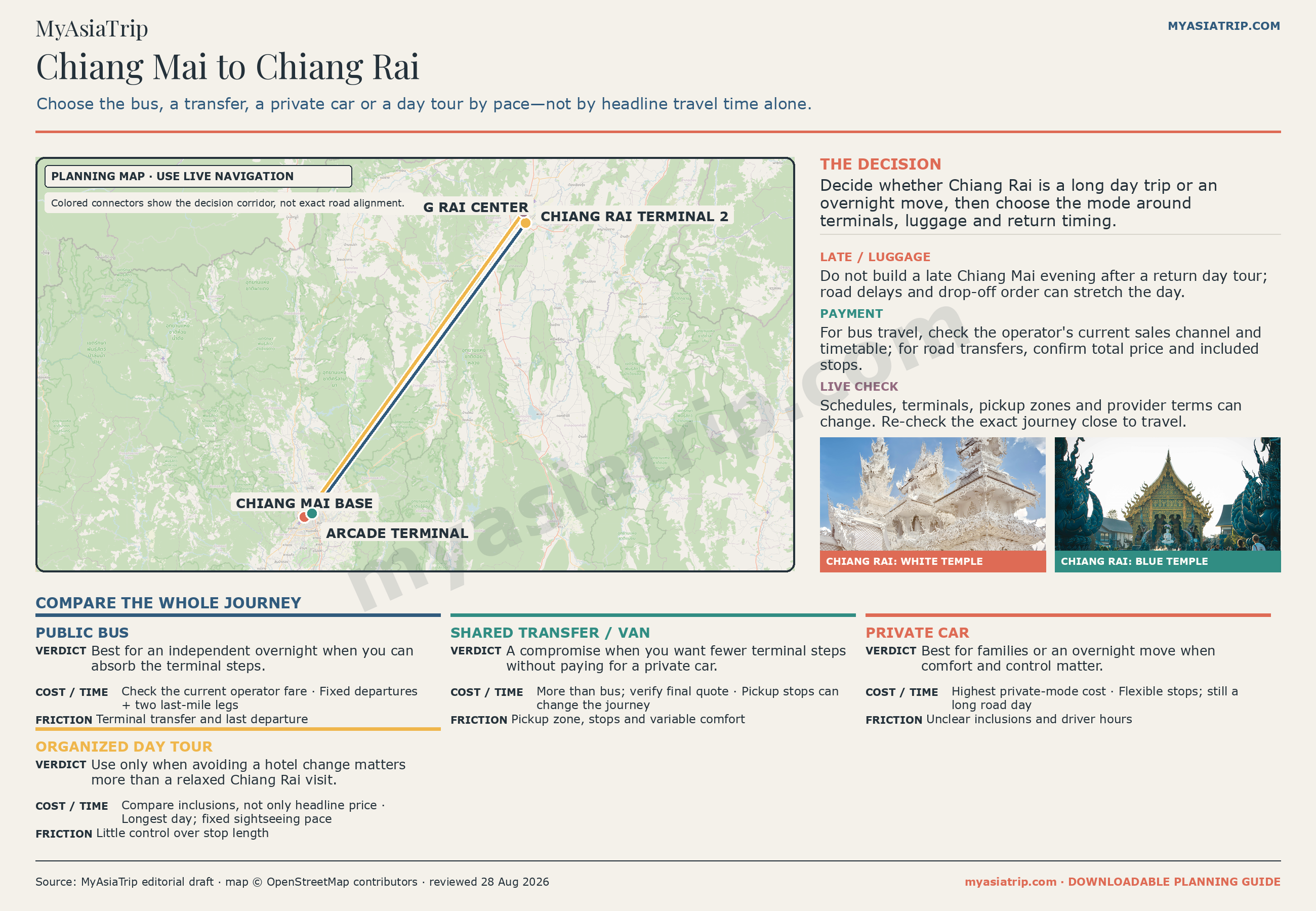
Your first decision: day trip or overnight?

Chiang Rai works in two very different ways:
- Day trip: you’ll spend a lot of time on the road, but you avoid packing and switching hotels.
- Overnight: less rushed visits and easier mornings, but you lose Chiang Mai time and add check-in/out friction.
The Tourism Authority of Thailand lists Wat Rong Khun and Wat Rong Suea Ten among Chiang Rai’s headline sights. Seeing both on a return day from Chiang Mai means the road journey and fixed stop times will dominate the schedule; staying overnight protects more time at the destination.
Mode comparison

| Option | Best for | Trade-off | What to verify |
|---|---|---|---|
| Public bus | Budget + independence | Terminal transfers + fixed schedule | Terminal location, last bus time |
| Shared transfer/van | Convenience without full private cost | Stops + variable comfort | Pickup zone, luggage rules |
| Private car | Families / comfort | Highest cost | Total time, stops, return plan |
| Organized day tour | No-planning travelers | Pace may be tight | Included stops, time at each site |
GreenBus timetable reality check
If you want the simplest “show up and go” option, GreenBus publishes a dedicated Chiang Mai–Chiang Rai schedule page with a latest update date. As of the July 15, 2026 update, the operator lists multiple daily departures from Chiang Mai (for example: 07:00, 07:30, 08:45, 09:30, 11:00, 13:30, 14:00, 17:00, 18:15, 18:30). Treat these as a reference, not a promise: always re-check the operator page close to your travel day.
The timetable is only one part of the trip. Allow time to reach Chiang Mai’s departure terminal, find the correct platform and handle luggage before the bus leaves. At the other end, confirm whether your service terminates at Chiang Rai Bus Terminal 1 in the city or uses another terminal, then price the final ride to your hotel. A cheap intercity ticket can still become an awkward arrival if you land after dark with heavy bags and no last-mile plan.
Book earlier for weekends, Thai public holidays and the coolest months, when the most convenient departures can fill. Keep the operator’s booking reference and the passenger name exactly as entered. Arrive with enough margin to solve a ticket or platform problem without watching the bus leave while you are still at the counter.
Public bus: best for an independent overnight trip
The public bus is the strongest value when you will stay in Chiang Rai and can work around a fixed departure. It separates transport from sightseeing: you travel to the city, check in, then choose your own temple times and meals. That is usually calmer than squeezing distant attractions into a same-day return.
Its weak point is the chain of transfers. From an Old City or Nimman hotel, you first need a local ride to the bus station. In Chiang Rai, you may need another vehicle to the hotel and separate transport for sights outside the center. Add those legs before comparing the bus price with a shared transfer or private car.
Pack valuables and essential medicine in a small bag that stays with you. Confirm the current luggage allowance if carrying an oversized suitcase, bicycle or other unusual item. Air-conditioning can feel cold after the outdoor heat, so keep a light layer accessible rather than buried below the bus.
Shared van or hotel transfer
A shared service is useful when pickup removes the most tiring transfer, but “hotel pickup” rarely means every address without conditions. Ask for the exact pickup zone, collection window and vehicle type. A wide window can consume the morning, and collecting passengers from several hotels may make the journey longer than the headline duration.
Seat space and luggage capacity vary. Tell the operator about large bags before paying and ask whether luggage occupies a seat or attracts an extra fee. Travelers prone to motion sickness should request a forward seat when possible and avoid treating a tightly scheduled van as a flexible sightseeing car.
Shared transport works best for a point-to-point move or a clearly defined tour. It is less satisfying when you expect spontaneous stops but the other passengers and driver are following a fixed plan.
Private car: pay for control, not only comfort
A private car becomes rational for three or four travelers, families with children, people with limited mobility or anyone moving with substantial luggage. The value is the ability to choose pickup time, take bathroom breaks and avoid two terminal transfers—not merely a softer seat.
Get the route in writing. Clarify whether the quote is one-way, round-trip or a full sightseeing day; which temples are included; whether the driver waits; how overtime is charged; and whether parking, fuel and tolls are included. A driver is not automatically a licensed guide, so decide whether transport alone is enough.
For a same-day return, agree on the final departure time from Chiang Rai before the first stop. Without that boundary, each photo pause eats into the last temple or pushes the drive home later, when everyone is tired.
Organized day tour: convenient but compressed
A tour removes route planning and can be the easiest way to see headline sights without changing hotels. The trade-off is that the timetable must work for a group. Pickup rounds, meal stops, souvenir stops and fixed photo time can occupy more of the day than expected.
Before booking, ask for the actual minutes at Wat Rong Khun and any other priority stop, the maximum group size, the vehicle type and the approximate return to Chiang Mai. Read the list for optional admissions and very distant add-ons. A longer attraction list is not automatically better if each stop becomes a hurried exit from the vehicle.
If you have only three days in Chiang Mai, compare this long excursion with a closer option in the Chiang Mai day-trip guide. Chiang Rai deserves time, but it does not have to be forced into every first visit.
Comfort and luggage notes
If you’re carrying large luggage, the practical difference is not the seat, it’s the last mile: terminals, pickups, and where you’ll be dropped. Choose the option that minimizes “one more transfer” after you’re already tired.
Families should count meals, toilets and the child’s tolerance for consecutive road hours, not only adult enthusiasm for the temples. Ask private and shared operators about child seats rather than assuming one will appear. For limited mobility, describe the passenger’s transfer needs precisely: step height, folding wheelchair storage and walking tolerance are more useful than the general phrase “accessible.”
Motion-sensitive travelers should eat lightly, carry their usual remedy and avoid planning the first important visit immediately after arrival. Northern roads can feel tiring even when the distance looks moderate. A quiet check-in and early meal may be the best first evening of an overnight plan.
Choose the correct Chiang Rai terminal and final stop
“Chiang Rai bus station” is not precise enough. Confirm the terminal printed on the current ticket and whether the service ends in the central area or at a terminal farther out. Then map the last ride to the hotel before buying the departure that looks cheapest.
This matters most at night. A central arrival can make a short walk or simple local ride possible; an outer-terminal arrival adds another negotiation when counters are quieter and everyone is tired. Ask the accommodation which terminal it expects guests to use and whether late check-in needs advance notice.
On the return, allow time to reach the correct terminal rather than ordering a car at the advertised departure time. Keep the ticket, passport and essential medicine with you, not in a bag placed out of reach. If a booking platform names a stop differently from the operator, the operator’s current ticket and departure notice should control the plan.
What a Chiang Rai day tour often hides
Read the tour in minutes rather than nouns. A listing can include hot springs, White Temple, Blue Temple, a museum, a village, lunch and a viewpoint, yet the two places you care about may receive less time than the pickup round and sales stops.
Ask whether “White Temple” includes the complete visitor area or only a photo stop, whether admission is included, and how the guide handles a queue. Ask whether optional long-neck-village or border-area stops are part of the route. These are not neutral bonuses: they add distance and raise cultural and ethical questions that deserve a separate decision.
For a first visit, two strong temple stops, lunch and enough time to walk are more defensible than a seven-name route. If the operator cannot state approximate stop durations, assume the itinerary is optimized for vehicle turnover rather than a calm visit.
Chiang Rai as part of a northern route
An overnight becomes more valuable when Chiang Rai continues to another destination, but onward transport must be checked before the Chiang Mai ticket. Do not assume Pai, Chiang Dao or a small border town connects conveniently just because all sit in northern Thailand. Roads radiate through different valleys, and a return through Chiang Mai may still be the simplest sequence.
If flying out of Chiang Rai, book the city stay and airport transfer as one plan. Do not place a long overland arrival beside a non-changeable flight. If returning to Chiang Mai for an international departure, keep the final night in Chiang Mai unless the schedule leaves a very large buffer.
Travelers with four or more northern nights can consider two nights in each city: Chiang Mai for the Old City and mountain side, Chiang Rai for its art-temple circuit and a slower morning. Travelers with only three Chiang Mai days should usually protect Chiang Mai and choose a closer excursion.
Day-trip and overnight planning templates
For a day trip, leave early, choose two genuine priorities and accept that the road is the main structure of the day. Protect a meal and bathroom break rather than adding another attraction. Keep the evening in Chiang Mai empty; a late dinner reservation after a long return is a fragile plan.
For an overnight, take a morning bus or transfer, leave luggage at the hotel and use the afternoon for one or two city-side stops. Reserve the next morning for the sight you most care about, then return later in the day. Two days do not require twice as many attractions; they let you see the same priorities without rushing.
If Chiang Rai is part of a longer northern route, check the onward segment before committing to a hotel or return ticket. A direct-looking map connection may have limited departures, and returning through Chiang Mai can be simpler than improvising from a smaller terminal.
A realistic decision rule
If you only care about one or two headline stops and you’re fine with a long travel day, do a day trip. If you want a calmer pace or you’re traveling with kids, overnight often feels better even though it’s less “efficient.”
Use the bus when price and independence matter, a shared transfer when a verified pickup solves the hardest part, and a private car when control over stops and bodies matters enough to pay for it. Choose a tour when you want one booking and can accept its rhythm.
Before paying, confirm the current timetable, exact pickup and drop-off, luggage allowance, cancellation terms and the final Chiang Mai return estimate. Then save your accommodation address in Thai and keep enough battery and cash for the last ride. The best option is the one that still works when the bus is cold, the child is tired or the temple visit runs twenty minutes long.
Use Getting Around Chiang Mai for the terminal transfer and the three-day Chiang Mai itinerary to test whether the intercity road day displaces something more valuable.
Research notes
Official planning references
We use these primary references for the time-sensitive details relevant to this guide. Rules, prices and operating hours can change, so confirm the live information before you travel.
- GreenBus Thailand — Bus Schedule (Latest Update: July 15, 2026)
Details to check: Chiang Mai ↔ Chiang Rai departure times listed by the operator; timetables can change (checked 2026-08-25).
- 12Go — GreenBus operator info
Details to check: Common departure/arrival terminals referenced for GreenBus routes (accessed 2026-08-25).
- Tourism Authority of Thailand — Chiang Rai
Details to check: Official destination overview confirming Wat Rong Khun and Wat Rong Suea Ten among Chiang Rai highlights (checked 2026-08-26).
Guide reviewed 30 August 2026. Confirm live rules, prices and operating details with the linked authority before travel.