

Best Time to Visit Chiang Mai: Weather by Month and Smoke Reality
Choose the best Chiang Mai month for your trip with practical guidance on heat, rain, mountain weather, smoke uncertainty, crowds and route changes.


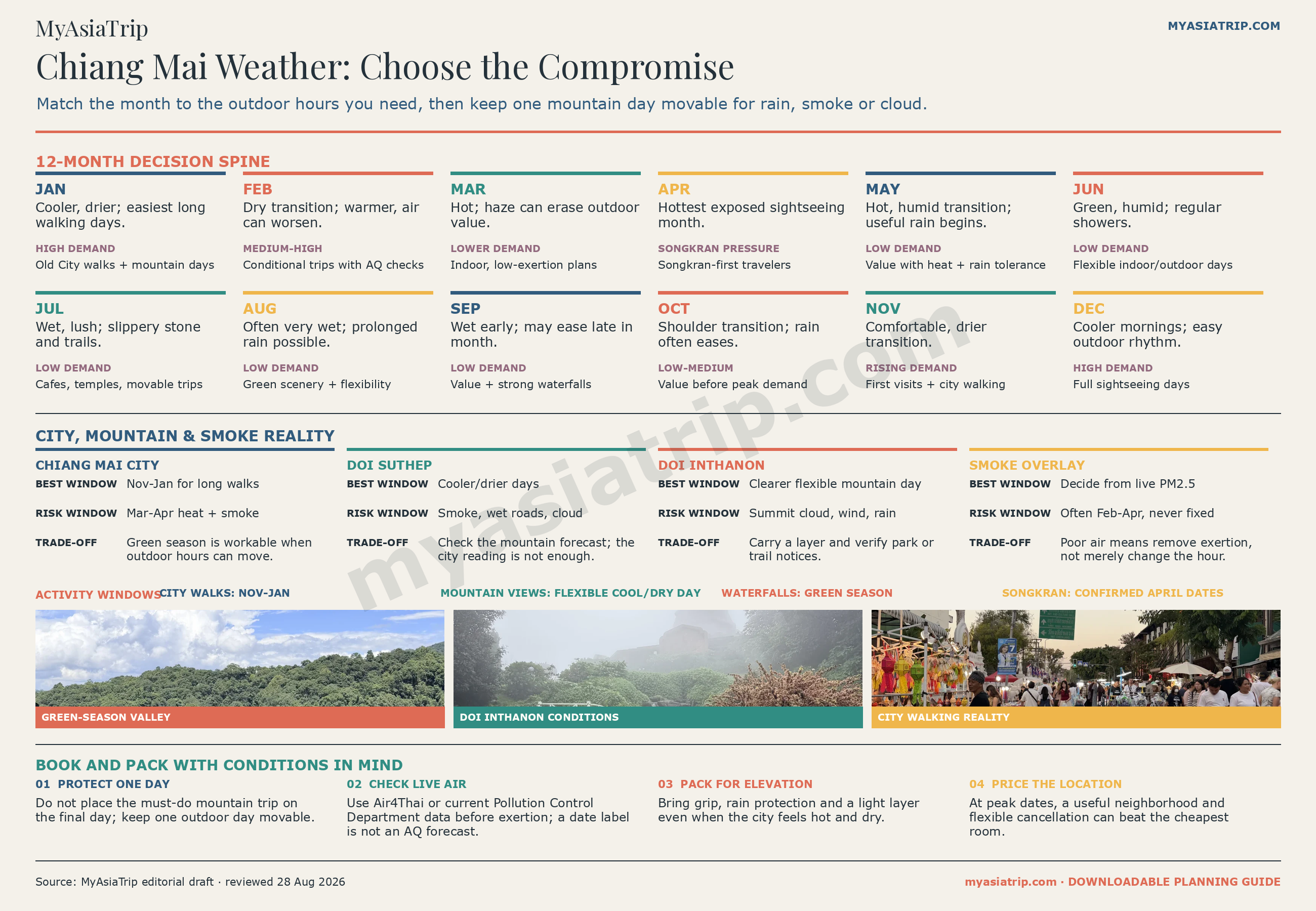
For a first Chiang Mai trip, November through January is the easiest broad window: outdoor hours are generally more comfortable, rain is less disruptive, and mountain days require fewer weather compromises. It is also the period when rooms and popular activities can tighten, so comfort comes with less spontaneity. February is a transition, not a clean-air promise. The greener months from roughly May through October can be excellent for flexible travelers who accept rain and slippery ground. March and April demand the hardest judgment because heat and smoke can reduce the value of the very outdoor experiences that bring many people north.
Understanding Chiang Mai’s Seasons and Smoke

Chiang Mai’s climate is best understood as three distinct seasons: cool, hot, and rainy. However, a fourth and crucial factor for any visitor to consider is the annual smoke, or “haze,” which is a man-made environmental issue, not a meteorological season. Its timing and severity can overlap with the end of the cool season and the entirety of the hot season, significantly impacting air quality and outdoor activities.
- The Cool Season (November–February): This is Chiang Mai’s peak tourist season for a reason. Daytime temperatures are comfortable, evenings can be genuinely cool, and rainfall is at its lowest. It’s the best time for long days of sightseeing. The trade-off is that it’s the most crowded and expensive time to visit.
- The Hot Season (March–May): Temperatures climb significantly, often making midday exploration in the city draining. April is typically the hottest month of the year. This period also coincides with the highest likelihood of smoke from agricultural burning in the region.
- The Rainy Season (May–October): Often called the “green season,” this period is characterized by frequent rainfall, higher humidity, and lush landscapes. Rain can range from a predictable afternoon downpour to several consecutive days of wet weather. It’s a period of lower visitor numbers and often better pricing.
- The Smoke Overlay (Typically February–April): This is not a natural season but an annual period of poor air quality. The smoke comes from agricultural fires across Northern Thailand and neighboring countries. Its intensity and duration vary each year depending on the number of fires, wind patterns, and the timing of the first rains. It is a serious consideration, especially for those with respiratory issues, young children, or anyone planning strenuous outdoor activities like hiking.
Month-by-Month Guide to Visiting Chiang Mai
Choosing the right month depends on which compromise you can absorb: higher demand, wet ground, heavy heat or uncertain smoke. The table keeps the weather qualitative because a climate normal is not a forecast and one year’s smoke does not set the next year’s dates.
| Month | City Comfort & Conditions | Rain & Smoke Uncertainty | Crowd & Price Pressure | Best For & Plan Adjustments |
|---|---|---|---|---|
| January | Usually the easiest city-walking month; mornings and evenings can feel cool. | Rain is often limited, but air still needs a current check. | High around holiday periods; advance booking reduces choice anxiety. | Temple walks and mountain days. A TMD station example for January 2026 recorded a 22.4°C monthly mean and no measured rain; that is one actual month, not a promise for the next January. |
| February | Often warmer than January while remaining within the drier period. | Smoke can emerge at different points in different years; even early dates are not guaranteed. | Demand may ease after the busiest holiday weeks, but exact room pressure varies. | A conditional choice: monitor air quality close to travel and daily before outdoor exertion. |
| March | Often hot and hazy; a long city walk can lose its appeal before lunch. | Smoke risk can be consequential, yet severity still varies by year and day. | Demand may soften outside events, but a cheaper room does not compensate for unusable outdoor plans. | Indoor or low-exertion days. Travelers sensitive to smoke should choose another date or region if they have flexibility. |
| April | Usually the hardest month for exposed city sightseeing because heat is intense. | Smoke may persist and the arrival of useful rain is not scheduled. Songkran water does not clean regional air. | Songkran can sharply change road access and room demand; confirm the exact current event plan. | Travelers coming specifically for Songkran and prepared for wet crowds, heat and altered transport. Otherwise, protect mornings and retreat at midday. |
| May | Fair. Heat and humidity are high, but the first rains begin to clear the air and lower temperatures. | Rain increases, helping to wash away smoke. A transition month from hot/dry to wet. | Low. A quiet month between Songkran and summer holidays. | Value travel. Be prepared for both heat and rain. A sample month in 2026 recorded a 29.3°C mean and 186.1 mm of rain. |
| June | Fair. Hot and humid with regular rain showers. Landscapes become increasingly green. | Moderate to high rain. Showers can be heavy but may not last all day. | Low. A good time for budget-conscious travelers. | Enjoying lush scenery and fewer crowds. Plan for flexible indoor/outdoor days. |
| July | Fair. Similar to June, with consistent rain and high humidity. | High rain. Expect wet days and plan accordingly. Slippery temple tiles and muddy trails are common. | Low. | Exploring cafes, museums, and temples. Waterfalls will be at their most powerful. |
| August | Fair. Often one of the wettest months, with similar temperatures and humidity to July. | High rain. Potential for prolonged wet spells. | Low. | Similar to July. A good time for those who don’t mind the rain and want to see the countryside at its greenest. |
| September | Fair to good. Rain begins to decrease towards the end of the month. Humidity is still high. | High to moderate rain. The tail end of the monsoon. | Low. | A great value month. Enjoy the last of the full-flowing waterfalls and green rice paddies with improving weather. |
| October | Good. A shoulder month. Rain and humidity drop significantly, and temperatures become more pleasant. | Moderate to low rain. The transition to the cool season is underway. | Low to Medium. Tourist numbers start to pick up. | Excellent value. You get pleasant weather without the peak season crowds or prices. |
| November | Often a comfortable transition into the cool, drier period. | Rain disruption usually eases, but a forecast still matters for mountains. | Festival periods can compress room choice; verify current dates before booking around them. | First visits that prioritize city walking and a greener post-rain landscape. |
| December | Usually comfortable for full outdoor days, with cooler mornings and evenings. | Rain is often limited; haze or cloud is never impossible. | Holiday demand can reduce flexibility. | Travelers willing to book earlier in exchange for easier sightseeing conditions. |
Planning for Chiang Mai’s Environmental Realities
Successful travel to Chiang Mai means planning for its specific conditions, not just looking at average temperatures.
How to handle smoke without pretending to predict it
The smoky season is a serious health and enjoyment factor. Do not assume it will start or end on a specific date.
- Monitor Actively: The most important tool is real-time data. Before and during your trip, check the PM2.5 levels on Thailand’s Pollution Control Department website or the Air4Thai app. This will give you an accurate picture of current conditions.
- Official Measures: Local authorities take action, such as the announced no-burning period in Chiang Mai province from January 1 to May 31, 2026. This shows official management but is not a guarantee of clear air, as wind can bring smoke from other regions.
- Health First: If you or your travel companions have asthma, respiratory issues, or are traveling with children, the typical smoke season (late Feb–April) is best avoided. Consult your doctor before travel if you have concerns.
- Adapt Your Plans: On poor-air days, remove exertion rather than merely moving the same hike to a different hour. Replace a long Old City walk or mountain trail with an indoor class, a short meal-focused outing, or genuine hotel recovery.
How to handle rain without losing the whole trip
Rain in the green season can be a minor inconvenience or a day-changer. Being prepared is key.
- Don’t Trust Timetables: The idea that it only rains for an hour in the afternoon is a common but unreliable myth. Be prepared for anything from a short, intense burst to a full day of drizzle.
- Protect Your Gear: A waterproof daypack or a rain cover is essential. Keep electronics in dry bags. A good quality travel umbrella or lightweight rain jacket is a must.
- Plan Flexibly: Don’t schedule a must-do mountain trip for your last day. Keep your 3-day itinerary flexible so you can swap an outdoor day for an indoor one if the weather turns.
- Watch Your Step: Stone courtyards at temples and unpaved trails can become extremely slippery when wet. Wear shoes with good grip.
City vs. Mountain Weather
A weather forecast for the city of Chiang Mai is not a reliable guide for its surrounding mountains.
- Expect a meaningful temperature change: Doi Suthep and especially Doi Inthanon can feel markedly cooler, wetter and windier than the city. Check the specific elevation rather than applying the city number to the summit.
- Pack a Layer: Always bring a long-sleeved shirt, fleece, or light jacket if you are heading up into the mountains, regardless of how hot it feels in the city.
- Visibility and Rain: The mountains create their own weather. It can be sunny in Chiang Mai but foggy, misty, or raining at the summit of Doi Inthanon. This can affect views and trail conditions. Check a specific mountain forecast if possible, but always be prepared for changing conditions.
Match the month to the activities you refuse to lose
The most useful question is not “Which month has the best weather?” It is “Which part of this trip would be ruined by the wrong conditions?” A temple-and-food city break can survive mist, a few showers and a cancelled viewpoint. A trip built around strenuous trails, sunrise views and consecutive mountain days has a much narrower tolerance.
| Non-negotiable plan | More forgiving window | What still needs checking |
|---|---|---|
| Long Old City walks | Cooler months, especially November–January | Event closures, midday sun and current air quality |
| Doi Inthanon views and trails | Cooler/drier period, with a flexible day | Park notices, trail opening, summit cloud, wind and rain |
| Full waterfalls and green countryside | Green season | Flood or closure notices, surface grip and return transport |
| Songkran | Confirmed April event dates | Road access, waterproofing, heat, smoke and hotel location |
| Quiet, lower-pressure city time | Much of the green season | Whether rain will undermine your specific outdoor anchor |
This is where the green season often beats a simplistic ranking. If your essential experience is food, crafts, cafés and one movable outdoor morning, rain is manageable. If your entire trip depends on one exposed viewpoint on one fixed day, it is not.
Crowds and price pressure are route problems too
Peak demand does more than raise a room quote. It can push you into a less useful neighborhood, a non-refundable booking or a day trip with a poor pickup schedule. Compare the final room location and cancellation terms, not only the nightly rate. A slightly higher rate inside the area you will repeatedly use can save several hot rides and make early starts easier.
During a major event, ask whether you want to participate or merely happen to be in the city. If the event is the purpose, book around its confirmed current dates and accept altered traffic. If it is not, moving the stay by a few days may deliver the same seasonal weather with less friction. Do not use an undated lantern-festival blog as a booking calendar.
A Decision-Making Guide
Use this checklist to match the best season to your travel style.
Choose the Cool Season (November–January) if:
- This is your first visit to Thailand.
- You prioritize comfortable, predictable weather for sightseeing.
- You plan on doing lots of outdoor activities like trekking or exploring the Old City on foot.
- Your budget can accommodate higher peak-season prices.
- You can book flights and accommodation several months in advance.
Choose the Shoulder Months (February, October) if:
- You want a balance of good weather and slightly fewer crowds.
- You are willing to accept a small risk of increasing heat and smoke (in February) or occasional rain (in October).
- You are looking for slightly better value than in the absolute peak season.
Choose the Green Season (May–September) if:
- You are a budget-conscious traveler.
- You want to avoid crowds.
- You love lush, green landscapes and powerful waterfalls.
- You have a flexible itinerary and don’t mind planning around potential rain showers.
- You are not planning a multi-day, hardcore trek where trail conditions are paramount.
Choose the Hot Season (March–April) only if:
- You are specifically coming for the Songkran festival in April.
- You have a high tolerance for heat and humidity.
- You have checked air quality data and are prepared to alter plans based on smoke levels, or you are not sensitive to haze.
- Your itinerary is focused on indoor activities, resort relaxation, or water-based fun.
For most first visits, choose November through January and accept higher demand. Choose the green season when flexibility and value matter more than dry shoes. Treat February as a live air-quality decision, and treat March–April as dates that need a positive reason—not merely a cheaper hotel. Whichever month you choose, leave one outdoor day movable. That single piece of slack is more useful than any claim that Chiang Mai weather is predictable.
Research notes
Official planning references
We use these primary references for the time-sensitive details relevant to this guide. Rules, prices and operating hours can change, so confirm the live information before you travel.
- Thai Meteorological Department — 30-year climate charts
Details to check: Climate-normal framework and monthly rainfall context; checked 2026-08-28.
- Thai Meteorological Department — January 2026 monthly summary
Details to check: Chiang Mai station January 2026 temperature and rainfall example; checked 2026-08-28.
- Thai Meteorological Department — May 2026 monthly summary
Details to check: Chiang Mai station May 2026 temperature and rainfall example; checked 2026-08-28.
- Environmental and Pollution Control Office 1 — Chiang Mai 2026 no-burning period
Details to check: Official 2026 smoke-control window and PM2.5 management context; checked 2026-08-28.
Guide reviewed 30 August 2026. Confirm live rules, prices and operating details with the linked authority before travel.