

3-Day Chiang Mai Itinerary
Plan three days in Chiang Mai around the Old City, Doi Suthep and one day trip, with midday recovery time and realistic transfers between districts.


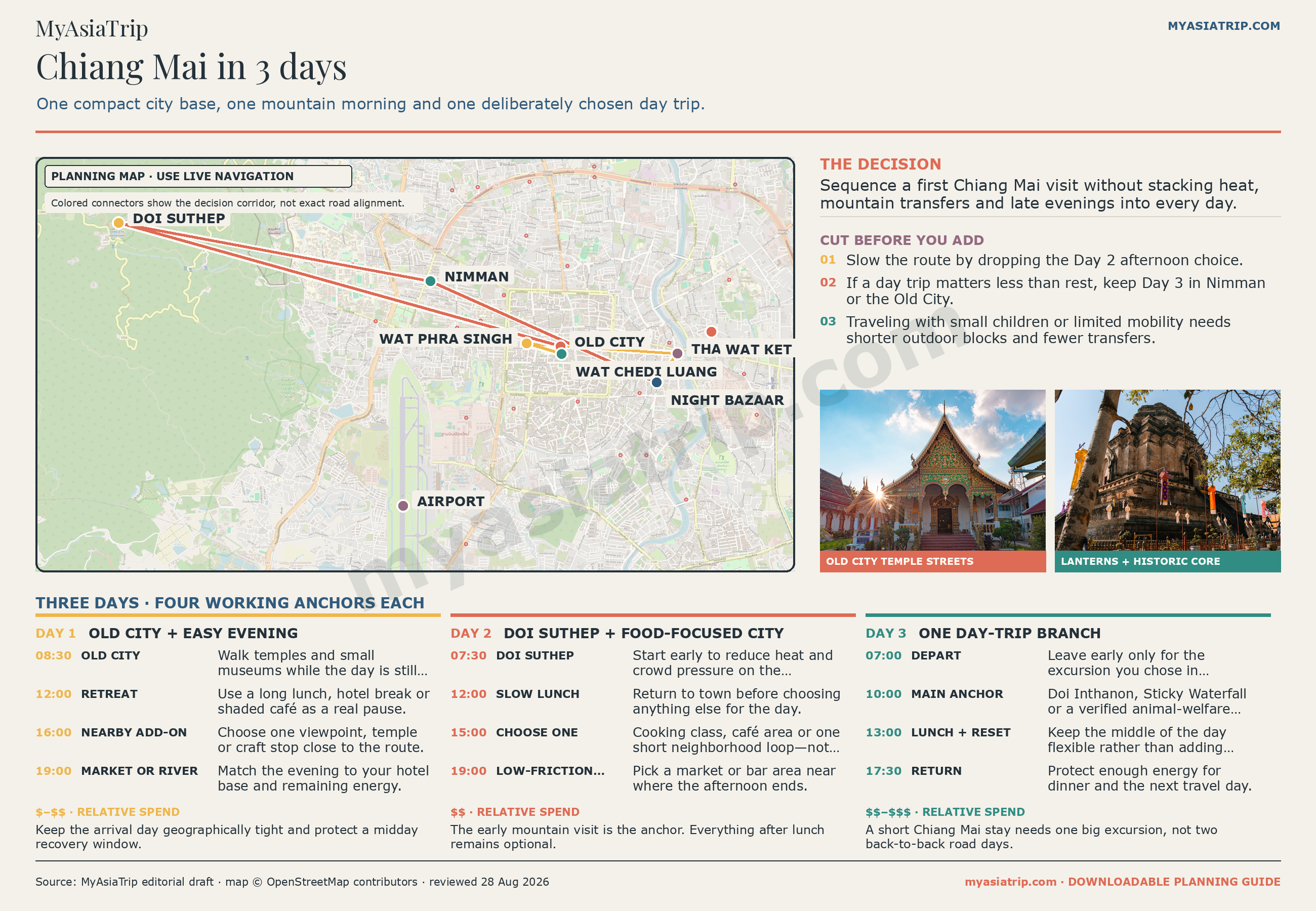
Three days in Chiang Mai is enough for the Old City, Doi Suthep and one nature day—if you protect the middle of each day and stop treating every café or market as compulsory. Stay in or near the Old City for the easiest first trip, move Doi Suthep to the clearest morning, and let your actual weekday decide which market belongs in the plan.
This route suits a first-time traveler comfortable with one early start and one full day out. If cafés, craft workshops and massages are the reason you came, skip the major day trip and keep Day 3 in town.
Quick fit check
- Choose this pace if you want one base, can handle two early mornings and prefer a clear route over a long checklist.
- Slow it down if you are arriving after a long flight, traveling with small children or want pool and café time to be real parts of the trip.
- Carry small cash even if you use ride-hailing and mobile payment. Markets, trail checkpoints and late appointments do not all behave like a mall.
Three days means three full usable days. If Day 1 begins after an afternoon flight or Day 3 ends with a morning departure, you have closer to two days and should cut the remote excursion. Arrival friction, baggage, showers and airport transfers consume real hours even when the flight is on time.
This plan is most comfortable from November through the cooler part of the dry season, but clear weather is never guaranteed. Check the Chiang Mai best-time guide for the month-by-month rain, heat and smoke trade-offs. In hotter months, shorten outdoor blocks and protect air-conditioned recovery. During periods of poor air quality, check current conditions and replace strenuous outdoor plans rather than treating the mountain as an automatic escape.
Before Day 1: settle the logistics
Book one base for all three nights. Moving hotels inside Chiang Mai usually costs more energy than it saves. The Old City edge suits this route; Nimman works when café and evening convenience outweighs extra rides to historic sights.
Arrange airport transport according to arrival time and luggage, install Grab and Bolt, and keep small baht notes. Confirm the one fixed day trip before arrival, but leave city meals and cafés flexible. Save each day’s neighborhood rather than twenty individual pins.
Pack covered temple clothing, comfortable walking shoes, a light rain layer and any motion-sickness medicine. Doi Suthep and Doi Inthanon can feel cooler than the city, while the Old City pavement becomes hot quickly. One small day bag should handle both conditions.
Three-day outline (realistic pace)
Use this as a sequence, not a promise. Keep each day to one anchor experience plus nearby add-ons.

Day 1: Old City + an easy evening
- 08:00–11:30: walk the Old City around Wat Chedi Luang and one other temple. Two unhurried temples are better than six doorways in the heat.
- 11:30–15:30: take a long lunch and hotel break. This is recovery time, not an empty slot waiting for another attraction.
- Late afternoon: choose a massage, a shaded café or one small museum close to your base. Reserve a specific popular massage ahead and confirm how it accepts payment.
- Evening: use the market that matches the day, or choose a relaxed dinner if the walking street would require crossing town.
Start at Wat Chedi Luang because it provides a strong historic anchor in the center. Add Wat Phan Tao, Wat Phra Singh or a museum according to interest and heat—only one. Wear clothing that covers shoulders and knees, remove shoes where required and allow active worship to set the pace.
Lunch should finish the morning route rather than begin a second one. Eat near the last temple, then return to the hotel. A massage or café late in the afternoon is optional; if the flight or heat has caught up with you, the correct activity is rest.
For the evening, match geography and weekday. Sunday Walking Street works when you are already inside the moat. Night Bazaar works more naturally for a Chang Khlan base. A first-night dinner close to the hotel is not wasted opportunity—it protects the early mountain morning.
Day 2: Doi Suthep half-day + food-focused Chiang Mai
- Early morning: take road transport to Wat Phra That Doi Suthep. Add Wat Pha Lat by road, or replace the upper temple with the Monk’s Trail if the forest walk is your priority.
- Midday: return to the western side of town for lunch.
- Afternoon: use Nimman as a compact café-and-shopping loop. MAYA is the practical retreat when heat or rain makes the streets tiring.
- Night: choose live music or an early dinner. Do not force another night market simply because the previous one was enjoyable.
Arrange the mountain return before leaving. A taxi or driver can wait, a shared songthaew can follow its passenger logic, and an app car may not be immediately available uphill. The Doi Suthep guide covers the tram, trail and transport choices.
For a first visit, take road transport to Wat Phra That Doi Suthep and add Wat Pha Lat by road if energy remains. If hiking is the true priority, use the Monk’s Trail to Wat Pha Lat and do not improvise the steeper continuation to the upper temple.
Return to the west side for lunch and use Nimman through the hottest hours. Choose one coffee purpose, one small shopping loop and MAYA or another indoor fallback. Dinner can focus on northern Thai food; use the Chiang Mai food guide instead of crossing town for every famous dish.
Day 3: One day trip (pick one)
- Mountain day: Doi Inthanon for cooler upper-elevation conditions, waterfalls and one chosen trail. Expect a long vehicle day.
- Active half-day: Bua Tong Sticky Waterfall for climbing and less time inside a van. Arrange the return before leaving town.
- City-and-craft day: Jing Jai on a weekend morning, or Baan Kang Wat and a hands-on class when the opening day works.
- Elephant day: only if the experience is observation-led and passes a meaningful welfare checklist.
Keep the final evening near your hotel. Wet clothes, mountain roads and an early pickup all create more fatigue than the itinerary map admits.
Choose Doi Inthanon when landscape and a full mountain day justify an early start. Select either a sightseeing circuit or one named trail; trying to combine every waterfall, pagoda and walk creates a rushed route. Confirm that transport moves between sights inside the park.
Choose Bua Tong when climbing is the activity and you want to return earlier. Secure the waiting driver or complete tour before departure, pack dry clothes and stop when the limestone surface or confidence changes.
Choose the city-and-craft version when Day 1 or 2 already felt full. Jing Jai is a weekend morning activity, while Baan Kang Wat depends on current shop and workshop days. A cooking class can anchor the afternoon when market visit, pickup and dietary handling are confirmed.
An elephant visit is not the default substitute for any canceled excursion. Choose observation-led experiences only, and skip venues that build the day around riding, bathing, touching or close feeding. Convenience does not lower the welfare threshold.
If your days fall in a different order
Move Doi Suthep to the clearest practical morning and the market to its actual operating day. Do not lock “Day 1” to Monday if you arrive on Sunday and want the walking street. Keep the underlying sequence: gentle city orientation, mountain half-day, then the largest outing.
Avoid placing Doi Inthanon immediately after arrival or before a time-critical departure. Its return is too variable. If Day 3 ends with an evening flight, use Bua Tong only with a generous buffer—or stay in town and keep luggage accessible.
If heavy rain disrupts the mountain, switch to food, craft, museums, cafés and a cooking class with safe transport. Do not force a forest trail because it appears on the assigned date. A flexible Chiang Mai day is easy to rebuild when bookings are limited to the true anchors.
Arrival day is not Day 1
An international arrival includes immigration, baggage, cash or data setup, the airport pickup and hotel check-in. A domestic arrival is faster but still creates luggage and transfer friction. Unless the flight lands early and everyone has slept, treat arrival as orientation rather than the first full sightseeing day.
From CNX, choose the official taxi counter, designated ride-hailing arrangement or a current bus whose stop genuinely fits the hotel. The cheapest option loses value when it leaves a family walking with bags in heat or rain. Save the hotel name and address in Thai before leaving the terminal.
After check-in, do one reversible thing: eat nearby, walk one familiar block, buy water and cash, or visit the market already beside the hotel. Do not book a rural class, mountain driver or non-refundable dinner against an arrival time the airline does not control.
On the final day, reverse the rule. Store luggage, stay in the same neighborhood and leave a wide airport buffer. A “last quick temple” on the opposite side of town is not quick once showers, checkout and pickup are included.
What three days cost in effort and money
Think in categories rather than one universal daily number: accommodation, city transport, one major excursion, admissions, food, coffee or alcohol, and a reserve for changes. The excursion and hotel usually create the largest swing; ordinary local meals are not the reason one traveler’s budget doubles another’s.
A budget route can use a central guesthouse, walking and shared city transport, an independent Old City morning and one carefully chosen group trip. A mid-range route can buy a quieter hotel, app cars between districts and a smaller tour or driver. A comfort-led route may use private transfers and a pool hotel, but it should still avoid paying for vehicles that wait through an inefficient itinerary.
Keep the weather reserve real. A canceled outdoor day may require a class, museum, mall, massage or different transport. Travel insurance and emergency funds are separate from the sightseeing allowance.
Use the Chiang Mai travel-cost guide for current city price bands and the Thailand trip budget for the wider country framework. Verify hotel, tour and transport prices at booking because season and group size can change the total.
Turn this into four or five days
With four days, keep the three anchors and add one city day: cooking, craft, food, work time or a slow neighborhood. Do not automatically add Chiang Rai as another dawn-to-night road loop.
With five days, choose between a second nature route and a deeper city day. Two excursions can work when separated by a recovery day. An overnight in Chiang Rai, Mae Kampong or another northern base may be better than two return tours, but it changes the accommodation and transport structure.
The extra days should reduce compression. Let a favorite café repeat, allow a laundry block and keep one evening open. If the five-day plan contains four fixed pickups, it has expanded the checklist rather than the experience.
How to choose your base
Your base decides how relaxed Chiang Mai feels. The Old City edge is easiest for this exact route. Nimman is better when cafés and modern evenings matter more than walking to temples, but check aircraft and main-road noise before booking. Use the full Chiang Mai neighborhood comparison before choosing a hotel.
Tha Phae and the east moat make Sunday evening and central pickups convenient, though nightlife and road closures can affect sleep and vehicle access. The riverside and Night Bazaar suit evening dining but add rides to Nimman and western mountain departures. Choose the area that reduces your repeated journeys, not the one with the most general praise.
Ask for a room away from bars, main roads and exposed aircraft noise when relevant. A quiet night improves every early start more than a rooftop pool you never use. Keep a refundable booking when recent reviews give conflicting evidence about noise or construction.
Weekend switches

- Saturday or Sunday morning: Jing Jai’s full farmers’ and craft market currently runs 06:30–15:00. Go in the morning; the wider complex remaining open later is not the same experience.
- Saturday evening: use Wualai Walking Street if you want a weekend market without restructuring the Old City day.
- Sunday evening: place Sunday Walking Street after Day 1 only if you are already near the Old City. Arrive before the densest crowd and leave when the products begin to repeat.
- No weekend overlap: use Warorot in the daytime or the Night Bazaar in the evening rather than chasing a closed weekend market.
Common failure modes (and fixes)
Over-stacking day trips: plan one big day out, not two back-to-back.
Ignoring midday heat: assume you’ll need a retreat window.
Too many transfers: if you’re doing “one more stop,” make it nearby.
Landing and immediately starting a remote day trip: luggage, flight delays and sleep debt make a private-car itinerary look easier than it feels.
Treating every market as unique: choose one polished morning market and one evening market, then stop.
Assuming a mountain view is guaranteed: haze and cloud change quickly; let the temple or forest be worthwhile without the panorama.
Leaving the rural return vague: book waiting time or a round-trip before the outbound ride.
Using cafés as checklist stops: pick the good one beside the route and sit long enough to recover.
Booking the final evening tightly: day trips return late; keep dinner refundable or close to the hotel.
Variations for different travelers
With young children, shorten Day 1 to one temple, use a car and tram for Doi Suthep, and replace the longest day trip if consecutive road hours will overwhelm them. A pool or playground break is a planned activity, not dead time. Confirm child restraints with every vehicle.
With limited mobility, ask each site about actual steps, thresholds, surfaces and toilets. Use vehicle hops inside the Old City, the tram at Doi Suthep where suitable and a private route that can cut stops. Doi Inthanon’s attractions differ widely in access; a general “easy tour” description is insufficient.
For solo travelers, a small-group mountain tour can offer better value and a clearer return. Keep app trip sharing active at night and choose visible pickup points. A cooking class or guided food experience can also provide social time without making the full itinerary group-based.
For remote workers or slow travelers, this should become four or five days. Keep the three anchors but insert work and recovery days between them. Chiang Mai’s appeal grows when breakfast, a familiar café and an unplanned dinner are allowed to repeat.
What to book—and what to leave open
Book accommodation, the main day-trip transport, any high-priority cooking class and a private driver needed for a fixed mountain morning. Confirm cancellation terms and actual inclusions. During busy Thai holidays or peak cool-season dates, reserve earlier.
Leave ordinary meals, massages with several acceptable alternatives, cafés and minor temples open. Weather, energy and weekday will improve those choices closer to the day. Save two options per neighborhood rather than constructing a timed reservation chain.
Reconfirm current park access, trail status, market hours and transport the day before. Keep screenshots or booking messages available offline. Carry enough cash for rural fees and the final ride without assuming every Thai QR system accepts a foreign account.
What to decide next
Once you have the pace, decide how you will move around and which one day trip you actually want enough to wake up early for. Leave the rest as a reason to return.
The final test is simple: each day should have one reason to get up and one period where nothing is demanded. If the plan contains three early starts, three markets and dinners across town, remove something now. Chiang Mai feels generous when the itinerary leaves room for weather, appetite and a slower walk home.
Research notes
Official planning references
We use these primary references for the time-sensitive details relevant to this guide. Rules, prices and operating hours can change, so confirm the live information before you travel.
- Tourism Authority of Thailand — Wat Phra That Doi Suthep
Details to check: Reference for Doi Suthep visit basics (entrance fee and access notes) used in the itinerary (checked 2026-08-25).
- Department of National Parks (DNP) — Doi Inthanon National Park
Details to check: Reference for the Doi Inthanon day-trip option used in the itinerary (checked 2026-08-25).
- Jing Jai Central Chiang Mai — Market
Details to check: Official weekend market days and hours used for the itinerary switch (checked 2026-08-26).
Guide reviewed 31 August 2026. Confirm live rules, prices and operating details with the linked authority before travel.