

Where to Stay in Bangkok: Best Neighborhoods (2026)
Compare where to stay in Bangkok by transport, atmosphere, nightlife and budget, with honest trade-offs for first-timers, families and repeat visitors.


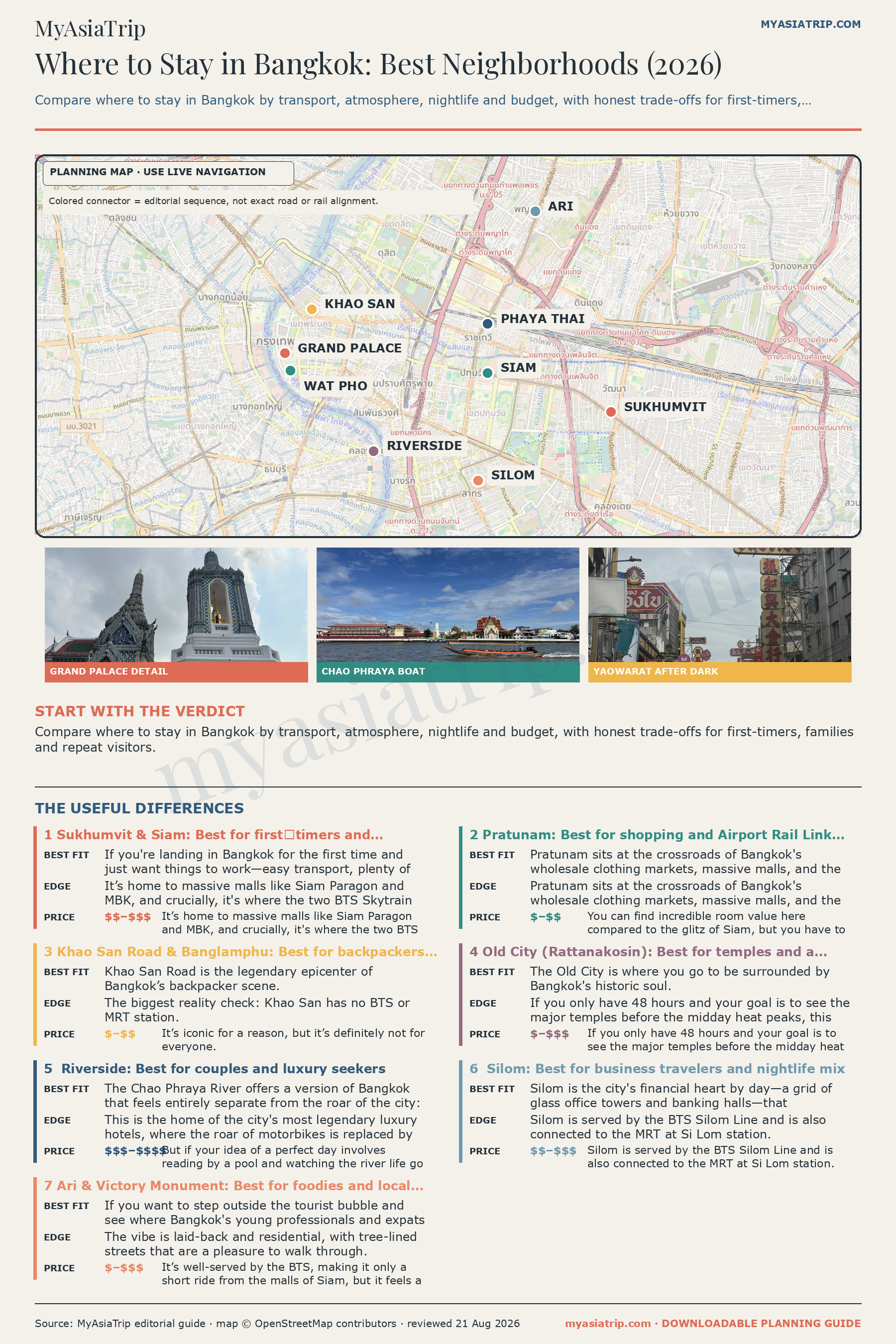
For a first Bangkok trip, choose the transit line and repeated daily journey before the neighborhood label. Siam or lower Sukhumvit suits a rail-heavy city plan; Silom balances BTS, MRT and evenings; the Riverside and Old City reduce temple travel but make many later journeys slower. Check the actual hotel entrance on a map: an address described as “near BTS” can still mean an uncovered walk with luggage in heavy rain.
At a glance: Bangkok areas by transit and traveler fit
Choosing where to base yourself in Bangkok is less about finding a “perfect” spot and more about picking the set of trade-offs you can live with. Before you book, pull up the BTS/MRT map and look at where you will actually spend your days. A cheaper room can quickly lose its appeal if every morning begins with two transfers in the humidity.
| Traveler Profile | Best Area(s) | Key Advantage | Potential Drawback |
|---|---|---|---|
| First‑timer / Urban explorer | Siam & Sukhumvit | Central location, BTS access, shopping, dining, entertainment | Lower Sukhumvit can be seedy at night; can feel overwhelming |
| Temples / Short historic stay | Old City (Rattanakosin) | Walkable access to the Grand Palace, Wat Pho and river | Limited rail access and quieter late evenings |
| Shopping / Value | Pratunam | Wholesale shopping, Airport Rail Link access, central position | Crowded pavements and heavy road traffic |
| Backpacker / Party crowd | Khao San Road & Banglamphu | Cheap accommodation, bars, street food, non‑stop energy | No BTS/MRT; very noisy |
| Couples / Luxury seeker | Riverside | Calm, romantic atmosphere, sunset views, luxury hotels | Distant from BTS; reliant on ferries or taxis |
| Business / Nightlife mixed | Silom | Well‑connected by BTS & MRT, rooftop bars, red‑light district nearby | Can feel quiet by day; Patpong is not for everyone |
| Foodie / Local vibe | Ari & Victory Monument | Excellent street food, trendy cafes, fewer tourists, good transport | Fewer big attractions; Victory Monument can feel chaotic |
The table above gives a quick way to narrow down options. If you value transit connectivity most, Siam, Sukhumvit and Silom are the safest choices. Old City reduces travel on a temple-focused short stay; Pratunam serves shoppers who can tolerate crowds. Riverside stands out for calm and views, while Ari and Victory Monument reward travelers who prioritize food and local routine. Test your shortlist against the Bangkok getting-around guide and the daily geography in the three-day Bangkok itinerary before booking.
Sukhumvit and Siam: easiest for rail-heavy first trips
If you’re landing in Bangkok for the first time and just want things to work—easy transport, plenty of food, and zero stress about finding a mall—Sukhumvit or Siam is where you’ll likely end up. It’s the path of least resistance. You can step out of your hotel and immediately find everything you need without a map.
Siam is the commercial heart. It’s home to massive malls like Siam Paragon and MBK, and crucially, it’s where the two BTS Skytrain lines meet. Transfers are effortless here, which is a lifesaver when you’re tired and just want to get back to your room. The downside? It’s always packed, and the hotels here are mostly modern, upscale, and functional rather than “charming.”
Sukhumvit is a long road that stretches northeast from central Bangkok, and its character changes dramatically depending on which soi you choose. Lower Sukhumvit, roughly Soi 1 through Soi 18, is nightlife‑heavy and includes red‑light areas such as Soi Cowboy and Nana Plaza. This stretch is lively, loud, and can feel aggressive after dark. If you’re traveling with kids, be aware that the area around Nana and Asok can feel quite intense. Upper Sukhumvit, roughly Soi 18 through Soi 63, shifts to a more residential and upscale character, with tree‑lined streets, family‑friendly hotels, and a calmer atmosphere. The BTS Skytrain runs the length of Sukhumvit Road, providing excellent coverage at stations like Phrom Phong and Thong Lo.
Unlike Khao San Road, Sukhumvit and Siam offer seamless BTS connectivity. You can reach most of the city without touching a taxi. Compared to Riverside, the energy is higher and the options for dining and shopping are far more abundant. The trade‑off is that you pay a premium for convenience, and the sheer scale of the area can feel overwhelming to some visitors. For a first‑timer, this is the most forgiving base because you can step out of your hotel and immediately find food, transport, and entertainment without needing to plan ahead. For a traveler who has visited Bangkok before and wants a deeper local experience, Upper Sukhumvit offers a better balance than the more touristic Lower Sukhumvit.
The biggest caveat is the nightlife split. Lower Sukhumvit’s scene is lively but can be off‑putting for families, couples, or anyone uncomfortable with aggressive bars and red‑light elements. Even if you choose a hotel in a quieter soi nearby, the main roads and BTS stations at Nana and Asok can feel seedy after dark. Siam itself can be noisy close to the main intersections, and hotels directly above Siam station are exposed to constant foot traffic and street noise. Hotels near BTS stations command a premium, but the time saved is worth it for most travelers. If you want to avoid the red‑light scene entirely, stick to Upper Sukhumvit or Siam.
First‑time visitors who want to maximize convenience, urban explorers who plan to spend most of their time shopping and eating, and travelers who value transit connectivity above all else should choose this area. Families should aim for Upper Sukhumvit rather than Lower Sukhumvit. Solo travelers will find plenty of company and easy navigation. For a balanced and slightly less intense introduction, consider staying near Thong Lo or Ekkamai stations in Upper Sukhumvit, where the atmosphere is more residential and the dining scene is excellent.
Pratunam: useful for shopping and Airport Rail Link access
Pratunam sits at the crossroads of Bangkok’s wholesale clothing markets, massive malls, and the Airport Rail Link. It’s the logical base for travelers who have come to Bangkok specifically to shop, or for those who want to simplify their arrival and departure via Ratchaprarop station. You can find incredible room value here compared to the glitz of Siam, but you have to be prepared for the environment.
The area is a functional hub, not a tidy pedestrian district. The pavements around Pratunam Market are a constant, chaotic obstacle course of vendors, tour groups, and mountains of luggage. If you’re pushing a stroller or just want a quiet evening walk, this isn’t it. A hotel might be described as “near Pratunam,” but that could still mean a long, hot walk to the nearest rail station or an awkward road crossing. Map your specific hotel entrance before you commit.
Choose Pratunam if your trip is focused on clothing markets or if the Airport Rail Link connection is a priority for your schedule. Avoid it if you value quiet evenings, wider pavements, or immediate access to the Old City’s historic charm. It is a highly efficient base for a specific kind of traveler, but it lacks the atmospheric polish of the Riverside or Ari.
Khao San Road and Banglamphu: nightlife with weak rail access
Khao San Road is the legendary epicenter of Bangkok’s backpacker scene. If you’re young, on a tight budget, and your primary goal is to meet other travelers and drink cheap beer until dawn, this is your place. It’s iconic for a reason, but it’s definitely not for everyone. The surrounding Banglamphu district has quieter guesthouses, but the main strip is relentless.
The biggest reality check: Khao San has no BTS or MRT station. The nearest public transport is the Chao Phraya ferry at Phra Arthit pier (about a 10-minute walk). This means every time you want to see the modern side of the city, you’re either walking in the heat, waiting for a ferry, or haggling with a tuk-tuk driver. It’s a trade-off: you save money on the room, but you lose time and energy in traffic. This is the single most important factor to weigh when considering Khao San as a base: you are trading convenience and speed for price and atmosphere.
Silom’s nightlife is more upscale and club‑oriented, with a professional crowd and rooftop bars. Khao San is younger, louder, and cheaper. The transport gap is the defining difference: Silom has both BTS and MRT, while Khao San has neither. For a traveler who wants nightlife but also wants to explore the city efficiently during the day, Silom is the better choice. For a traveler who wants to be surrounded by other backpackers and does not mind the extra effort to get around, Khao San is iconic.
Constant noise from bars and street vendors can make it difficult to sleep before 2 a.m. Accommodation is basic, and shared facilities are the norm. This area is not recommended for families, early risers, or anyone who dislikes loud music and street food stalls. For those who value a good night’s sleep over nightlife, look at Banglamphu’s quieter side streets, such as Phra Athit and Soi Rambuttri, which offer a more relaxed, “old Bangkok” atmosphere while still being walkable to the main strip. You can also consider a hostel near a BTS station in another district and simply visit Khao San for an evening, which avoids the accommodation downsides entirely.
Budget backpackers, solo travelers who want to meet people easily, and anyone whose primary goal is nightlife and socializing should choose this area. If you are on a tight budget and your itinerary focuses on the old city’s temples and markets, Khao San offers unbeatable value. If you have a moderate budget and want to see more of Bangkok, choose a different area and visit Khao San for a night.
Old City (Rattanakosin): efficient for temples, awkward for later trips
The Old City is where you go to be surrounded by Bangkok’s historic soul. Staying here places the Grand Palace, Wat Pho, and the river within a much smaller daily radius than if you were commuting from Sukhumvit. If you only have 48 hours and your goal is to see the major temples before the midday heat peaks, this saved travel time is far more valuable than a BTS connection.
However, transport is the major trade-off. While MRT Sanam Chai serves part of the district, you’ll mostly be relying on river piers, taxis, or your own feet to get around. The district is significantly quieter after dark once the day-trippers leave, and you won’t find the dense concentration of nightlife or modern dining that defines the city center. It’s a place for early risers and history buffs.
Check your micro-location carefully. A hotel near a pier or the MRT behaves very differently from one tucked deep inside a narrow street that requires a taxi for every single movement. The Old City is perfect for photographers and short-stay visitors who want to prioritize the historic corridor. It’s less ideal if you plan to spend your evenings exploring the rooftop bars and malls of modern Bangkok.
Use the Old City temple route and two-day itinerary to test whether the historic-location advantage matches your actual plans.

Riverside: atmosphere and hotels, with slower cross-city journeys
The Chao Phraya River offers a version of Bangkok that feels entirely separate from the roar of the city: calm, scenic, and undeniably romantic. This is the home of the city’s most legendary luxury hotels, where the roar of motorbikes is replaced by the gentle hum of ferry boats and the sunset over the water is a nightly event.
While Sukhumvit and Silom are powered by a frantic energy, the Riverside is where you go to retreat. It’s the obvious choice for couples or anyone who wants a luxurious escape from the city’s intensity. The trade-off is isolation. Most riverside hotels are a significant walk or shuttle-boat ride from the nearest BTS or MRT station. If your plan involves a high-speed itinerary of malls and multiple districts, the river’s slower pace might frustrate you. But if your idea of a perfect day involves reading by a pool and watching the river life go by, this is unmatched.
Riverside and Khao San share the same riverbank, but they couldn’t be more different. Khao San is loud, budget-oriented, and chaotic; the Riverside is refined, quiet, and expensive. Both share the transport challenge of having no direct BTS access, but the Riverside compensates with private boat networks and high-end shuttle services.
Expect to pay a premium for the view, and be realistic about your evening plans. If you want to explore the nightlife in Sukhumvit or Silom, you’ll be relying on taxis, and the river ferries stop running relatively early. A late dinner in the city center means a long road trip back to your room. Choose this area if you value atmosphere and sunset views over transit speed and a central location.
Silom: the most balanced BTS–MRT base
Silom is the city’s financial heart by day—a grid of glass office towers and banking halls—that transforms into a dense nightlife hub once the sun sets. It’s a neighborhood with a split personality, home to both corporate headquarters and the infamous Patpong night market. For travelers who want serious daytime efficiency combined with a wide range of evening entertainment, it’s a very logical base.
Transit here is arguably the best in the city. Silom is served by the BTS Silom Line and is also connected to the MRT at Si Lom station. This dual-rail access makes it incredibly easy to reach both the shopping districts and the historic sites. Business travelers and urban explorers who value being able to get anywhere quickly will find Silom far superior to the Riverside or Khao San.
The nightlife is more professional and club-oriented than the backpacker scene at Khao San, with plenty of rooftop bars and hidden speakeasies. However, the red-light association of Patpong is hard to ignore, and the area can feel quite intense after dark. During the day, the streets are compact and walkable, but they can feel a bit corporate and empty on weekend afternoons when the office workers have gone home.
Choose Silom if you want an efficient, well-connected base that offers a bit of everything. It’s a great compromise for first-timers who want a mix of modern and traditional. If you want a completely family-friendly or ROMANTIC environment, you might find the energy of Upper Sukhumvit or the Riverside more to your taste.
Ari and Victory Monument: food-led bases away from the main sights
If you want to step outside the tourist bubble and see where Bangkok’s young professionals and expats actually live, Ari and Victory Monument are the places to be. These aren’t areas for ticking off major sights; they are areas for experiencing the local neighborhood routine.
Ari is the trendy, “village” alternative to the city center. It’s filled with independent boutiques, specialty coffee shops, and a dining scene that feels creative and personal. The vibe is laid-back and residential, with tree-lined streets that are a pleasure to walk through. It’s well-served by the BTS, making it only a short ride from the malls of Siam, but it feels a world away from the tourist crowds.
Victory Monument is a massive, busy transit hub with strong bus and rail connections and a dense street-food scene. It can suit budget-conscious travelers who value transport and quick meals more than a polished hotel district. The downside is constant movement: traffic noise, crowded pavements and complicated road crossings are part of the stay.
Unlike the Riverside or Sukhumvit, you won’t find many mega-malls or famous landmarks here. The accommodation is mostly small hotels and serviced apartments rather than large resorts. This rewards the independent traveler who values neighborhood charm over uniform luxury. If you’re a return visitor or a food-obsessed explorer, these areas offer a much richer, more immersive experience than the standard tourist hubs.
Be realistic: Victory Monument can feel chaotic and utilitarian, and the traffic around the roundabout is relentless. Ari has fewer high-end amenities than Sukhumvit. Choose either area when better-value food and a less resort-like setting matter more than door-to-door convenience.
Practical tips for choosing your Bangkok base
Turn an area choice into a hotel shortlist
Once you have chosen the district, compare actual hotel entrances—not just marketing addresses. “Near BTS” can mean a shaded two-minute walk or a narrow ten-minute soi with broken pavement, traffic and no easy taxi pickup. Open the walking route from the most useful station exit, switch to street view where available, and inspect the final 500 metres.
Shortlist hotels against the journeys you will repeat:
- Rail access: Which BTS, MRT or Airport Rail Link line is useful, and does reaching it require stairs or an uncovered road crossing?
- Arrival friction: Can a taxi stop at the entrance, and is reception open when your flight lands?
- Room position: Ask about street-facing rooms, nearby bars, connecting doors and lift noise if sleep matters.
- Real price: Compare the same room type with taxes, breakfast, cancellation terms and any child or extra-bed charge included.
- Family practicality: Check room occupancy rules, cot availability, lift access and whether the pool or breakfast area is actually open during your stay.
- Last journey home: A cheap room loses value if every evening ends with a long taxi ride from the neighborhoods you came to see.
Named “best hotels in Bangkok” lists age quickly. Base the final booking on the current room, total price, cancellation terms and exact entrance rather than a neighborhood label alone.
Bangkok’s traffic is severe. Staying near a BTS or MRT station saves significant time. Taxis and tuk‑tuks are plentiful but often stuck in jams. If your budget allows, prioritize accommodation within a 5‑minute walk of a station. Otherwise, you may spend hours each day stuck in traffic.
Match the area to your trip’s rhythm. A short weekend break might justify a central location like Siam or Sukhumvit even if it costs more. A longer stay could benefit from the local feel of Ari or the calm of Riverside, where you can decompress between excursions. If you plan to spend most evenings out, choose an area with nightlife that fits your style, but also ensure you have a quiet enough hotel room to sleep. If your trip is focused on cultural attractions in the old city, the convenience of Khao San is offset by its transport limitations, but the proximity to temples may tip the balance.
Consider your daily priorities. Food‑focused travelers will get more value from Victory Monument or Ari than from Silom. First‑timers overwhelmed by the city should consider the convenience of Sukhumvit, where everything is accessible via Skytrain. Couples wanting romance should look at Riverside despite the transport trade‑offs. Align the area’s primary strength with your trip’s main purpose. Write down your top three priorities (for example, good transit, quiet at night, budget‑friendly) and see which area ticks the most boxes.
Be realistic about red‑light districts. Lower Sukhumvit, Patpong in Silom, and parts of the old city contain red‑light zones. If you want no exposure to such scenes, stick to Upper Sukhumvit, Siam, Riverside, or Ari. Even if you choose a hotel in a quiet street in Silom or Lower Sukhumvit, you will likely encounter touts and street‑level nightlife during the evening. For some travelers this is part of the city’s character; for others it is uncomfortable. Know your tolerance and plan accordingly.
Understand the trade‑offs of each area. No neighborhood is perfect. Khao San is cheap and lively but transit‑poor. Riverside is romantic but isolated. Silom is well‑connected but can feel quiet by day. Ari is local and food‑rich but has fewer attractions. The art of choosing a base is accepting these trade‑offs rather than hoping for an area that excels in every dimension. If you need both excellent transit and a quiet atmosphere, Upper Sukhumvit or Siam are your best bets. If you need both budget accommodation and good nightlife, Khao San is the clear choice, and you accept the transport inconvenience.
Think about your arrival and departure logistics. From Suvarnabhumi, the Airport Rail Link connects to the BTS at Phaya Thai. From Don Mueang Airport, the Red Line reaches Krung Thep Aphiwat and the A1-A4 buses serve different city corridors, but most hotel areas still require a transfer. Khao San and Riverside are more dependent on road transport, which adds cost and uncertainty.
Choose the neighborhood whose main compromise you can live with every day: a longer ride, a higher room price, more nightlife noise or fewer nearby attractions.
Quick answers
Frequently asked questions
What is the best area to stay in Bangkok for first-time visitors?
Which Bangkok area has the best nightlife?
Where should I stay in Bangkok if I want peace and quiet?
Is Khao San Road close to BTS?
What is the best area for foodies in Bangkok?
Research notes
Official planning references
We use these primary references for the time-sensitive details relevant to this guide. Rules, prices and operating hours can change, so confirm the live information before you travel.
- BTS Skytrain — Routes and Fares
Details to check: Official BTS routes, interchanges and fare checks behind the Siam, Sukhumvit, Silom and Ari base comparisons (checked 2026-08-30).
- Bangkok MRT — System Map
Details to check: Official MRT stations and operating windows behind the rail-access comparisons (checked 2026-08-30).
- Tourism Authority of Thailand — Bangkok
Details to check: Official district and attraction context behind the first-trip neighborhood recommendations (checked 2026-08-30).
Guide reviewed 31 August 2026. Confirm live rules, prices and operating details with the linked authority before travel.