Grand Palace Bangkok Guide: Hours, Dress Code and Tickets
Plan a Grand Palace Bangkok visit with current hours, ticket guidance, strict dress rules, transport options and a route that avoids common scams.


The Grand Palace is worth the effort when royal history and Wat Phra Kaew are priorities; it is a reasonable skip when you want a quieter temple morning or cannot meet the strict dress rules comfortably in Bangkok’s heat. Allow roughly two to three hours inside the complex, arrive with conservative clothing already on, and check the official site that morning for ceremonial changes. Wat Phra Kaew belongs to this visit—it is inside the ticketed palace complex, not a separate attraction to schedule later.
What to know before you go
The Grand Palace is the spiritual heart of Thailand, housing Wat Phra Kaew and the legendary Emerald Buddha, but it is also a place that demands a lot from its visitors. It is formal, frequently overcrowded, and uncompromisingly strict about its dress code. To survive the experience without a headache, you need to check the latest opening status, arrive the moment the gates open, and—most importantly—walk with blinkers on directly to the official ticket booth. Ignore anyone on the sidewalk who tries to tell you the palace is closed for a ceremony; they are almost certainly trying to redirect you to a commission-based shopping tour.
Grand Palace and Wat Phra Kaew are one visit
The Grand Palace is พระบรมมหาราชวัง (Phra Borom Maha Ratcha Wang). Wat Phra Kaew is วัดพระศรีรัตนศาสดาราม (Wat Phra Si Rattana Satsadaram), commonly called the Temple of the Emerald Buddha. The temple sits inside the palace complex, and the revered image commonly described in searches as the “Wat Phra Kaew Buddha” is the Emerald Buddha. You do not need to schedule or buy a separate neighborhood transfer between the palace and Wat Phra Kaew.
This distinction prevents two common planning mistakes: treating “Bangkok Palace” and the Grand Palace as separate attractions, or allocating a second time block to Wat Phra Kaew. Use the official Grand Palace entrance and ticket information for the combined visit, then plan Wat Pho or Wat Arun as genuinely separate nearby stops.
A brief history of the Grand Palace
The story of the Grand Palace begins in 1782, when King Rama I decided to move the capital across the river from Thonburi. The site he chose was already home to a Chinese community, who were relocated to make way for the new royal seat. This move effectively founded the Bangkok we know today, anchoring the city’s power on the eastern bank of the Chao Phraya.
Over the next two centuries, the palace grew into a sprawling architectural history book. As you walk through, you’ll see the evolution of Siamese power: from the early traditional structures to the European-influenced neoclassical halls added by Kings Rama IV and V. It is a strange, beautiful hybrid of Siamese gables and Western masonry that reflects Thailand’s history of balancing local tradition with global influence.
While it hasn’t been a full-time royal residence since the 1920s, the palace is far from a museum. It remains the symbolic heart of the Chakri dynasty and is still used for the most important state ceremonies. The King may now live at Dusit Palace, but the Grand Palace is where the nation’s biggest transitions are still marked.

Getting there: the most reliable routes
Finding the palace in the maze of the Old City (Rattanakosin Island) is easy enough, but getting there through the gridlock is another matter. The roads around the district are notoriously congested, and a taxi ride that looks short on a map can easily turn into a forty-minute crawl. If you value your time and your sanity, public transport or the river boats are almost always the superior choice.
By public boat and BTS Skytrain
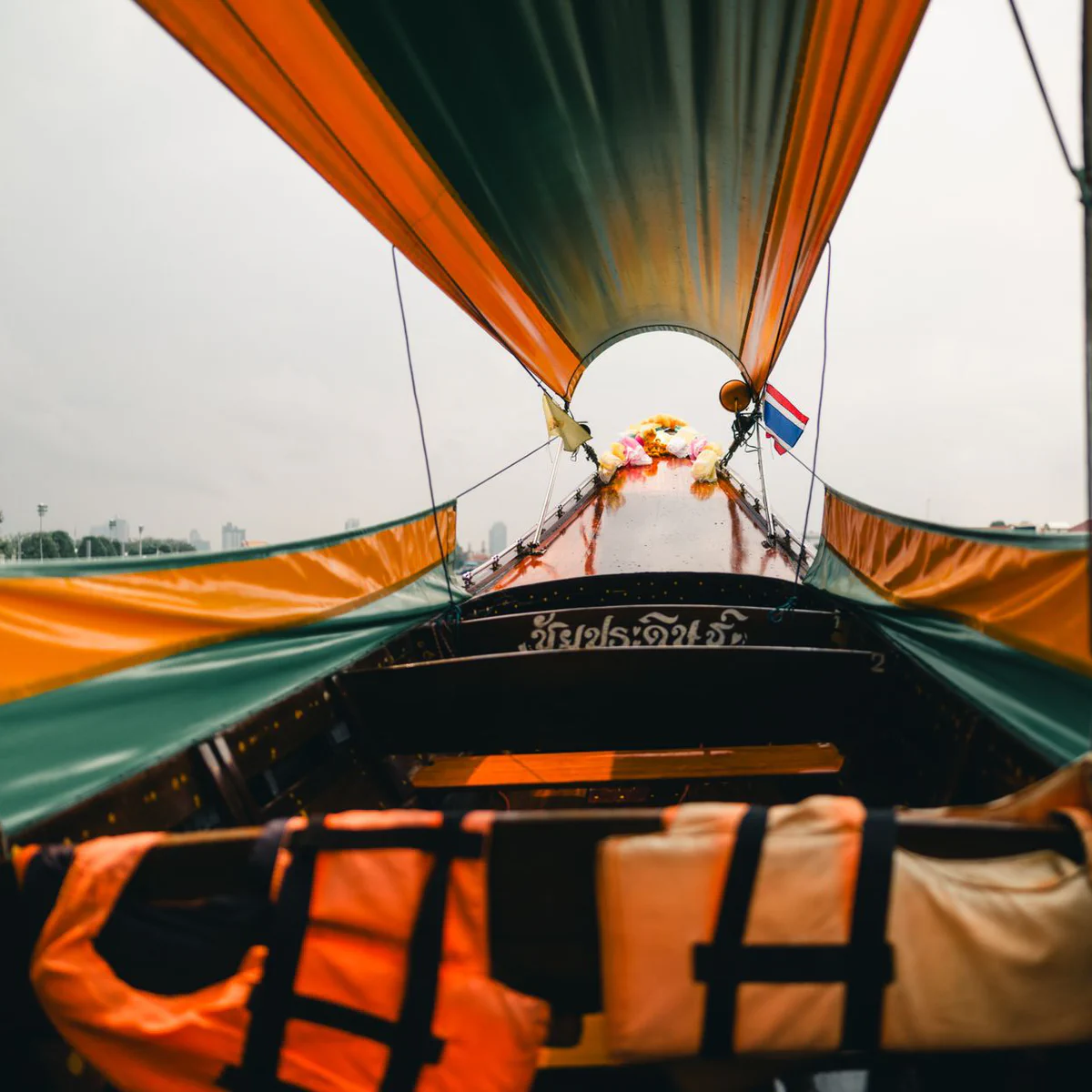
The smartest way to arrive is by water. Take the BTS Skytrain to Saphan Taksin and head straight for the Sathorn Pier. From there, hop on an orange-flag express boat heading north. You’ll disembark at Tha Chang Pier (N9), followed by a short ten-minute walk to the palace gates. It isn’t just a transport strategy; it’s the best introduction to the city. You’ll glide past ancient riverside temples and rickety wooden houses on stilts, arriving at the palace feeling like you’ve actually seen Bangkok rather than just the back of a driver’s head.
By taxi or rideshare
If the heat makes the boat trip sound like too much work, a metered taxi or a Grab is your next best bet. Tell the driver you’re heading to “Wang Luang.” Be prepared for a bit of a struggle over the meter—many drivers in this area will try to quote you a flat, inflated price. If they won’t budge, just hail another cab. Avoid a tuk-tuk for the journey to the palace; you won’t save any money, and you’ll likely spend the ride being pitched a “special tour” that you don’t want.
By bus
The local buses are the cheapest way to reach the palace, with fares often under 20 baht, but they are a puzzle even for long-time residents. You’ll need to figure out which numbers have air conditioning and which ones will leave you sweating in an open window. Unless you’re feeling particularly adventurous, the rail-and-boat combination is far more predictable.
Practical note on traffic
Traffic in the Old City doesn’t follow a logical schedule; it’s just varying degrees of bad. The river boat is the only mode of transport that bypasses this mess entirely. If you’re traveling during the morning or evening rush, the water is the only way to ensure you actually make it to the palace before the ticket office closes.
Opening hours and admission
Opening hours
The palace doors officially open at 8:30 AM and close at 4:30 PM, but the ticket office stops selling entries at 3:30 PM sharp. Don’t push your luck; if you arrive after 2:00 PM, you’ll be rushing through the complex in the worst of the afternoon heat. Give yourself at least two to three hours to actually see the grounds without feeling like you’re on a forced march.
Be aware that royal life takes precedence over tourism. The palace can close certain sections—or the entire complex—at very short notice for ceremonies or visiting dignitaries. These closures aren’t always reflected on Google Maps or in your guidebook. The only way to be sure is to check the official website (royalgrandpalace.th) the very morning you plan to go.
Ticket prices
For international visitors, the entry fee is a steep 500 baht. Thai citizens enter for free, and small children (under 120 cm) are also exempt from the fee. You can buy your tickets at the gate, or if you want to save a few minutes in the queue, book them online up to a month in advance. Just be certain of your dates, as online tickets are strictly non-refundable and cannot be changed once they are booked.
Your 500-baht ticket isn’t just for the palace; it’s a combined pass that covers the grounds, the sacred Wat Phra Kaew, and the Queen Sirikit Museum of Textiles. There is no way to buy a “partial” ticket just for the temple, so you might as well see all three while you’re there. The museum, in particular, is worth the stop—not just for the fabrics, but for the glorious air conditioning.
Make sure your wallet has a decent amount of Thai baht in cash. While the palace ticket office is modernizing, the smaller boat piers, street food stalls, and surrounding cafes are strictly cash-only. Don’t rely on a single credit card for your entire morning; having a backup payment method and enough cash for a taxi or a meal will save you from a stressful detour to an ATM in the middle of a hot day.
Is it worth 500 baht?
Is the 500-baht ticket worth it? If this is your first time in Bangkok and you want to see the pinnacle of Thai religious architecture and the incredible Ramakien murals, then yes, it is. But be honest with yourself: if you’re just after a quick selfie and don’t care about the history, it’s a lot of money and effort for a photo. If your group includes young children or anyone who can’t handle long walks in the direct sun, you might be better off skipping the palace and heading to Wat Pho instead—it’s cheaper, less crowded, and much easier to navigate.
Dress code: non-negotiable rules
The dress code at the Grand Palace is not a suggestion; it is a hard requirement that is strictly enforced at the gate. If you show up in the wrong gear, you will be turned away. It’s that simple.
You must have your shoulders and knees covered. This means no tank tops, no sleeveless shirts, and absolutely no shorts—even the ones that hit just above the knee. The rules also explicitly forbid ripped jeans, tight leggings, yoga pants, and anything see-through. While sandals and flip-flops are allowed, you’ll be taking your shoes off frequently to enter the buildings, so wear something that’s easy to slip on and off.
If you show up improperly dressed
Don’t assume you can just borrow a sarong at the entrance. The palace has moved away from providing loaner clothes, and relying on this is a gamble that usually ends in a second long queue or a forced purchase from an overpriced stall outside the gates. The best way to handle this is to dress correctly from the moment you leave your hotel. It saves time, money, and the embarrassment of being the person arguing with a security guard at the gate.
Practical tip
In this climate, your choice of fabric is everything. Wear lightweight, breathable cottons that cover what they need to without trapping the heat. Loose-fitting trousers or a long, airy skirt will be far more comfortable than tight activewear, which the guards will likely reject anyway. Remember that you’ll be walking on hot stone courtyards with very little shade. A wide-brimmed hat is a lifesaver, and while you’ll be removing your shoes to enter the temples, you still want something comfortable for the mile or two of walking you’ll do across the grounds.
Photography restrictions
Photography is strictly forbidden inside the sacred buildings, especially the Temple of the Emerald Buddha. You can snap as many photos as you like of the golden exteriors and the ornate courtyards, but once you step inside, put the camera away. The guards are very watchful, and trying to sneak a photo is seen as a major sign of disrespect. It’s better to just put the phone down and take a moment to actually look at the statue.
Also, don’t even think about bringing a drone. The entire palace complex and the surrounding government buildings are a strictly enforced no-fly zone. Leave the drone at your hotel; carrying it around all day will only get you flagged at the security screening.
What to see: key sights within the complex
The complex is huge, and trying to see every single building will leave you exhausted. Most people focus on a handful of key sights that represent the best of the palace’s history and art.

Wat Phra Kaew (Temple of the Emerald Buddha)
Wat Phra Kaew is the most significant temple in the country, home to the Emerald Buddha—which, despite the name, is actually carved from a single block of translucent jade. The statue is so revered that only the King is allowed to touch it. Three times a year, he personally changes the Buddha’s seasonal robes in a solemn ceremony. It is a small statue in a massive, ornate hall, but the atmosphere inside is incredibly powerful.
The temple itself is an explosion of color and gold. The roofs are layered with lively tiles, and the walls are covered in fine murals that tell the story of the Buddha’s life. Since you can’t take photos, you’re forced to actually stand there and soak in the details. It’s one of the few places in Bangkok where you’ll see everyone actually looking at the art rather than their screens.
The outer court and the wall murals
Encircling the temple is a long, shaded cloister that houses one of the most impressive artworks in Asia: the Ramakien murals. These paintings tell the epic story of the battle between good and evil, full of demons, monkey warriors, and celestial battles. It’s worth walking the entire circuit, even if you just skim the scenes. The level of detail is staggering—look closely and you’ll see tiny, perfectly rendered animals and everyday village scenes tucked away in the corners of the grand epic.
The Phra Mondop (library)
The Phra Mondop is a stunning library designed to hold sacred Buddhist texts. While you can’t go inside, the exterior is a clear example of Thai decorative art, covered in shimmering gold and intricate glass mosaics. It’s one of those buildings that looks different every time the sun moves, reflecting light in a hundred different directions.
Prasat Phra Thep Bidon (the Royal Pantheon)
The Royal Pantheon is a grand hall containing life-sized statues of all the previous kings of the current dynasty. It’s a place of deep national pride, but it’s rarely open to the general public. If you happen to be visiting on a major holiday like Chakri Day, you might get a rare glimpse inside.
The Upper Terrace
The Upper Terrace is where you’ll find the palace’s most famous skyline, including the massive Golden Stupa. It also holds a surprising detailed model of Angkor Wat, commissioned by King Rama IV. This terrace is the best place to get those wide-angle photos of the golden spires, but it’s also the most exposed part of the complex, so you’ll feel the sun here more than anywhere else.
The inner palace buildings
As you move toward the exit, you’ll pass the secular buildings of the palace. The Chakri Maha Prasat Hall is the most striking—it looks like a European palace that has been topped with traditional Thai spires. It’s a perfect visual metaphor for the 19th-century Thai monarchy’s effort to modernize while staying rooted in their own culture. Keep an eye out for the elephant statues guarding the base; they are a favorite for quick photos.
Queen Sirikit Museum of Textiles
Before you head back into the chaos of the city, stop by the Queen Sirikit Museum of Textiles. It’s included in your ticket and is home to royal gowns and traditional fabrics. For many visitors, the powerful air conditioning is just as welcome: sit for twenty minutes and let your core temperature drop before tackling the walk to the next destination.
Tips for visiting: timing, scams, and audio guides
Best time to visit
The window for a “pleasant” visit to the Grand Palace is very small. Between 10:00 AM and 1:00 PM, the tour buses arrive and the grounds become a sea of umbrellas and crowds. Be at the gates by 8:15 AM so you can be among the first through when they open at 8:30. You’ll get an hour of relatively quiet courtyards and slightly cooler air before the mid-morning rush hits. If you can, visit on a Tuesday or Wednesday; weekends and holidays are always significantly busier.
The heat factor
Don’t underestimate the Bangkok sun. The palace courtyards are vast, paved in stone, and offer almost no shade. Even in the “cool” season, you will feel the heat within thirty minutes. While you can buy water inside, it’s overpriced and the queues can be long—bring a large bottle of your own. Sunscreen and a hat aren’t optional here; they are survival tools. If you’re visiting during the rainy season, carry a light poncho, but know that a sudden downpour is often the only thing that actually clears the crowds.
Scam alert: the “closed” tactic
This is the oldest trick in the book, and yet people still fall for it every day. As you approach the entrance, someone—often dressed quite smartly and speaking excellent English—will tell you that the palace is closed. They’ll give a very plausible reason: a holiday you haven’t heard of, a royal visit, or a cleaning day. They will then offer to take you on a “special” tour of other temples for a tiny fee. Don’t believe them. The goal is to get you into a tuk-tuk and eventually into a gem shop or a tailor where they can earn a commission.
The fix is easy: don’t even engage. If someone approaches you, keep walking. The only person you should listen to is the uniformed guard at the actual gate. The palace is almost never closed unexpectedly. If you’ve checked the website and it says they are open, just keep moving until you reach the ticket counter.
Another variation: you might also hear the same “closed” lie at the boat pier. A tout will try to convince you to take a canal tour instead of walking to the palace. Again, just ignore them and head toward the palace walls. Once you see the white fortifications, you’ll know you’re in the right place.
Audio guides
If you want to understand the stories behind the murals and the symbolism of the buildings, the 200-baht audio guide is a solid investment. It’s available in most major languages, but you’ll need to leave your passport or a credit card as security. It’s a good way to pace yourself and actually learn something, rather than just wandering aimlessly through the heat.
Guided tours
If you prefer a human guide, only hire the ones who are officially sanctioned inside the palace grounds. Anyone who approaches you on the street claiming to be a “government guide” is almost certainly a tout. A real guide won’t start the conversation by telling you the palace is closed or trying to sell you a suit.
Compare independent, small-group and private Grand Palace routes
Booking a tour does not remove the dress code, heat or possibility of a ceremonial change. It buys interpretation and a prearranged meeting plan. The useful comparison is therefore not “ticket or no ticket,” but how much of the Old City you want a guide to structure and whether the selected package actually includes each attraction admission.
The two- to four-hour highlights walk is the lowest-commitment guided option. The shorter format concentrates on the Grand Palace and Wat Phra Kaew; the extended route can continue through Wat Pho and Wat Arun using local transport. It suits an independent traveler who wants explanation without committing the whole day to a vehicle tour. Check the exact package name before payment, because route length, languages and admission treatment can differ by option.
The four-hour royal-heritage circuit is a more structured shared choice covering the Grand Palace, Wat Pho and Wat Arun. It is useful when the three-temple sequence matters more than keeping the morning flexible. The product page reviewed on 31 August 2026 listed a one-day cancellation window, but the meeting point, departure minimum and inclusions still need a live check for your date.
Travelers who dislike a large or anonymous group have two further levels of control. A 4.5-hour walk capped at 15 keeps the transport simple but creates more room for questions. A private full-day temple route buys pace control and hotel transport for a family or small party. The private temple-and-canal day adds a river dimension, but it is only good value when the boat journey is a real priority rather than an extra attraction added to justify a higher price.
| Recommended Grand Palace tours | Tour format | Suits | Main trade-off |
|---|---|---|---|
| Two- or four-hour highlights walk · lowest guided commitment | Shorter and extended temple formats | Solo travelers and couples wanting context without giving away the day | Similarly named packages can include different temples, admissions and languages |
| Four-hour royal-heritage circuit · structured three-temple sequence | Grand Palace, Wat Pho and Wat Arun | First-time visitors who want one connected shared route | Fixed pace and less room to linger or leave early |
| 4.5-hour riverside temple walk · shared group capped at 15 | Grand Palace and riverside temples on foot and local transport | Travelers who want more guide access without private-tour pricing | More walking and heat exposure; the cap is not the same as a tiny private party |
| Eight-hour private temple day · family pace and hotel transport | Full-day private Grand Palace, Wat Pho and Wat Arun route | Families, older travelers and small groups splitting the per-party cost | High price and a long day; admissions, lunch and vehicle scope need a line-by-line check |
| 7.5-hour private temples-and-canal day · Old City plus river context | Private guide, temples and canal component | Visitors with one Bangkok day who genuinely prioritize both palace and waterways | Too much structure for slow travelers; the canal add-on is wasted if heat or jet lag cuts the day short |
| If this is your situation | Best starting choice | Why |
|---|---|---|
| You want to enter at opening and leave when the heat builds | Independent entry or the earliest two-hour walk | A long fixed circuit can keep you outside after your energy has gone |
| You want the murals explained but still watch the budget | Four-hour royal-heritage circuit | The guide is the main purchase; confirm that the selected package includes the palace admission you expect |
| You dislike large groups but do not need a vehicle | Walk capped at 15 | It pays for more guide access without turning the day into a private-car itinerary |
| A family needs toilet pauses, shade breaks or pacing control | Eight-hour private temple day | Private control matters more than the nominal attraction count |
| You have only one full day and the canals are non-negotiable | Private temples-and-canal day | It solves several transfers, but only if the group can comfortably sustain the full route |
| You have mobility, allergy, language or strict timing needs | Ask the selected operator in writing before booking | A generic “half day” label does not answer steps, shade, food or return-time questions |
Toilets, bags, and belongings
There are toilets inside, but try to use the ones near the entrance before you get deep into the complex. Consider leaving any large bags at your hotel. Security screening is thorough, and lugging a heavy backpack through a crowded, hot courtyard is a recipe for a bad mood. Keep your water and valuables in a small, light bag that won’t weigh you down.
Nearby attractions: extending your visit
The palace is just the beginning of what the Old City has to offer. Because you’re already in the district, it makes sense to pair your visit with two other iconic temples that are just a short walk or ferry ride away.
Wat Pho (Temple of the Reclining Buddha)
Just ten minutes south of the palace is Wat Pho, home to the massive, gold-leaf-covered Reclining Buddha. It’s a much more relaxed experience than the Grand Palace, with sprawling grounds and beautiful stupas. It’s also the headquarters for traditional Thai massage—if your legs are starting to fail you after the palace tour, this is the place to get them fixed. The entry fee is 300 baht, and it’s worth every penny just for the calmer atmosphere.
Wat Arun (Temple of Dawn)
Once you’ve seen Wat Pho, walk to the Tha Tien Pier and catch the five-baht ferry across the river to Wat Arun. The crossing takes only a couple of minutes but offers the best view of the temple’s iconic porcelain-covered spire. If you have the energy, climb the steep stairs for a view over the river—it’s the perfect place to see the Grand Palace from a distance and realize just how massive the complex actually is.
Other nearby options
If you want to escape the tourist trail, the nearby Thammasat University campus offers a quiet, leafy retreat. For something completely different, Khao San Road is a twenty-minute walk north—it’s a chaotic hub of backpacker culture, cheap beer, and street food that couldn’t be further from the quiet reverence of the palace. If you have any energy left, take a short boat ride to the Royal Barges Museum to see the incredible, ornate boats used in the King’s processions; they are masterpieces of woodcarving that many visitors completely miss.
Suggested half-day itinerary
Following this schedule allows you to see the big three—the Palace, Wat Pho, and Wat Arun—before the afternoon humidity becomes completely unbearable and the biggest crowds arrive. It’s a full morning, but it’s the most efficient way to see the heart of old Bangkok.
Practical considerations and uncertainties
Cash and ATMs
Keep a pocketful of small notes. You’ll need them for the river boats, the cross-river ferry, and the inevitable cold drinks you’ll buy along the way. While there are ATMs around, you don’t want to be hunting for one in the middle of your morning—it’s a waste of the few “cool” hours you have. Come prepared with cash, and you’ll have a much smoother day.
What is not confirmed
A few final checks: small children (under 120 cm) get in for free, and you should confirm the current audio guide price when you arrive. Remember that state functions are the only thing that will truly close the palace, so always check the website. Also, be aware that the grounds are full of uneven stones, high steps, and steep ramps. If you’re traveling with a wheelchair, it’s a difficult route—contacting the palace staff in advance to see what assistance they can provide for your specific visit.
Summary of key details
| Detail | Information |
|---|---|
| Opening hours | 8:30 AM to 4:30 PM daily; ticket sales until 3:30 PM |
| Ticket price (foreign adults) | 500 baht |
| Ticket price (Thai nationals) | Free with valid ID card |
| Dress code | Shoulders and knees covered; no sleeveless, no shorts, no ripped jeans, no sheer fabrics |
| Audio guide rental | 200 baht; eight languages; passport or credit card required |
| Best time to visit | Early morning, 8:30 AM opening, weekdays preferred |
| How to get there (public transport) | BTS to Saphan Taksin, then Chao Phraya Express Boat (orange flag) to Tha Chang Pier (N9) |
| Scam awareness | Ignore anyone claiming the palace is closed; proceed directly to the ticket counter |
| Nearby attractions | Wat Pho (10-minute walk), Wat Arun (ferry from Tha Tien Pier) |
Official checks
Fit the visit into the Bangkok one-day itinerary, compare it with Wat Pho, and use Getting Around Bangkok to avoid a long midday walk or an unnecessary taxi negotiation.
Checked details
Prices and opening hours
Checked 20 August 2026
- Grand Palace opening hours
- Daily, 8:30 AM–4:30 PM; tickets sold until 3:30 PM
- Verify with Grand Palace official FAQ
- Grand Palace admission
- 500 THB for foreign visitors; children under 120 cm enter free
- Verify with Grand Palace official FAQ
Live prices, closures and admission conditions can change after the checked date. Use the linked operator page before booking or departure.
Quick answers
Frequently asked questions
Is the Grand Palace open every day?
How much does it cost to enter the Grand Palace?
What is the dress code at the Grand Palace?
Can I take photos inside the Temple of the Emerald Buddha?
How can I avoid scams at the Grand Palace?
Research notes
Official planning references
We use these primary references for the time-sensitive details relevant to this guide. Rules, prices and operating hours can change, so confirm the live information before you travel.
- Tourism Authority of Thailand
Details to check: Official destination information and trip-planning context
- BTS Skytrain
Details to check: Official Bangkok rail routes, stations and fares
Guide reviewed 31 August 2026. Confirm live rules, prices and operating details with the linked authority before travel.