
Don Mueang Airport to Bangkok: Train, Bus, Taxi & BKK Transfer
Compare DMK-to-Bangkok routes by hotel area, then plan the Don Mueang-Suvarnabhumi transfer, late arrival or a realistic Bangkok layover.


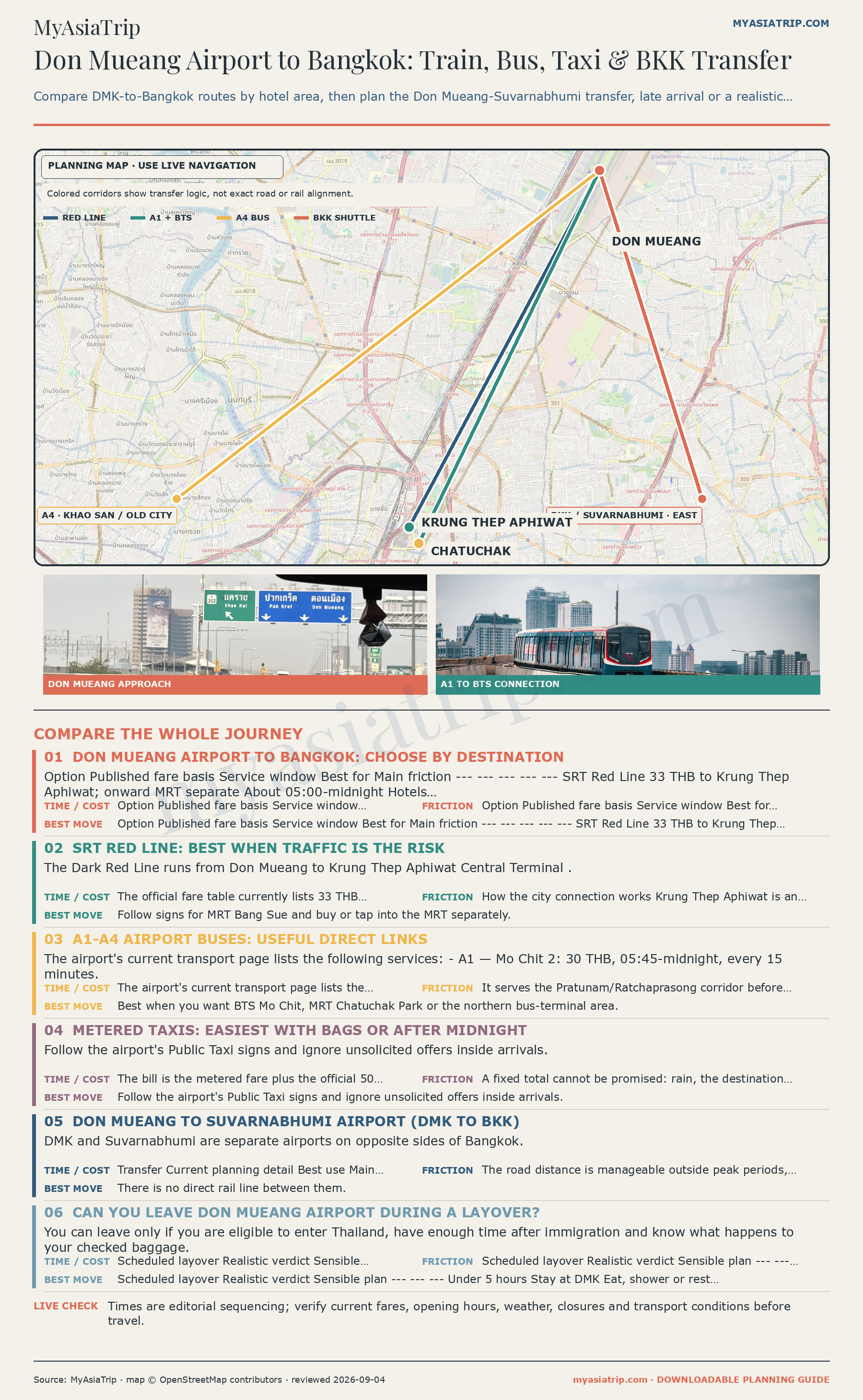
Choose the SRT Red Line if Bangkok traffic is heavy and your hotel is near the MRT. Choose A1 for Mo Chit, A4 for Khao San Road and the Old City, and a metered taxi or app-booked car when luggage, children or a late arrival make transfers feel like false economy.
Don Mueang International Airport (DMK) is north of central Bangkok. The airport is not difficult, but the best option changes with your destination: the train is predictable, the airport buses can remove a transfer, and a road journey can be either painless or slow depending on the hour and rain.
Don Mueang Airport to Bangkok: choose by destination
| Option | Published fare basis | Service window | Best for | Main friction |
|---|---|---|---|---|
| SRT Red Line | 33 THB to Krung Thep Aphiwat; onward MRT separate | About 05:00-midnight | Hotels near MRT; rush-hour arrivals | One interchange before most central areas |
| A1 bus | 30 THB | 05:45-midnight; every 15 min | Mo Chit BTS/MRT and northern Bangkok | Traffic and limited luggage room |
| A2 bus | 30 THB | 06:00-23:00; every 15 min | Victory Monument | Longer road exposure than A1 |
| A3 bus | 50 THB | 06:00-23:00; every 30 min | Pratunam and Lumphini | Central traffic can erase the convenience |
| A4 bus | 50 THB | 06:00-23:00; every 30 min | Khao San Road and Sanam Luang | Slowest when Old City roads are congested |
| Metered taxi | Meter + 50 THB airport surcharge + tolls; some luggage fees may apply | 24 hours | Door-to-door travel, families, heavy bags | Queue and journey time vary with traffic |
| Ride-hailing | Live app quote + any tolls | 24 hours, subject to driver supply | Upfront quote and pinned destination | Pickup coordination and surge pricing |
| DMK-BKK shuttle | Free for eligible connecting passengers | 05:00-midnight | A flight departing from the other airport | Not a general free transfer into Bangkok |
Times and fares above are the official published details checked on 4 September 2026. Treat them as planning figures and recheck the linked operator pages on your travel day.
Match the option to your hotel area
The cheapest vehicle is not always the cheapest journey. Count the final rail change, pavement walk and the point at which you will have to carry a suitcase through a station.
| Hotel area | Usually start with | Why | When to switch |
|---|---|---|---|
| Chatuchak / Mo Chit | A1 bus | Direct airport-bus corridor with no central detour | Use Red Line if road traffic is already severe |
| Sukhumvit / Asok | Red Line + MRT | Traffic-resistant and the MRT reaches Sukhumvit directly | Use taxi after midnight or with several bags |
| Silom / Sala Daeng | Red Line + MRT | One rail interchange and no dependence on the expressway | A3 may suit a light-bag traveler who dislikes changing trains |
| Siam / Ratchaprasong | A1 + BTS or A3 | A1 gives a frequent BTS connection; A3 removes the rail change | Taxi may win for three or four people outside peak traffic |
| Khao San / Banglamphu | A4 | It is the only airport bus aimed at the Old City corridor | Take a taxi when A4 has ended or the group is exhausted |
| Riverside | Taxi or Red Line + final taxi | Most riverside hotels are awkward from a single public-transport line | Ask the hotel which entrance or pier is usable with luggage |
If your hotel advertises itself as “near BTS” or “near MRT,” look up the walking route from the actual station exit. A 700-meter walk that seems minor at home can mean broken pavement, stairs and sweat after a flight.
Don Mueang Airport to Sukhumvit and Asok
For a solo traveler with manageable luggage, use the SRT Red Line to Krung Thep Aphiwat, follow signs to MRT Bang Sue, then stay on the Blue Line to Sukhumvit. You buy the Red Line and MRT legs separately. This route is more predictable than the road during weekday peaks, but the interchange is large and the walk from Sukhumvit MRT to a deep-soi hotel may be the hardest part.
Choose a taxi or app car after midnight, with two large bags, or when three or four people can split the fare. Enter the exact hotel pin: “Sukhumvit” covers a long corridor, and the wrong soi entrance can add another slow loop through traffic.
Don Mueang Airport to Siam, Pratunam and Ratchaprasong
For Siam, A1 to Mo Chit followed by the BTS is easy to understand and avoids navigating the large Bang Sue interchange. The Red Line plus MRT/BTS chain is steadier in severe traffic but involves more wayfinding. For Pratunam or Ratchaprasong, A3 removes the rail change, though the final road section can be slow exactly when you most want to use it.
If arriving with a family, compare one taxi with four public-transport fares plus the final walk. Around the evening rush, the rail route may still be faster; late at night, a car usually wins on effort.
Don Mueang Airport to Khao San Road, Chinatown and the Old City
Use A4 toward Sanam Luang for Khao San Road and Banglamphu while it is operating. It costs more than A1 but avoids an awkward final transfer into an area without direct BTS access. In heavy Old City traffic, it is not fast—only direct.
For Bangkok Chinatown, the traffic-resistant route is Red Line to Krung Thep Aphiwat, then MRT Blue Line to Wat Mangkon. For the Grand Palace or Wat Pho, A4 is the simpler bus; for an early temple appointment or several bags, a taxi is more dependable door to door.
Don Mueang Airport to Silom and the riverside
For Silom, take the Red Line and MRT Blue Line to Si Lom. A3 can suit a light-bag traveler whose accommodation lies near its central corridor, but it remains exposed to road congestion.
The riverside is too broad for one public-transport answer. A hotel near Saphan Taksin differs from one near the Old City or on the west bank. Ask the hotel for the correct road entrance, then compare Red Line plus a final taxi with one airport taxi. Do not arrive at a commuter pier assuming a suitcase-friendly boat will still be running.
SRT Red Line: best when traffic is the risk
The Dark Red Line runs from Don Mueang to Krung Thep Aphiwat Central Terminal. It is the calmest choice during weekday peaks or a downpour because the trip does not depend on the expressway.
How the city connection works
Krung Thep Aphiwat is an interchange, not the tourist center. Follow signs for MRT Bang Sue and buy or tap into the MRT separately.
- Sukhumvit or Silom: continue on the MRT Blue Line to Sukhumvit or Si Lom.
- Chinatown: stay on the Blue Line to Wat Mangkon.
- Siam: one workable route is MRT to Chatuchak Park, then BTS from Mo Chit; with large luggage, a taxi from Krung Thep Aphiwat may feel easier.
The official fare table currently lists 33 THB from Don Mueang to Krung Thep Aphiwat. Do not plan around the older 20-baht promotional figure. Red Line and MRT fares are separate.
Finding the station
From either terminal, follow the overhead SRT Red Line signs toward the enclosed connection. Allow extra time from an international baggage belt: the route is longer than stepping outside to the taxi rank, even though much of it is indoors and step-free. Elevators are available, but anyone who cannot comfortably manage a transfer with luggage may still prefer a taxi.
A1-A4 airport buses: useful direct links
The airport’s current transport page lists the following services:
- A1 — Mo Chit 2: 30 THB, 05:45-midnight, every 15 minutes. Best when you want BTS Mo Chit, MRT Chatuchak Park or the northern bus-terminal area.
- A2 — Victory Monument: 30 THB, 06:00-23:00, every 15 minutes. Use it when Victory Monument is genuinely near your accommodation; otherwise A1 plus rail is often clearer.
- A3 — Lumphini Park: 50 THB, 06:00-23:00, every 30 minutes. It serves the Pratunam/Ratchaprasong corridor before Lumphini, but city traffic is the trade-off.
- A4 — Sanam Luang: 50 THB, 06:00-23:00, every 30 minutes. It is the practical public-transport choice for Khao San Road, Banglamphu and the Old City.
For Terminal 1, the official bus page identifies Level 1, Gate 6. AOT’s accessibility guidance identifies the Terminal 2 boarding point as Level 3, Door 8. Airport pages and signs have not always been consistent, so follow the live terminal signage rather than walking to an old gate number from a blog.
Pay the conductor on board and carry small cash. These are city buses, not coaches: luggage space can fill quickly, boarding may involve a step, and standing is possible at busy times. A taxi is the kinder choice for a wheelchair user unless the specific bus and stop arrangement has been confirmed.
Metered taxis: easiest with bags or after midnight
Follow the airport’s Public Taxi signs and ignore unsolicited offers inside arrivals. AOT lists the official counters at:
- Terminal 1: Level 1, Gate 8.
- Terminal 2: next to Gate 15, beneath the seven-storey parking building.
The service operates 24 hours. The bill is the metered fare plus the official 50 THB airport surcharge, and the passenger pays expressway tolls. AOT also publishes limited luggage charges for oversized bags, more than two standard bags, and large sports equipment, so a small extra fee is not automatically a scam.
Keep your queue slip until the journey ends. Show the driver your hotel name and pin in Thai if possible, and ask before entering whether you will use the tollway. A fixed total cannot be promised: rain, the destination and time in traffic all matter.
Ride-hailing: convenient, not automatically cheaper
Grab, Bolt and local app-based services can remove the language friction because the destination and quote appear in the app. Compare the live quote with the taxi queue rather than assuming one is always cheaper. Confirm the terminal, level and numbered pickup zone before requesting the car; a driver waiting on another level can turn a simple pickup into a humid 15-minute phone call.
Don Mueang to Suvarnabhumi Airport (DMK to BKK)
DMK and Suvarnabhumi are separate airports on opposite sides of Bangkok. There is no direct rail line between them. The road distance is manageable outside peak periods, but rain or expressway congestion can turn an ordinary transfer into the most fragile part of a self-connected itinerary.
| Transfer | Current planning detail | Best use | Main risk |
|---|---|---|---|
| Free AOT shuttle | Connecting passengers only; proof of onward flight and passport/ID required | Eligible traveler with a generous connection | Published AOT pages currently disagree on the first and last bus |
| Public van 555 | 60 THB; official page lists 06:00-19:00 | Passenger without shuttle eligibility and light luggage | Less frequent and unsuitable for a tight flight connection |
| Metered taxi / app car | Meter or live quote, plus any tolls and airport fees | Door-to-door speed, family or heavy bags | Traffic remains unpredictable |
| Rail through Bangkok | Red Line, MRT and Airport Rail Link with multiple changes | Only when road conditions are exceptional and time is ample | Too much interchange friction for a close connection |
Free airport shuttle: eligibility and boarding points
The free AOT shuttle is for passengers connecting to a flight at the other airport, not a general free bus across Bangkok. Bring your passport or ID plus a valid ticket, e-ticket or boarding pass for the onward flight.
- At DMK: AOT lists Terminal 1 Gate 3 and Terminal 2 Gate 14.
- At BKK: AOT lists Level 2, Gate 3.
- Frequency: generally published as every 30 minutes.
There is an important official inconsistency: the DMK route description says 05:00-midnight, while live schedule panels on the same airport page showed 06:00-22:00 during this review. The BKK airport page publishes 05:00-midnight. If you need the first or last bus, confirm at the airport instead of treating either edge time as guaranteed.
Paid van, taxi and rail alternatives
AOT’s current page lists public van 555 between the two airport bus terminals for 60 baht, from 06:00 to 19:00, normally hourly and more frequently in peak periods. It is a passenger service rather than the restricted connecting-flight shuttle, but the additional terminal transfer and limited luggage space make it a poor rescue plan for a close flight.
A taxi or app-booked car is the clearest fallback. Budget roughly 45-90 minutes on the road in ordinary conditions, then add time for the taxi queue, tolls and traffic volatility. A rail-only chain requires several systems and is not sensible for a tight self-transfer.
How much connection time do you need?
For separate tickets, allow at least four hours, but do not treat that as a guarantee. Five to six hours is safer during weekday peaks, rainy periods, international arrival processing or when baggage is not checked through. Count:
- immigration and baggage collection at the first airport;
- queue and road time between airports;
- the second airline’s check-in and bag-drop deadline;
- security and, for an international departure, outbound immigration.
If missing the second flight would be expensive, stay overnight near the departure airport rather than trusting the minimum. For BKK city-transfer options, use the Suvarnabhumi Airport guide.
Can you leave Don Mueang Airport during a layover?
You can leave only if you are eligible to enter Thailand, have enough time after immigration and know what happens to your checked baggage. A long gap printed on one itinerary is not the same as usable city time.
| Scheduled layover | Realistic verdict | Sensible plan |
|---|---|---|
| Under 5 hours | Stay at DMK | Eat, shower or rest airside/landside as your ticket allows |
| 5-7 hours | Nearby outing only | IT Square or a local meal; avoid the Old City |
| 7-9 hours | One rail-connected area | Ari, Siam, or Chatuchak only when the market is actually open |
| 9+ hours | Compact city visit possible | Choose one district and one meal, then return early |
Before leaving, subtract arrival processing, both airport-city journeys, a return buffer and your airline’s check-in cutoff. Travelers on separate tickets may need to collect bags and check in again; through-checked baggage and boarding-pass rules depend on the airlines, not the airport guide.
Three realistic DMK layover ideas
- Ari meal and walk: one of the lowest-friction city tastes from the northern rail corridor. It is better for food and cafes than headline sightseeing.
- Chatuchak: useful only on the market’s correct opening day and during opening hours. Do not build a weekday layover around the weekend market.
- Siam: one BTS-accessible shopping and food stop with predictable indoor shelter. Return before rush-hour uncertainty consumes the buffer.
Do not attempt Grand Palace, Wat Arun and Chinatown on one airport layover. The map makes them look close; ticket queues, heat, river crossings and the return journey make that plan brittle.
Terminal and late-arrival reality
Terminal 1 serves international flights and Terminal 2 serves domestic flights. They connect indoors, but walking from one end of the airport to a train, bus or pickup point still takes time when a flight unloads at once.
- Before the last public transport: choose the mode by destination, not headline fare.
- After midnight: go to the official taxi queue or arrange an app pickup.
- Early departure: staying near DMK can be worth one plain night of sleep. The Amari Don Muang Airport Bangkok is connected by a covered walkway, but confirm the current route and access hours with the hotel.
- Cash and data: obtain enough connectivity to load your hotel pin and enough small cash for a bus, toll or taxi fallback. Airport booths and machines change; avoid building the plan around one named counter.
Arriving early, late or during a flight wave
An arrival time on the ticket is not the time you reach transport. Immigration, a remote stand, baggage delivery and the walk across the terminal can easily consume the margin before the last train or bus. If a scheduled landing is within 90 minutes of the final service, save a taxi fallback before flying rather than assuming the public-transport plan will work.
At the opposite extreme, an early-morning arrival may place you in the terminal before your preferred bus or train has settled into its normal frequency. Sit inside until you have connectivity, confirm the first departure and only then walk to the stop. Waiting in air conditioning is better than standing outside with luggage beside the wrong door.
Several low-cost flights landing together can fill the taxi hall and app pickup zones at once. Check the live Red Line or bus option before committing to a long queue. If traffic is light and the taxi line is moving, however, saving 100 or 150 THB may not justify two transfers after an overnight flight.
Luggage, children and accessibility
The Red Line station route has elevators, but a nominally step-free trip is not automatically an easy trip. You still need to move through a large interchange, buy or tap into a second system and reach the correct exit near the hotel. Leave both hands free where possible and keep one adult responsible for children while the other handles tickets and bags.
Airport buses can be excellent value with a backpack. With a large suitcase, the open luggage area may already be full, and boarding is closer to a city bus than an airport coach. Do not place a bag where it blocks the aisle or emergency exit. If the group includes a wheelchair user, contact the airport assistance service before travel and confirm the actual vehicle and boarding point; “accessible transport available” does not guarantee that every departure has the same equipment.
For a family of three or four, compare the whole group cost. A taxi can become reasonable once separate train and MRT fares, a last-mile ride and the effort of managing tired children are included. Bring a suitable child restraint if it is essential to you; do not assume an airport taxi carries one.
Payment and backup checklist
Before leaving arrivals, keep a screenshot of the hotel name, full address and map pin. Carry small Thai notes for airport buses, tolls and situations where a card reader is unavailable. Contactless acceptance differs between systems, and a foreign bank may decline a tap even when the gate supports EMV.
Do not exchange a large trip budget solely for the transfer. You need enough cash for the chosen route plus a fallback, not a second financial decision while jet-lagged. Keep the passport, phone and taxi queue slip on your body rather than in luggage stored away from your seat.
Which option should you choose?
- Solo, light luggage, hotel near MRT: Red Line.
- Mo Chit or easy BTS connection: A1.
- Khao San Road or Old City: A4 when it is operating; taxi when tired or late.
- Family, mobility limitation or several bags: official taxi or pre-arranged accessible vehicle.
- Flight at Suvarnabhumi: free shuttle only if eligible; otherwise compare a taxi with rail-based routes and leave a generous buffer.
Continue with the Bangkok transport guide for BTS, MRT, boats and payment, or use the Bangkok where-to-stay guide to choose a base that reduces transfers after arrival.
Quick answers
Frequently asked questions
What is the best way from Don Mueang Airport to central Bangkok?
How much is the Red Line from Don Mueang?
Which Don Mueang airport bus goes to Khao San Road?
Is the DMK-BKK airport shuttle free?
How long does it take to transfer from Don Mueang to Suvarnabhumi?
Can I leave Don Mueang Airport during a layover?
Can I leave Don Mueang Airport after midnight?
Research notes
Official planning references
We use these primary references for the time-sensitive details relevant to this guide. Rules, prices and operating hours can change, so confirm the live information before you travel.
- Airports of Thailand (AOT) — Don Mueang BMTA airport buses
Details to check: Official A1-A4 routes, fares, frequencies, service windows and Terminal 1 boarding point; checked 2026-09-04.
- Airports of Thailand (AOT) — Don Mueang metered taxis
Details to check: Official taxi locations, 24-hour operation, airport surcharge, toll and luggage-charge rules; checked 2026-09-04.
- Airports of Thailand (AOT) — accessible transport at DMK
Details to check: Terminal 2 bus access, accessible transport overview and connecting-passenger shuttle conditions; checked 2026-09-04.
- SRT Electrified Train (SRTET) — Red Line fares
Details to check: Official Red Line fare table, including Don Mueang to Krung Thep Aphiwat; checked 2026-09-04.
- Airports of Thailand (AOT) — DMK-BKK inter-airport shuttle
Details to check: Official DMK boarding points and published shuttle frequency; checked 2026-09-04. The route copy and live schedule panels showed conflicting service windows.
- Suvarnabhumi Airport (AOT) — airport transportation
Details to check: Official BKK boarding point, shuttle eligibility, document requirements, service window and frequency; checked 2026-09-04.
- Airports of Thailand (AOT) — public van 555
Details to check: Official paid DMK-BKK public van fare, operating window and frequency; checked 2026-09-04.
Guide reviewed 4 September 2026. Confirm live rules, prices and operating details with the linked authority before travel.