Bangkok Itinerary 7 Days: A Slower City and Day-Trip Plan
Spend one week in Bangkok with neighborhood days, temple and food routes, recovery time and one deliberate day trip instead of seven overloaded checklists.


A week in Bangkok is a luxury that lets you move past the “checklist” phase of travel. By Day 3, you should be able to slow down and start treating the city as a collection of neighborhoods rather than a sequence of attractions. The real advantage of seven days is the ability to return to a favorite street food stall or take a long day trip without feeling like you’ve sacrificed the rest of your trip. If you’re looking for a denser route that hits just the main contrasts, you might be better served by our Bangkok 5-day itinerary.
How to use this Bangkok itinerary: 7 days with room to recover
One week is long enough to stop fighting the city and start working with its rhythm. Give each day a single geographic anchor, protect your afternoons from the brutal heat, and leave at least one day completely flexible. This plan assumes you’re staying near a BTS, MRT, or a useful river pier; if your hotel depends on taxis, you’ll likely find the cross-city travel much more draining than you expected.
Book only the most time-sensitive experiences—like a specific cooking class or a high-end rooftop—before you arrive. Everything else, from neighborhood walks to market visits, should stay movable. This way, your week can respond to the reality of Bangkok’s tropical rain and your own energy levels.
Choose your day-trip destination early, but don’t make it an emotional obligation. Ayutthaya is magnificent, but a tired group will gain much more from a slow morning and a good massage than from a 7:00 AM train followed by hours in the sun. Be honest with yourself about how you’re feeling.
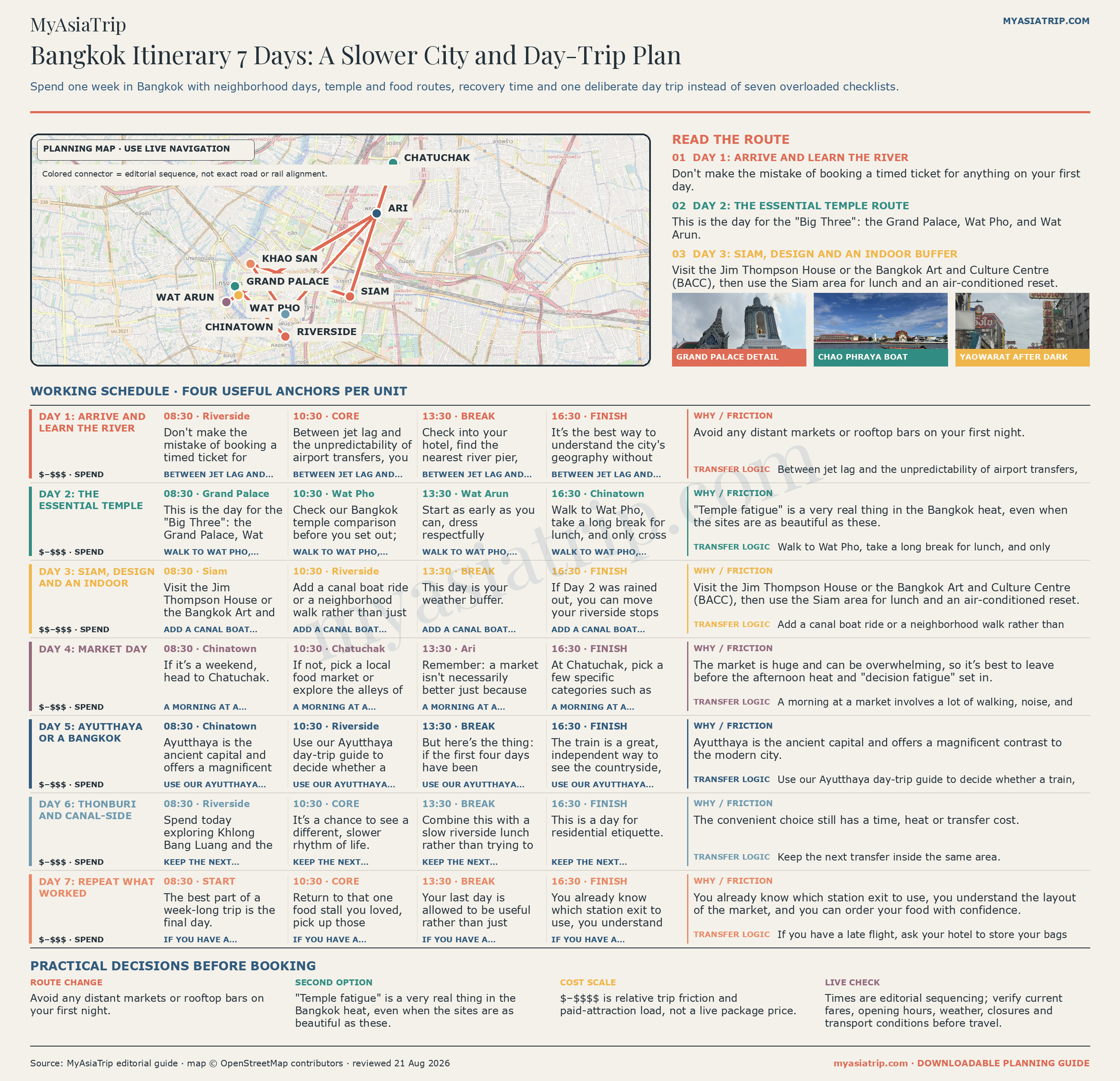
Seven days at a glance
| Day | Area or decision | Core plan |
|---|---|---|
| 1 | Riverside | Arrival, boat orientation and early night |
| 2 | Old City | Grand Palace, Wat Pho and Wat Arun |
| 3 | Siam and canals | Jim Thompson House, Siam and an indoor break |
| 4 | Markets | Chatuchak on a weekend or a neighborhood market route |
| 5 | Day trip | Ayutthaya, or stay in Bangkok if energy is low |
| 6 | Thonburi | Khlong Bang Luang, local streets and a flexible evening |
| 7 | Favorite district | Return, shop, eat and prepare to leave |
Days 1–3 are for the essentials. Days 4–6 are for seeing different versions of the city. Day 7 is your buffer—it’s there to absorb any delays from rain, to revisit a favorite market, or to just make your departure day a little easier. If your flight schedule cuts into your time, always remove an optional extension rather than trying to compress the whole week.
Day 1: arrive and learn the river
Don’t make the mistake of booking a timed ticket for anything on your first day. Between jet lag and the unpredictability of airport transfers, you need a soft landing. Check into your hotel, find the nearest river pier, and take a short public boat ride. It’s the best way to understand the city’s geography without having to think too hard.
Use this first afternoon to identify your nearest station, buy some water, and find an easy spot for breakfast tomorrow. A slow walk along the river will tell you more about the city than a dozen taxi windows. If you arrive late, just grab a quiet dinner near your hotel and save the orientation for tomorrow morning.
Avoid any distant markets or rooftop bars on your first night. Bangkok traffic is a beast, and missing a reservation because your flight was delayed or your bags were slow is a stressful way to start a holiday.
Day 2: the essential temple route
This is the day for the “Big Three”: the Grand Palace, Wat Pho, and Wat Arun. Check our Bangkok temple comparison before you set out; it’ll help you decide if you really want to see all three or if one might be enough for your group.
Start as early as you can, dress respectfully (shoulders and knees covered), and decide if you’re up for the full Grand Palace experience. Walk to Wat Pho, take a long break for lunch, and only cross the river to Wat Arun if you still have the attention span for another major site. “Temple fatigue” is a very real thing in the Bangkok heat, even when the sites are as beautiful as these.
After a hotel break in the late afternoon, head to Chinatown for dinner. It’s geographically close to the Old City and keeps your day from feeling like a series of long, hot transfers.
Day 3: Siam, design and an indoor buffer
Visit the Jim Thompson House or the Bangkok Art and Culture Centre (BACC), then use the Siam area for lunch and an air-conditioned reset. Add a canal boat ride or a neighborhood walk rather than just spending the day in another mall.
This day is your weather buffer. If Day 2 was rained out, you can move your riverside stops to this morning and shorten your time in Siam. If everyone is feeling the heat, keep the museum visit, have a long, slow meal, and maybe do a bit of shopping.
The canal boats are a great way to see the “backstage” of the city, but they can be a bit frantic. If you’re carrying large bags or have limited mobility, you might find the BTS or a short walk more comfortable.
Day 4: market day
If it’s a weekend, head to Chatuchak. If not, pick a local food market or explore the alleys of Talat Noi. Remember: a market isn’t necessarily better just because it’s far away or full of tourists.
At Chatuchak, pick a few specific categories such as ceramics or clothing and set a clear meeting point. The market is huge and can be overwhelming, so it’s best to leave before the afternoon heat and “decision fatigue” set in. On a weekday, Talat Noi offers a slower walk through the city’s Chinese-Thai heritage and street-art lanes.
Keep your evening plans light. A morning at a market involves a lot of walking, noise, and bargaining; sometimes a quiet dinner near your hotel is exactly what you need to recharge for the second half of the week.
Day 5: Ayutthaya or a Bangkok recovery day
Ayutthaya is the ancient capital and offers a magnificent contrast to the modern city. Use our Ayutthaya day-trip guide to decide whether a train, a private driver, or a guided tour is right for you. But here’s the thing: if the first four days have been exhausting, don’t feel guilty about staying in the city.
The train is a great, independent way to see the countryside, while a private car simplifies the transfers between the spread-out ruins. Be cautious about renting a bicycle unless you’re very comfortable with the sun and the local traffic—it looks picturesque in photos but can be brutal in practice.
A “recovery day” in Bangkok can be just as rewarding as a day trip. Sleep in, do your laundry, find a reputable massage spot, or just revisit a favorite corner of Chinatown. Protecting your energy for the final two days is never a waste of time.
Day 6: Thonburi and canal-side Bangkok
Spend today exploring Khlong Bang Luang and the quiet canal communities on the west bank. It’s a chance to see a different, slower rhythm of life. Combine this with a slow riverside lunch rather than trying to hit five different stops.
This is a day for residential etiquette. Keep your voice down and your camera respectful around the homes, schools, and temples along the water. While private tours can make access easier, remember that these are active neighborhoods, not a performance for tourists.
Try to return across the river before you commit to a big evening plan. If you still have the gas, choose one great rooftop bar or a jazz club. If not, a quiet meal near your hotel is a perfectly fine way to wrap up the week.
Day 7: repeat what worked
The best part of a week-long trip is the final day. Return to that one food stall you loved, pick up those last-minute gifts, and give yourself a huge buffer for the airport. Your last day is allowed to be useful rather than just “impressive.”
Repeat visits have a lot of value. You already know which station exit to use, you understand the layout of the market, and you can order your food with confidence. Use that ease to enjoy a final meal rather than stressing over a new, remote attraction that creates departure risk.
If you have a late flight, ask your hotel to store your bags and calculate your airport journey from the time you collect them, not from your last stop. A sudden tropical downpour or the evening rush hour can easily double your travel time, so give yourself plenty of room.
One-week variations
If you’re traveling as a family, consider swapping the long day trip for something in our Bangkok family guide. Food lovers should add a market tour or a hands-on Thai cooking class in Bangkok only if the experience offers something beyond just ordering from a menu. Returning visitors can skip the Grand Palace and spend that time in Ari or Thonburi instead.
For families
Stick to one major activity per day and always have a pool or an air-conditioned break on the schedule. Treat the boats and trains as part of the fun rather than just a way to get around. A full day in the sun at Ayutthaya might be a bit much for younger kids, so consider a shorter riverside outing instead.
For food-focused travelers
Keep your meals tied to the neighborhoods you’re already exploring so you aren’t crossing the city for a single famous stall. Leave several meals completely unplanned—the best food in Bangkok is often the stall you stumble upon because it’s packed with locals.
For repeat visitors
Don’t feel like you have to do the “Big Three” again. Use your week to explore neighborhoods like Ari, Talat Noi, or the deeper parts of Thonburi. The seven-day structure still works even when you swap the famous stops for more niche ones.
Budget and transport strategy for a week
On a long stay, your hotel’s location becomes your most important decision. A room near a BTS or MRT station might cost more per night, but it will save you hours of uncertainty and the stress of trying to find a taxi in the rain. Use the trains and boats for the main corridors, and only take a taxi when it solves a specific gap.
Budget separately for your day trip, your shopping, and your nights out. Those cheap street meals are great, but several cocktails at a rooftop bar or a private driver for the day will quickly eat through an optimistic budget. Our Bangkok travel-cost guide gives you a realistic look at the daily tiers and seven-day totals.
If you’re looking for a more intense week, you could always double up on some days, but the value of seven days is the space it creates. It should feel easier than a shorter trip, not like a longer list of obligations.
Quick answers
Frequently asked questions
Is seven days too long in Bangkok?
What is the best day trip during a week in Bangkok?
Research notes
Official planning references
We use these primary references for the time-sensitive details relevant to this guide. Rules, prices and operating hours can change, so confirm the live information before you travel.
- BTS Skytrain — Routes and Fares
Details to check: Official BTS route and fare checks behind the week-long transport strategy (checked 2026-08-30).
- Bangkok MRT — System Map
Details to check: Official MRT station and service-window checks behind the Old City and cross-town days (checked 2026-08-30).
- State Railway of Thailand — Timetables and Booking
Details to check: Official timetable pathway for the optional Ayutthaya day (checked 2026-08-30).
Guide reviewed 31 August 2026. Confirm live rules, prices and operating details with the linked authority before travel.