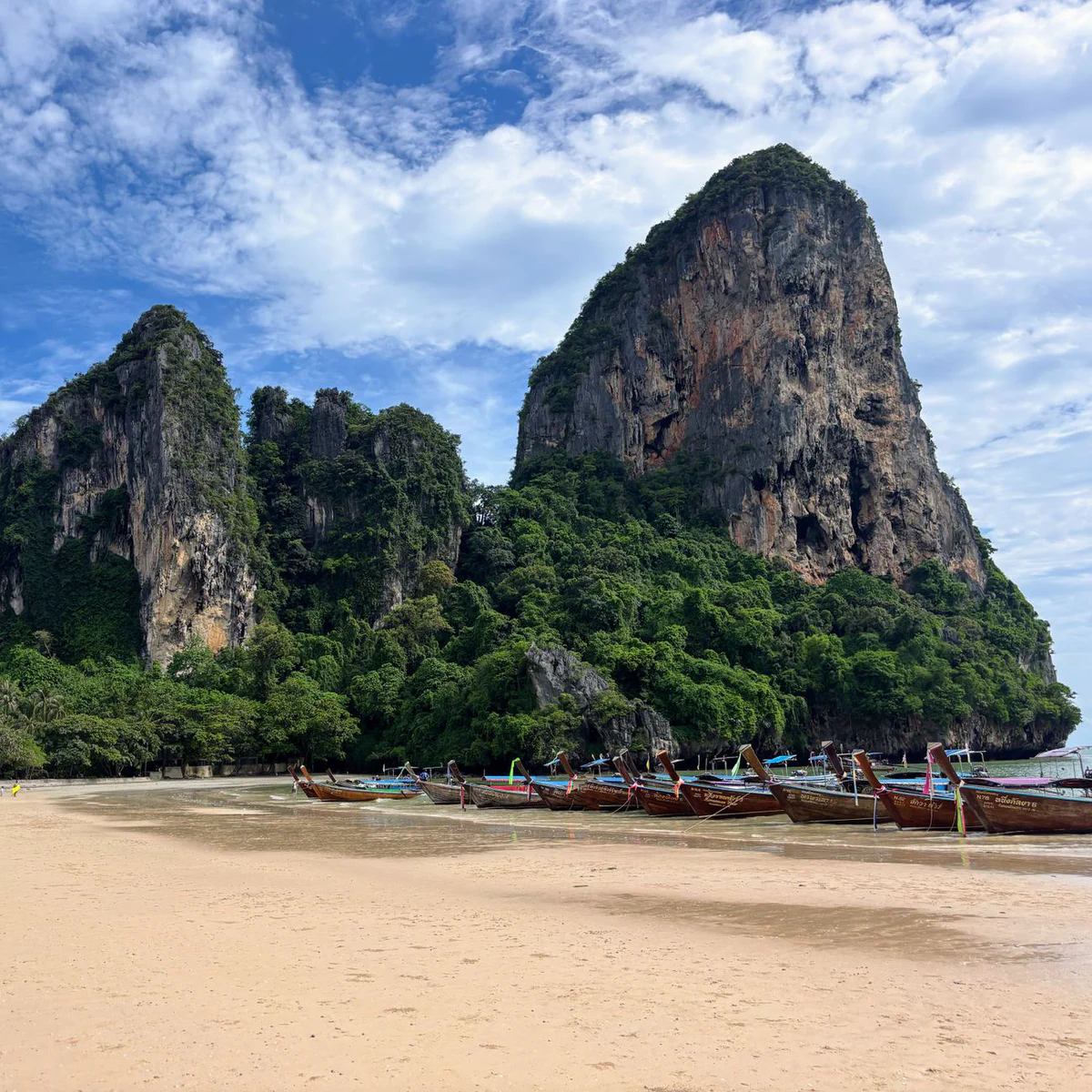
Thailand 2-Week Itinerary: 3 Realistic 14-Day Routes
Compare three realistic Thailand 2-week itineraries by budget, pace and season, then follow a complete 14-day Bangkok, Chiang Mai and coast route.


Two weeks in Thailand is enough for a memorable first route, but not for collecting every famous island and northern city. My default choice is three bases: Bangkok, Chiang Mai and one coast. It gives you temples, food, a change of landscape and several genuinely slow beach days, while accepting two tiring regional transfers. If that pace sounds wrong, the beach-and-nature route protects your rest, and the northern loop trades beaches for history and mountains. The comparison below helps you choose before you spend money on flights or non-refundable rooms.
Compare three Thailand 14-day routes before booking
These are planning ranges, not quotes. They exclude international flights and assume shared rooms where relevant. The existing Thailand travel-cost guide explains what each budget level includes; islands, peak dates, solo rooms, private transfers and marine activities usually cost more.
| Route | Base sequence and nights | Approx. planning budget per person | Pace and best fit | Main compromise |
|---|---|---|---|---|
| Classic north and south | Bangkok 3, Chiang Mai 4, one coast 6 | ฿17,000–30,000 budget; ฿40,000–75,000 comfortable | Medium-fast; first-time travelers wanting variety | Two regional travel days and only one coast |
| Beach and nature | Bangkok 3, Khao Sok 3, Koh Lanta or one Andaman base 7 | ฿20,000–35,000 budget; ฿45,000–80,000 comfortable | Slower; couples, families and swimmers who want recovery time | Skips Chiang Mai and needs road/boat connections |
| Northern history and nature | Bangkok 4, Ayutthaya 1, Chiang Mai 3, Chiang Rai 2, Sukhothai 3 | ฿17,000–30,000 budget; ฿38,000–70,000 comfortable | Curious, food-led and inland-focused travelers | No beach, with more hotel changes than the classic route |
The classic route has three bases and a six-night coast, but its Chiang Mai and southern transfer days are real travel days rather than hidden sightseeing time. The beach-and-nature version has fewer flights and a better rain buffer around the coast, but Khao Sok and the islands are not next door. The northern loop is the most coherent choice when marine weather is poor or the north is your main reason for coming; it still needs discipline because Ayutthaya, Chiang Mai, Chiang Rai and Sukhothai are not one compact area.

Complete 14-day route summaries
Use these tables as the skeleton of a booking plan. Each day has one anchor and enough space for meals, check-in tasks, heat and an evening that can be abandoned when everyone is tired.
Route 1: Classic Bangkok, Chiang Mai and one coast
| Day | Base | Main block | Travel and recovery note |
|---|---|---|---|
| 1 | Bangkok | Arrive, baggage, check-in and easy riverside or neighborhood meal | Keep the evening local; jet lag is part of the plan |
| 2 | Bangkok | Grand Palace, Wat Phra Kaew, Wat Pho; Wat Arun after lunch | Cluster the river temples to avoid repeated cross-city rides |
| 3 | Bangkok | Canals plus Chatuchak on the weekend, or Jim Thompson House and Chinatown | Leave a flexible evening and confirm the next flight |
| 4 | Chiang Mai | Fly north; Old City temples and a quiet dinner | Hotel transfer and heat make this a half sightseeing day |
| 5 | Chiang Mai | Full-day responsible elephant observation or Doi Inthanon | Choose one full-day anchor; do not stack both |
| 6 | Chiang Mai | Doi Suthep in the morning; cooking class or Nimman in the afternoon | Book a class only if the market timing works |
| 7 | Chiang Mai | Craft village, museum or café/rest day | Pack and leave room for a delayed onward flight |
| 8 | Coast | Fly south, transfer to one Andaman or Gulf base, sunset walk | Treat this as a full travel day |
| 9 | Coast | Beach morning; nearby town or viewpoint in the late afternoon | Keep the first sea day weather-flexible |
| 10 | Coast | Boat, snorkeling or diving day if sea conditions allow | Replace with a land day if ferries are canceled |
| 11 | Coast | Slow beach day, massage, market or pool | A deliberately low-output day prevents burnout |
| 12 | Coast | One nearby island, bay or national-park outing | Do not change hotels to add a second island |
| 13 | Coast | Buffer morning and final beach or old-town evening | Keep luggage packed before dinner |
| 14 | Departure | Return to Bangkok or depart from the coast on an open-jaw ticket | Allow airport, traffic and baggage buffer; do not book a tight self-transfer |
Route 2: Bangkok, Khao Sok and one island cluster
| Day | Base | Main block | Replacement rule or friction |
|---|---|---|---|
| 1 | Bangkok | Arrive and rest near a rail line or river | Do not add a timed attraction after a long-haul flight |
| 2 | Bangkok | River-temple cluster: Grand Palace, Wat Pho and Wat Arun | Replace the whole block with Chinatown if heat is punishing |
| 3 | Bangkok | Canal ride and market, or a museum and food-focused afternoon | Keep one half-day free for weather or luggage issues |
| 4 | Khao Sok | Road/flight connection south, check-in and short nature walk | This is a transfer day, not a full park day |
| 5 | Khao Sok | Cheow Lan Lake boat and viewpoint or a guided jungle walk | Pick one full-day nature block; do not promise both |
| 6 | Khao Sok | Easy nature morning, village time and a proper rest afternoon | Do not add a second full-day excursion before the road-and-boat transfer |
| 7 | Koh Lanta or one Andaman base | Transfer, check-in, beach and sunset if energy permits | Treat the journey as the main block and keep one island base afterward |
| 8 | Same base | Beach and village/old-town-style exploration | A land day is the fallback for rough seas |
| 9 | Same base | Snorkel or boat day, conditions permitting | Cancel rather than force a rough crossing |
| 10 | Same base | No-alarm beach day and long lunch | This is why this route suits tired travelers |
| 11 | Same base | National-park, mangrove or short viewpoint outing | Replace the outing with a pool/market block in rain |
| 12 | Same base | Optional dive course or second beach day | A dive course replaces the entire day, including the boat trip |
| 13 | Same base | Buffer morning and pack before a final dinner | Do not schedule a distant excursion |
| 14 | Departure | Transfer to the departure airport with a generous buffer | Open-jaw or an overnight near the airport reduces risk |
Route 3: Bangkok, Ayutthaya, Chiang Mai, Chiang Rai and Sukhothai
| Day | Base | Main block | Replacement rule or friction |
|---|---|---|---|
| 1 | Bangkok | Arrival, shower, nearby meal and sleep | No day trip on arrival day |
| 2 | Bangkok | Old Bangkok river-temple half-day; shaded afternoon | Replace outdoor walking with a museum if the heat wins |
| 3 | Ayutthaya | Transfer, luggage drop and a small temple cluster | Ayutthaya is a travel day; do not chase every ruin |
| 4 | Chiang Mai | Transfer or flight north; Old City walk and early night | Use the hotel afternoon to recover |
| 5 | Chiang Mai | Doi Suthep and a northern food or cooking block | The class replaces a second temple circuit |
| 6 | Chiang Mai | Old City museum, craft village or responsible wildlife day | A full-day wildlife visit replaces all other anchors |
| 7 | Chiang Rai | Transfer north; White Temple or city food walk | Keep the first afternoon short |
| 8 | Chiang Rai | One temple/cultural route plus a long lunch | Do not add a remote border excursion |
| 9 | Sukhothai | Long transfer south; check-in and sunset near the historical park | Luggage and road time consume most of the day |
| 10 | Sukhothai | Historical Park morning cycle/walk | Choose a small geographic cluster rather than the entire park |
| 11 | Sukhothai | Museum, local food and rest | This is a buffer against heat and transport delays |
| 12 | Bangkok | Return by the most practical live connection | Treat the return as a travel day |
| 13 | Bangkok | Flexible final city day, shopping or riverside meal | Replace shopping with a quiet café if worn out |
| 14 | Departure | Airport transfer and international flight | Keep the final night in Bangkok rather than risking a same-day long road leg |
The third route is intentionally not a list of every northern attraction. If you want more Chiang Mai time, remove Ayutthaya and use its day as a Chiang Mai rest or food block. If you want a beach, replace Days 7–11 with the classic coast block, not by adding a fifth base.
The classic route: choose the coast after you choose the structure
For a first visit, I would choose Bangkok → Chiang Mai → one coast, with the coast occupying Days 8–13. Stay in a practical Bangkok base such as Sukhumvit, Silom or the riverside; compare real walking distances and rail access in the Bangkok Where to Stay guide. In Chiang Mai, the Old City is useful for temple-heavy days and the Ping River is calmer; use the Chiang Mai Where to Stay guide before choosing a hotel. No verified southern Where to Stay page is available yet, so choose one southern base with the Thailand islands and beaches guide, then confirm the final address, pier transfer and luggage route yourself.

The Andaman coast is the simpler classic finish when you want limestone scenery and many flight choices: use Phuket for transport, services and a busier evening scene, or Krabi/Ao Nang for Railay access and a more compact base. Koh Lanta makes a quieter finish but adds a road or boat transfer. The Gulf works well for diving and a slower island rhythm: Koh Samui is easiest for flights and services, while Koh Phangan and Koh Tao add boat time but can suit travelers who want more beach or diving. Choose one cluster, not Phuket plus Samui.

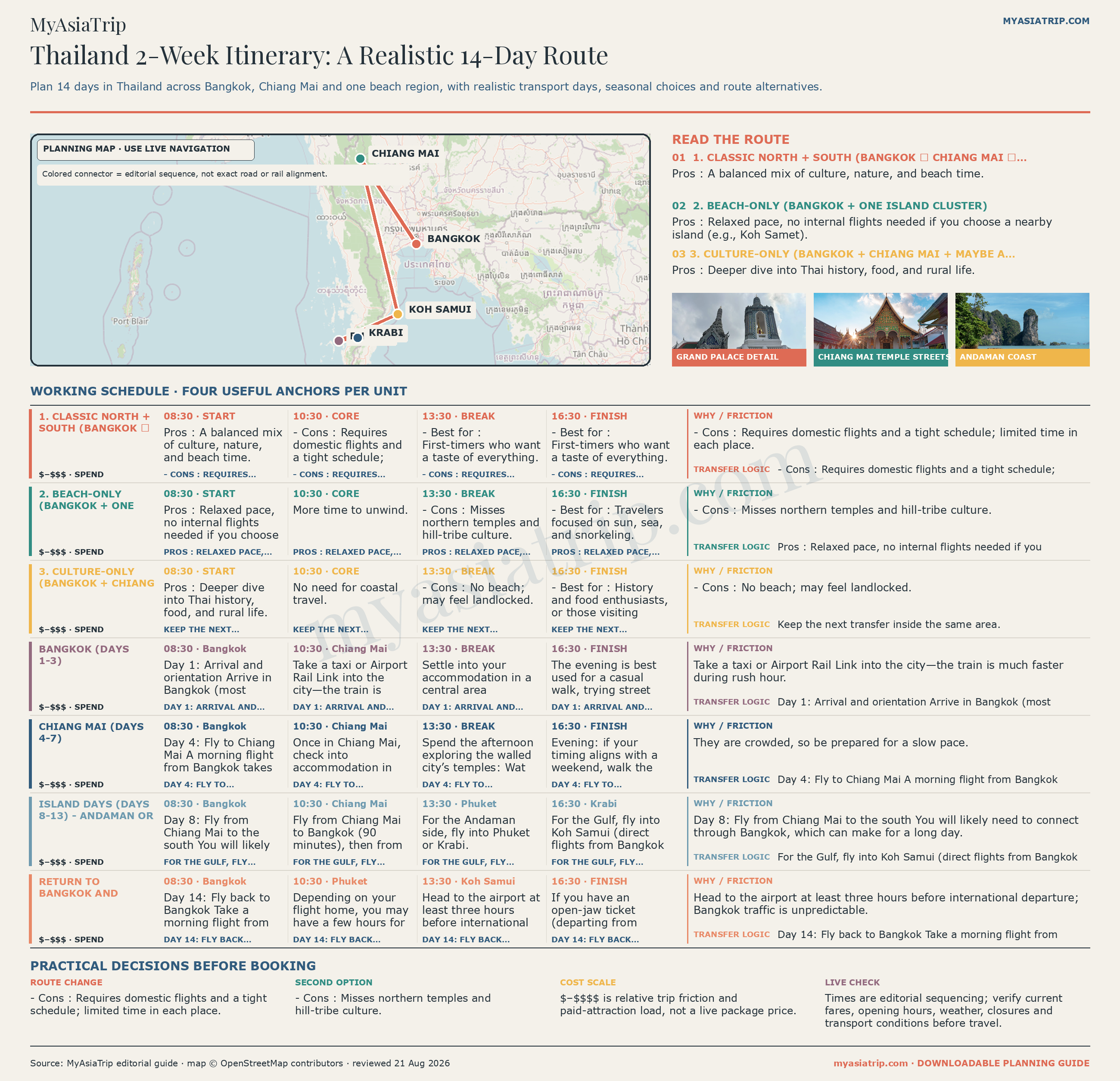
This approved downloadable infographic depicts the classic Bangkok–Chiang Mai–one-coast route above. It does not depict the beach-and-nature or northern-loop alternatives; any later route change needs a separate infographic synchronization review.
Classic route day-by-day timeline
Days 1–3: Bangkok, with the first day deliberately light
Day 1 — Arrival and orientation. Allow immigration, baggage and the airport-to-city transfer before you count any sightseeing. The Airport Rail Link can reduce traffic exposure when it matches your hotel area; a taxi may be simpler with heavy luggage or a late arrival. Check in, shower, eat within walking distance and stop. If you land early, take a short Chao Phraya riverside walk, but keep a full river cruise or distant market optional.
Day 2 — Grand Palace, Wat Phra Kaew, Wat Pho and Wat Arun. Make the river-temple cluster your one major block. Arrive in the morning, dress so shoulders and knees are covered, eat lunch nearby, then cross to Wat Arun if energy and heat allow. The exposed courtyards and steep steps are more tiring than the map suggests; an afternoon hotel rest is sensible. Use the Bangkok things-to-do guide for a deeper comparison rather than adding another cross-city attraction.
Day 3 — Canals and a calendar-led afternoon. Take a canal ride in the morning, then choose Chatuchak if it is a weekend and shopping is genuinely your priority. Otherwise choose the Jim Thompson House and a Chinatown food walk, leaving time to pack. Book or confirm the Day 4 flight to Chiang Mai and do not put a timed dinner across town after it.
Days 4–7: Chiang Mai, grouped around the Old City and mountain
Day 4 — Fly north and settle into the Old City. A morning flight is usually the least disruptive way to preserve the afternoon. After baggage and hotel check-in, walk only the nearby Old City: Wat Chedi Luang, Wat Phra Singh and one quiet café are enough. If a weekend walking street falls on this evening, expect slow crowds; it replaces, rather than follows, a second dinner excursion.

Day 5 — One full-day anchor. Choose a responsible elephant observation program that does not offer riding or shows, or choose Doi Inthanon if you prefer a national-park day. A pickup, long lunch and return transfer make either a full day. Do not add a cooking class afterward. If a conservation program is sold out, switch to the park or a city food block rather than supporting an attraction built around forced interaction.
Day 6 — Doi Suthep plus one food block. Go to Wat Phra That Doi Suthep in the morning, when the climb and mountain road are more manageable. After lunch and a rest, take a half-day Thai cooking class with its market visit, or choose Nimman cafés. The class replaces the café block; it does not fit beside another distant temple.

Day 7 — Recovery and a small cultural choice. Pick Baan Tawai, the Chiang Mai City Arts & Cultural Centre, a Mae Ping boat ride, or simply a café and laundry morning. This is the day that keeps a 14-day route humane. Pack, confirm the southern connection and check whether your baggage allowance covers beach equipment. The Chiang Mai day-trips guide can help you replace this block, but do not turn it into a second full-day excursion.
Days 8–13: one Andaman or Gulf base
Day 8 — Cross the country. Fly from Chiang Mai toward the selected southern airport; many practical itineraries connect through Bangkok. Phuket or Krabi serve the Andaman route. For the Gulf, fly to Samui or reach a ferry connection via Surat Thani. Airport waiting, baggage, the last-mile transfer and check-in consume most of the day, so make sunset a bonus rather than a promise.
Day 9 — Beach and local geography. Sleep in, swim if conditions are comfortable, and use the late afternoon for the nearest town, viewpoint or market. In Phuket, that might mean pairing a beach with Old Town on a separate half-day; in Krabi, keep Railay as the anchor and skip another distant bay. On an island, let the walk or taxi back to the room be the stopping point.
Day 10 — Sea day, weather permitting. Choose one boat, snorkeling or diving block. Check the operator and sea conditions close to departure; ferries and excursions can be canceled in monsoon weather. If the water is rough, replace the whole block with a massage, food walk, pool and long lunch. Do not try to salvage a boat day by squeezing in another island after a delay.
Day 11 — A true low-output day. Spend the morning on the beach and the afternoon resting, reading, or visiting a nearby market. This is not wasted time: after two flights and a sea excursion, heat fatigue often catches up here. Families can use this as a laundry and early-dinner day; divers can use it as a surface interval rather than adding a third activity.
Day 12 — One nearby nature or island block. Pick Railay, a close island, a mangrove route, or a short national-park outing depending on your base and the forecast. One anchor is enough. If it requires a long van, pier wait and multiple boats, replace it with a second beach day; a photograph is not worth losing the last calm evening.
Day 13 — Buffer before departure. Keep the morning unbooked. Swim, revisit the beach you liked, or walk a nearby old town, then pack before dinner. This absorbs a canceled ferry, a delayed flight or the simple need to do nothing. Do not change islands on Day 13 just to say you slept somewhere new.
Day 14: departure without a fragile connection
If your international flight leaves Bangkok, return with a generous buffer and treat the airport transfer as the day’s only fixed block. Bangkok traffic is variable, and a separate domestic ticket is not protected by your international airline. An open-jaw ticket departing Phuket or Samui can make the classic route more comfortable, but only if the connection and baggage rules are clear. Keep the final morning close to the departure airport, not on a remote beach.
Season, transport and budget decisions
Thailand’s north and two southern coasts do not share one reliable “best season.” The Thai Meteorological Department’s broad seasonal framing is a starting point, not a forecast. Northern burning can make February–April a poor choice for an outdoor Chiang Mai route. The Andaman coast commonly has wetter, rougher conditions from May–October, while the Gulf pattern is often wetter around October–December. November–February can work well across the classic route but brings peak demand and higher prices. Check Thailand weather by month and the best time to visit guide against your exact coast before paying for a non-refundable stay.
For long legs, flights save a day but add airport and baggage friction. An overnight Bangkok–Chiang Mai sleeper can work for travelers who value the experience and can tolerate a 12-plus-hour journey; check the State Railway of Thailand timetable and never connect it to a tight flight. Buses and minivans are useful for regional links, while ferries need weather slack. The Thailand getting-around guide is the right place to compare current options. In Bangkok, use BTS/MRT when the route fits; with luggage, a metered taxi or pre-arranged hotel transfer can be the less exhausting last mile.
For a shared-room, excluding-international-flight plan, budget travelers should reserve roughly ฿1,200–2,000 per person per day; comfortable travel is roughly ฿2,800–5,500; premium travel starts around ฿7,000. These are planning ranges, not a promise of a daily bill. Islands and marine days can exceed them, and a solo room changes the arithmetic quickly. Price the whole route—including domestic flights, ferries, park or activity fees, laundry, airport transfers and a weather buffer—rather than multiplying a low room rate by 14.
Health, packing and booking checks that matter
Talk to a qualified clinician about travel vaccines and personal health needs well before departure; requirements depend on your circumstances. Dengue occurs in Thailand, so bring and consistently use a suitable mosquito repellent. Heat, dehydration and exposed temple courtyards are more likely to derail this itinerary than a lack of attractions.
Pack breathable clothes that cover shoulders and knees, a light rain layer, swimwear, a sarong or scarf, sunscreen, a reusable bottle, a universal adapter and a small day bag. Keep one change of clothes and medication in your cabin bag when crossing regions. A wet ferry deck and a delayed checked bag are ordinary travel problems, not reasons to sacrifice a whole day.
Book domestic flights, sleeper berths and capacity-limited ethical wildlife, cooking or diving activities early around November–February and Thai holiday periods. Recheck live schedules before departure. Near the Grand Palace, ignore unsolicited claims that a temple is closed and use official entrances; for taxis, ask for the meter or choose another ride. These small choices protect both your budget and your remaining patience.
The best two-week route is the one that leaves room for a late flight, a rainy sea day and an evening when everyone wants noodles near the hotel. Start with the classic route if you want Thailand’s broadest first impression; choose beach and nature when recovery matters more than northern temples; choose the inland loop when food, history and mountains are the point. Remove a base before adding another attraction.
Quick answers
Frequently asked questions
Is 2 weeks enough for Thailand?
What is the best Thailand 14-day itinerary for a first trip?
How much does two weeks in Thailand cost?
Should I visit Chiang Mai during burning season?
Research notes
Official planning references
We use these primary references for the time-sensitive details relevant to this guide. Rules, prices and operating hours can change, so confirm the live information before you travel.
- Thai Meteorological Department — Seasons of Thailand
Details to check: National season definitions and regional monsoon differences behind the north-versus-coast route choice (checked 2026-09-17).
- State Railway of Thailand — Timetables and Booking
Details to check: Official timetable and booking checks for Bangkok–Chiang Mai rail legs; exact trains remain live-check items (checked 2026-09-17).
- Tourism Authority of Thailand — Chiang Mai
Details to check: Official destination geography and attraction context for the northern base (checked 2026-09-17).
Guide reviewed 17 September 2026. Confirm live rules, prices and operating details with the linked authority before travel.