Thailand 10-Day Itinerary: Bangkok, Chiang Mai and One Southern Base
Use this realistic Thailand 10-day itinerary to balance Bangkok landmarks, Chiang Mai culture and one southern beach base, with budgets, transfers and swaps.


Ten days is enough for a first Thailand trip if you accept one clear compromise: you will change bases twice and spend two days partly in airports. The route that usually works best is three nights in Bangkok, three in Chiang Mai, and three in either Phuket or Krabi, followed by a departure day. Bangkok contributes the landmarks, food and urban energy; Chiang Mai slows the rhythm with an old city, northern culture and mountain air; the south gives you recovery time and sea days. If two regional flights sound like too much friction, remove one region before adding another stop.
This is a practical framework rather than a promise that every flight, ferry or attraction runs on your preferred schedule. Treat the windows below as planning blocks, check live transport before paying for non-refundable rooms, and keep the most weather-sensitive activity replaceable.
Is this 10-day Thailand route right for you?
| Traveler situation | Fit | Pace and bases | Core highlights | Early planning budget* | Main compromise |
|---|---|---|---|---|---|
| First-time traveler wanting contrasts | Strongest fit | Moderate-fast; 3 bases | Bangkok landmarks and food, Chiang Mai old city and Doi Suthep, one southern coast | ฿28,000–55,000 comfortable | Two regional flight days |
| Budget-focused traveler | Possible with discipline | Moderate-fast; 3 bases | Self-guided cities, local meals, one simple beach base | ฿12,000–20,000 | Fewer private transfers and paid excursions |
| Couple wanting a soft finish | Strong fit | Moderate; 3 bases | Culture first, flexible southern days | ฿28,000–55,000 comfortable | Less time in each region than a two-base trip |
| Family or traveler who tires easily | Better with a change | Slower; 2 bases | Bangkok plus Chiang Mai or one southern base | Similar daily range, less intercity spend | You must choose between north and coast |
*These are planning bands in Thai baht per person for 10 days, excluding international flights and based on the supplied daily ranges. They are not quotes. Solo rooms, peak dates, island transfers, private cars, premium resorts and marine activities can push the total higher. Price live domestic flights, rooms and the activities you actually want separately, then use the Thailand travel cost guide to test the arithmetic.
The route at a glance: three bases, two flight days
| Day | Base | Main half-day blocks | What makes the day realistic |
|---|---|---|---|
| 1 | Bangkok | Arrival, luggage and recovery; nearby riverside evening | No timed attraction after a long-haul flight |
| 2 | Bangkok | Historic district in the morning; long lunch and Wat Arun; optional Chinatown evening | Three nearby anchors, not a cross-city checklist |
| 3 | Bangkok | Chatuchak on a weekend, or Talat Noi/Song Wat and canals on a weekday | Calendar-based choice and an open evening |
| 4 | Chiang Mai | Airport and hotel transfer; Old City afternoon; market only if energy remains | A travel day with one walkable anchor |
| 5 | Chiang Mai | Doi Suthep morning; Nimman lunch and an indoor or café afternoon | Mountain visibility can change the plan |
| 6 | Chiang Mai | One wildlife, cooking or craft block; independent city time | One substantial experience, not all three |
| 7 | Phuket or Krabi | Flight and check-in; local beach or town reset | No boat trip immediately after arrival |
| 8 | Phuket or Krabi | One weather-dependent sea block; land-based replacement if needed | Boat inclusions and conditions checked first |
| 9 | Phuket or Krabi | Old town/nearby beach or Railay/Ao Nang; packing buffer | Protects the route from Day 7 or 8 disruption |
| 10 | Departure | Airport buffer and international connection | Separate tickets and Bangkok airport changes need margin |
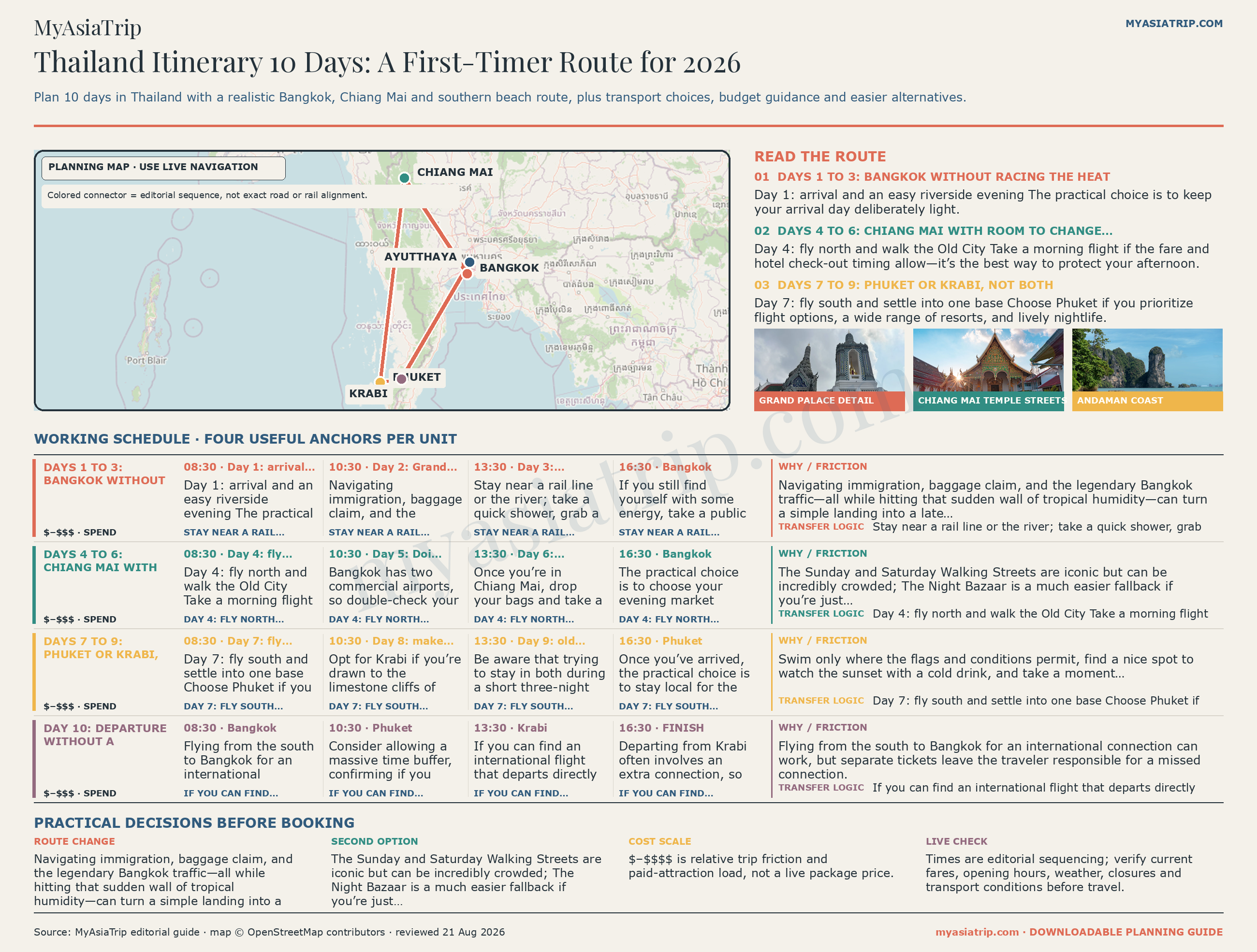
The classic route infographic below represents this Bangkok–Chiang Mai–one-southern-base route only. It is a visual planning aid, not a live transport map; keep it alongside current flight and marine-operator information.
Before choosing dates and bases
Thailand does not have one coast-wide weather rule. The Thailand weather by month guide is useful for comparing the month and coast you are considering, but the Thai Meteorological Department’s broad seasonal framing is only a starting point. A wet forecast does not automatically cancel a city day; it does make a tightly timed ferry or snorkeling plan less forgiving. Put the sea excursion on Day 8 and leave Day 9 open for that reason.
For Bangkok, use the Bangkok Where to Stay guide to choose a base near the journeys you will repeat, rather than booking by district name alone. A room near a rail line or a practical river connection can save energy after a hot temple morning. In Chiang Mai, the Chiang Mai Where to Stay guide explains the difference between an Old City base and Nimman; both can work, but they produce different evening walks and airport transfers. No verified Phuket or Krabi Where to Stay article exists in this site inventory, so choose the southern area from current maps and your activity plan instead of following a made-up internal recommendation.
Days 1–3: give Bangkok enough room to be a city
Bangkok is the route’s orientation point: a dense introduction to royal architecture, Buddhist temples, river transport, street food and the fatigue caused by crossing a huge city in humid weather. Three nights are useful because the first usable morning may disappear into jet lag and luggage.
Day 1 — arrive, check in and let your body catch up
| Approximate window | Block | Practical plan |
|---|---|---|
| Arrival–14:00 | Airport, transfer and luggage | Allow time for immigration, baggage collection and the ride to your hotel. Confirm whether you arrive at BKK or DMK before arranging the last leg. |
| 14:00–17:00 | Check-in and recovery | Shower, hydrate, unpack only what you need and take a proper rest. Do not spend this window chasing a distant attraction. |
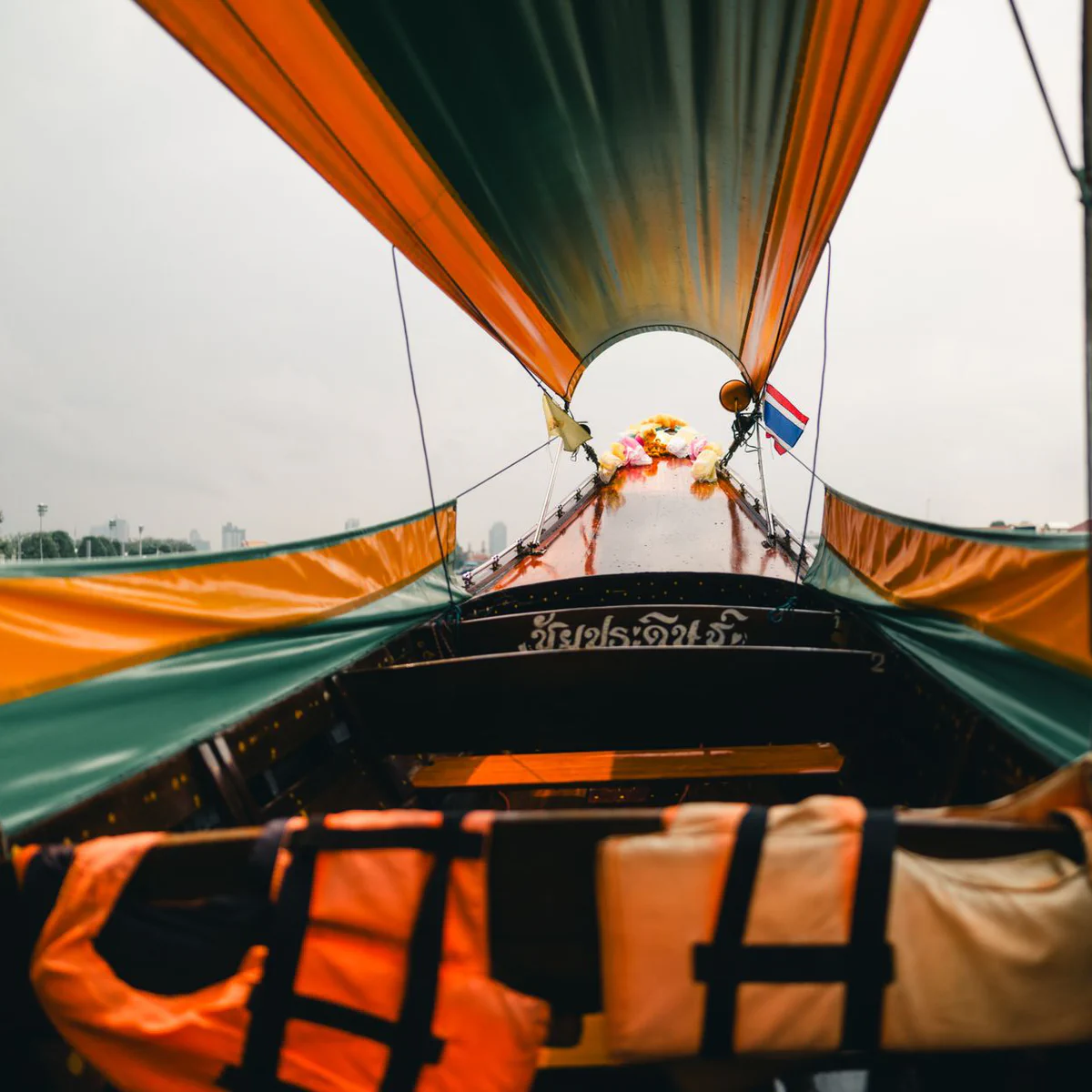
| 17:00–20:30 | Nearby dinner or short river outing | If you have energy, take a short ride on the Chao Phraya public boats or eat close to the hotel. Stop after dinner if the heat and jet lag win. |
Stay near a useful rail line or river connection; the right area is more valuable than a theoretically central address. If you land late, the fallback is simply food, a shower and sleep. That is not a wasted day—it protects Day 2.

Day 2 — the historic district, then a slower evening
| Approximate window | Block | Practical plan |
|---|---|---|
| 08:00–12:00 | Grand Palace and Wat Pho | Start in the historic district while walking is less punishing. Use the Grand Palace guide for current visitor details and dress with covered shoulders and knees. |
| 12:00–14:00 | Lunch and shade | Eat near the river or old town, sit down and refill water. The point is recovery, not fitting in a fourth landmark. |
| 14:00–16:30 | Wat Arun | Walk or use the short river crossing to reach the Wat Arun guide. Allow for stairs, sun and time to remove shoes where required. |
| 17:30 onward | Optional Chinatown food walk | Only if everyone still has capacity, use Bangkok Chinatown as an evening meal district. Otherwise return to the hotel. |
The Wat Pho guide can help you decide whether to give the temple more time. These places sit close on a map, but the exposed paths and repeated standing add up. A long lunch is part of the route, not a hole in it. Avoid booking a rooftop reservation or show with a non-refundable start time on this evening unless your arrival and energy are predictable.
Day 3 — match the plan to the calendar
If it is a weekend, make Chatuchak Weekend Market the morning anchor. Go early, agree on a meeting point, carry water and keep cash available for stalls that do not take cards. Once the heat and crowds become tiring, leave; shopping is not a test of endurance.
If it is a weekday, replace the market block with Talat Noi and Song Wat, then choose one nearby meal. A second option is a canal-side outing around Khlong Bang Luang and the Artist’s House area. Do not attempt both as full excursions. Use the afternoon for a nap, massage or air-conditioned café, and keep the evening unbooked. This is the first deliberate buffer in the itinerary: Bangkok traffic can turn a simple dinner into an exhausting transfer.

Days 4–6: Chiang Mai for old-city texture and northern perspective
Chiang Mai changes the scale of the trip. The old city is walkable in pieces, evenings are easier to keep local, and Doi Suthep gives the route a mountain counterpoint. It is still hot in much of the year, and smoke or rain can obscure a viewpoint, so do not build the whole region around one photograph.
Day 4 — fly north and use the afternoon gently
| Approximate window | Block | Practical plan |
|---|---|---|
| 07:00–11:30 | Check-out, airport and flight | Build in hotel check-out, the ride to the correct Bangkok airport and airline baggage rules. BKK and DMK are separate airports. |
| 11:30–14:30 | Chiang Mai arrival, luggage and lunch | Transfer to the hotel, leave bags if the room is not ready, eat nearby and take a short break. Do not attach a distant day trip to this arrival. |
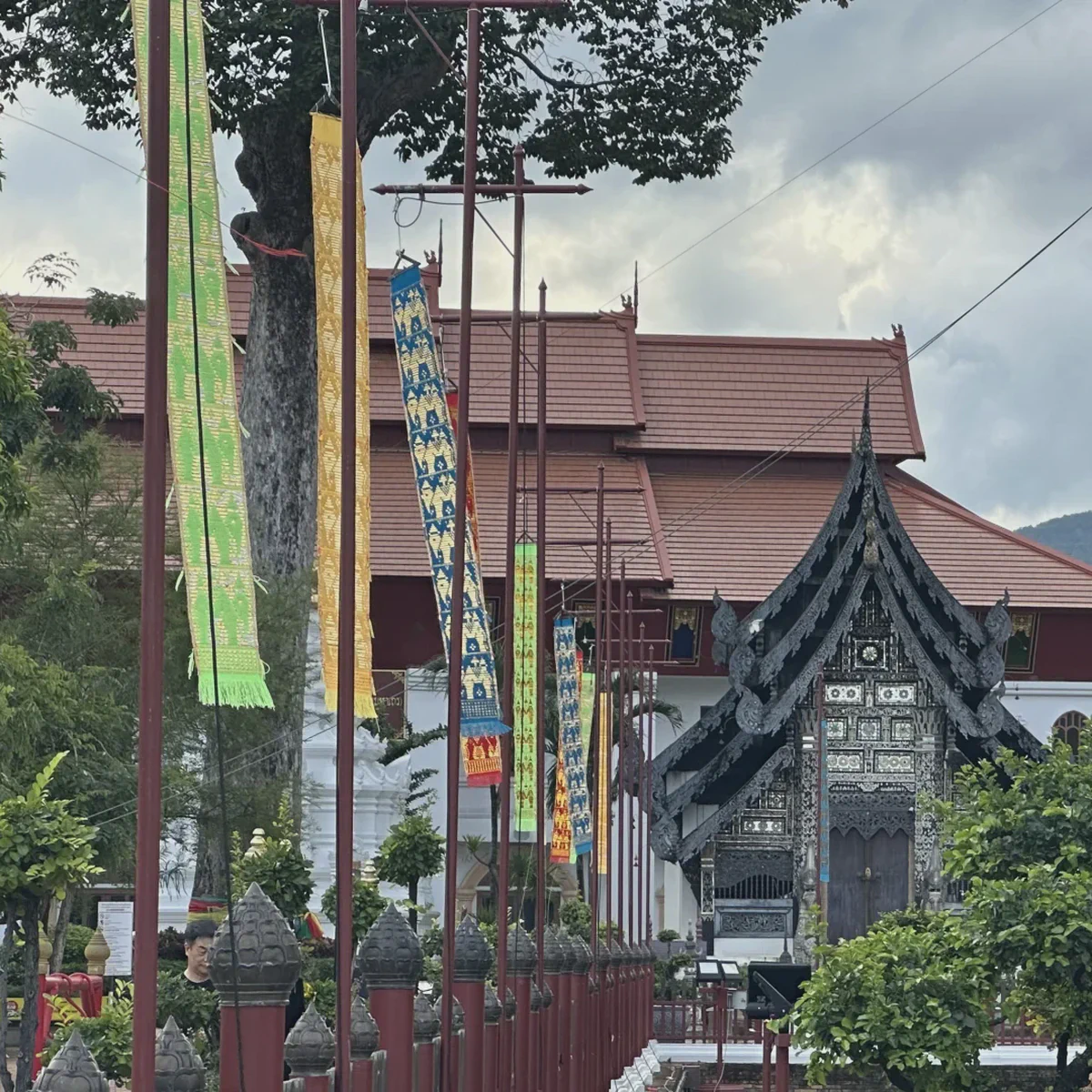
| 15:00–18:00 | Old City walk | Use the Chiang Mai Old City guide to choose one or two temples, such as Wat Phra Singh and Wat Chedi Luang, rather than racing around every lane. |
| Evening | Market or early night | Choose Saturday/Sunday Walking Street when the calendar and crowd tolerance fit; otherwise use the Night Bazaar or a quiet local meal. |
Three nights in Chiang Mai work best when the hotel is chosen for the actual evening pattern you want. The Where to Stay guide linked above covers the Old City and Nimman trade-off. The stopping point is your hotel after dinner; there is no prize for turning a flight day into a full sightseeing day.

Day 5 — Doi Suthep, then Nimman or an indoor swap
| Approximate window | Block | Practical plan |
|---|---|---|
| 07:30–12:00 | Doi Suthep | Use the Doi Suthep guide to plan a cooler morning. The winding ascent can be uncomfortable for people prone to motion sickness; a private car may be worth the cost. Dress respectfully and carry a light layer. |
| 12:00–14:00 | Lunch and return | Eat in or near the city after descending. Treat the transfer as recovery time rather than squeezing in another mountain stop. |
| 14:00–17:00 | Nimman, café or rest | Browse Nimman at an easy pace, or return to the hotel for pool and laundry time. |
| Evening | Flexible dinner | Pick a nearby restaurant. If smoke or heavy rain makes the mountain unpleasant, replace the Doi Suthep block—not the whole day—with a cooking class, museum or craft workshop. |

Day 6 — choose one substantial experience
Pick one of these half-day or full-day blocks, then leave the other half for an unhurried meal and independent time.
- Cooking and food: A Chiang Mai cooking class gives a structured northern-food experience without another long transfer. Ask about market time, dietary adaptations and the class length before paying.
- Wildlife: If you consider an elephant visit, use the elephant sanctuary guide and reject riding, performances and forced close-contact bathing. “Sanctuary” is not proof of welfare. Ask whether elephants can move away from visitors and how chaining, breeding and observation are handled.
- Crafts and local neighborhoods: Choose a craft workshop or a slower food-and-market day if you prefer making something, browsing produce and resting in cafés. A cooking class can connect northern/Lanna dishes to the city without claiming one regional tradition is more authentic than another.
Replace the entire wildlife block with the cooking block; do not book both and call the second one an evening activity. For families, a half-day class is usually easier to stop than a remote excursion. For solo travelers, choose an organized class when you want built-in company and an independent afternoon when you need quiet.

Days 7–9: one southern base for sea and recovery
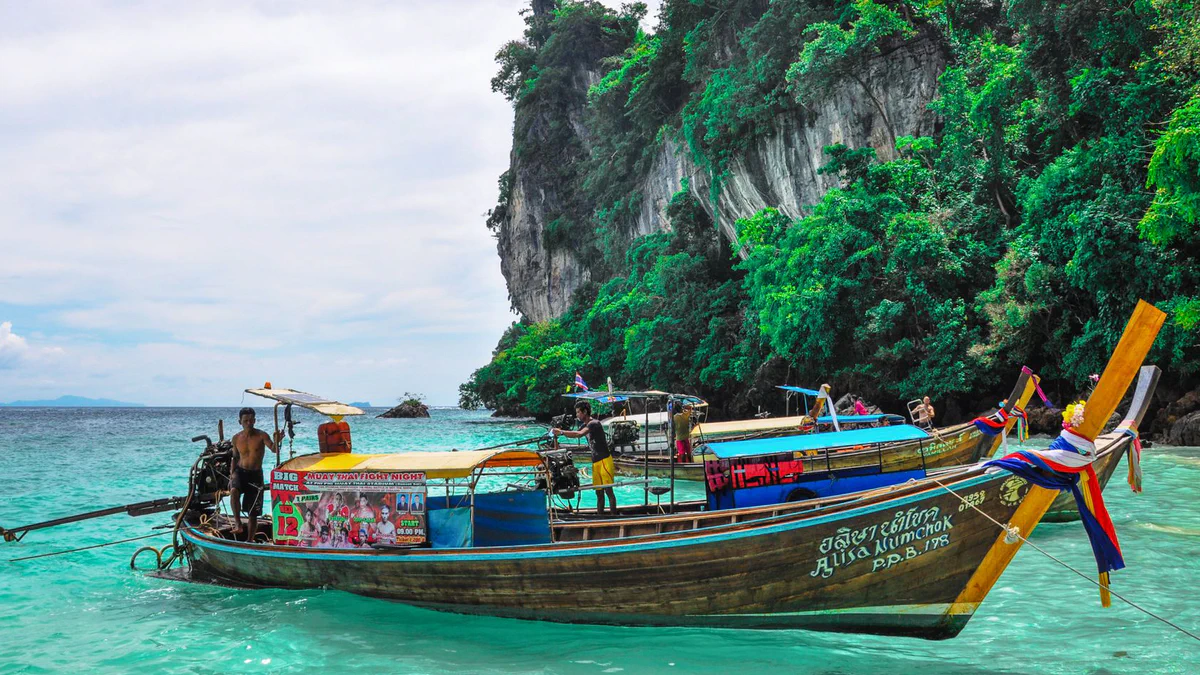
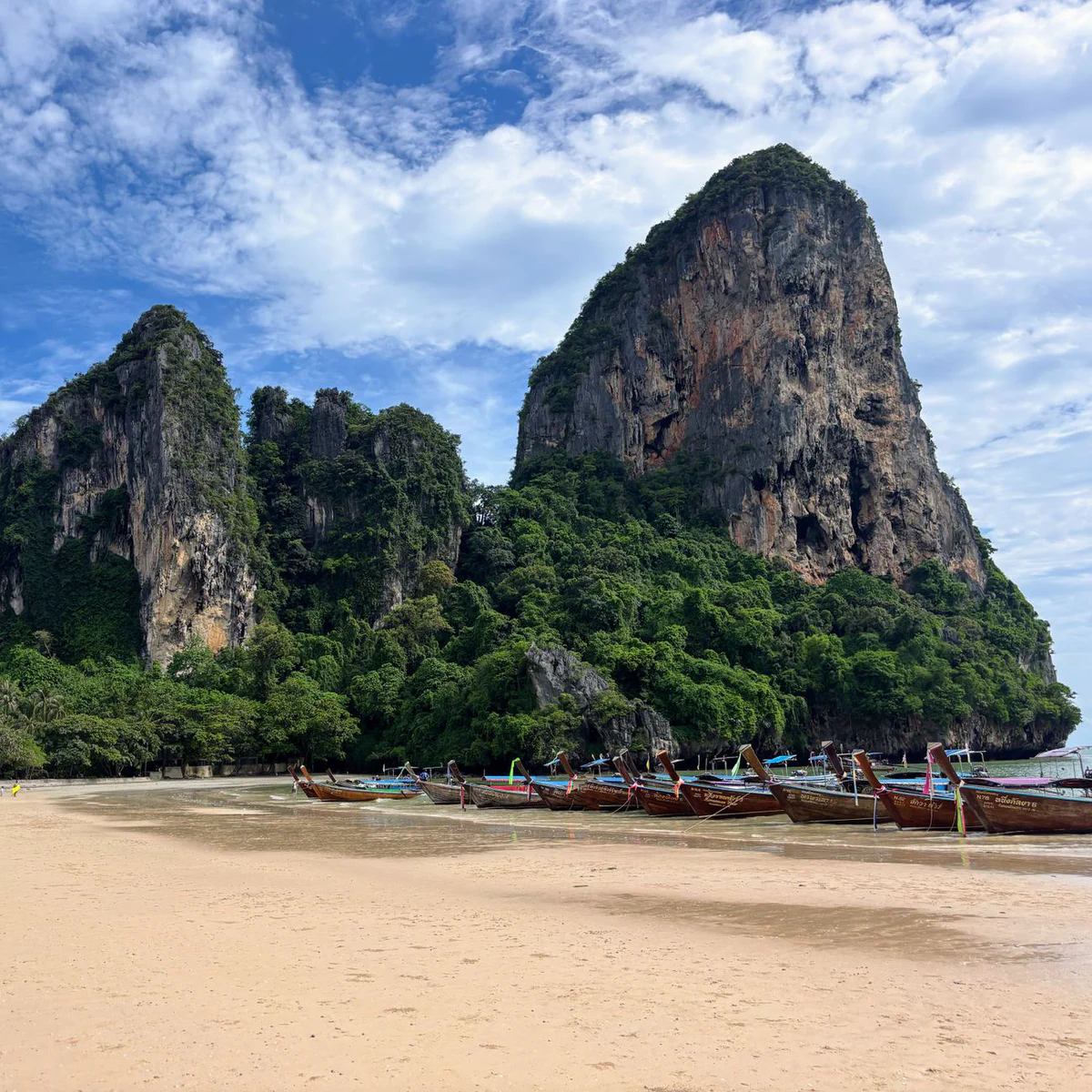
Choose the south according to what you want the final third of the trip to do. Phuket is the practical choice when flight options, accommodation range, restaurant choice and nightlife matter. Krabi is the better fit when limestone scenery, Railay and a quieter finish matter more. Use the islands and beaches guide to compare the coast and activity, then pick one base. Three nights are not enough to sleep in Phuket and Krabi while also enjoying the sea.
Day 7 — fly south, check in and stay local
| Approximate window | Block | Practical plan |
|---|---|---|
| 07:00–13:00 | Check-out, airport, flight and bags | Allow for the hotel task, airport transfer, flight, baggage and the last ride to your southern accommodation. Exact timings vary; do not schedule a boat with a narrow check-in window. |
| 13:00–16:00 | Lunch, check-in and rest | Leave bags with the property if the room is not ready. Eat close by, shower and check sea conditions and the next day’s operator meeting point. |
| 16:00–sunset | Local beach or town | Swim only where conditions and flags permit. In Krabi, stay around Ao Nang or your chosen base; in Phuket, use a nearby beach or town rather than crossing the island. |
| Evening | Simple dinner | Keep luggage and plans easy. This is recovery after a second flight day. |

Day 8 — put the sea day where it can move
From Phuket, a bay or island trip may focus on Phang Nga Bay or the Phi Phi Islands. From Krabi, consider Railay, the Hong Islands or a shorter local circuit. These are examples of activity blocks, not a guarantee of daily operation. Check the operator’s current departure, weather policy, inclusions and meeting point before paying.
| Approximate window | Block | Practical plan |
|---|---|---|
| Morning–mid-afternoon | One marine or coastal anchor | Choose one route whose time on the water matches the day’s conditions. Confirm whether park fees, transfers, water and snorkeling equipment are included. |
| Mid-afternoon–evening | Return, shower and meal | Do not add a second island or a nightlife commitment. Sun, boat motion and an early start are tiring even when the sea is calm. |
If wind or rain cancels the trip, replace the entire marine block with Old Phuket Town, Krabi Town, a long spa afternoon or a beach near the hotel. Do not try to “make up” the cancelled boat by adding a dawn departure on Day 9. If the weather is unsettled for the whole stay, the land-based replacement is the itinerary, not a failure of it.

Day 9 — a buffer that still feels like a holiday
In Phuket, combine Old Phuket Town with a beach near your accommodation, using the town as the cultural anchor and the beach as the recovery block. In Krabi, spend more time around Railay or Ao Nang, but keep the final evening simple. Allow time to collect laundry, repack and confirm the next airport transfer.
This day replaces whatever the weather or transport disrupted earlier. If Day 8 ran perfectly, resist another all-day excursion; choose a late breakfast, one neighborhood and a comfortable sunset. If Day 7 was delayed, move the missed local beach block here. Packing is part of the day, especially if you have checked bags and a separate international ticket.
Day 10 — leave enough margin for the long way home
If your international flight leaves Phuket, the route can finish cleanly from the south. If you depart from Krabi, compare the complete itinerary and connection risk rather than the first low fare. If you must fly south to Bangkok, a same-day connection can work only with generous time and a clear airport plan. BKK and DMK are not interchangeable terminals, and separate tickets leave you responsible for a missed connection.
| Departure situation | Safer planning choice |
|---|---|
| Direct international departure from Phuket | Stay in your southern base on Day 9 and arrange the airport ride with a generous buffer. |
| International flight from Bangkok on one ticket | Confirm the ticket’s airport and baggage handling, then follow the airline’s connection guidance. |
| Separate domestic and international tickets | Prefer a Bangkok overnight before the long-haul flight, especially for an early departure. |
| Early international flight after a Krabi stay | Price the extra connection and night against a longer southern transfer; convenience can be worth more than the lowest fare. |
Use the Thailand getting-around guide for the mode choice. The key rule is simple: do not put a weather-sensitive boat, a cross-airport transfer and a separate international ticket into one tight chain.
What the 10 days cost in practice
The daily planning bands above translate to roughly ฿12,000–20,000 per person for a budget-focused trip, ฿28,000–55,000 for a comfortable trip, and ฿70,000+ for a premium trip. These totals exclude international flights. They also assume the categories are chosen consistently: room sharing where relevant, ordinary meals, local transport and a limited number of paid activities. They are not promises that every base can be booked at the lower edge.
| Spend first | Budget approach | Comfortable approach | Why it moves the total |
|---|---|---|---|
| Accommodation | Hostels or simple guesthouses | Private hotels or a resort night | Southern location, season and solo occupancy |
| Regional transport | Compare flight dates and baggage | Two flights with suitable luggage allowance | Booking date and baggage can erase a low fare |
| Local transport | Rail, public boats and shared rides | Mix of apps and private cars | Airport, Doi Suthep and last-mile transfers |
| Food | Markets and local restaurants | Local meals plus selected destination dinners | Alcohol and hotel dining add quickly |
| Activities | Self-guided temples, town and beach | One class plus one marine or guided day | Park fees, transfers and private guides |
Price the two domestic flights, the three southern nights and the one or two activities you will actually take before worrying about small daily savings. A cheap hotel far from your route can create extra rides and lost time; a private car on a winding mountain transfer may be a comfort decision rather than a luxury. Keep live hotel and flight quotes separate from this editorial planning range.
How to modify the route without making it worse
The safest modification is subtraction. Remove a block before adding a new one, and keep the replacement in the same half-day or full-day capacity.
Slower pace
Remove Chiang Mai or the south and turn the trip into two bases. For Bangkok plus Chiang Mai, replace Days 7–9 with extra old-city, food and mountain flexibility. For Bangkok plus Krabi, replace Days 4–6 with extra beach recovery and one weather-flexible coastal day. Do not add Ayutthaya, Pai and a third beach on top of the classic route.
Families
Replace Day 6’s remote wildlife block with a half-day cooking or craft class, and keep Day 9 close to the hotel. If younger children are traveling, choose Bangkok plus one other region; fewer airport mornings protect naps, pool time and everyone’s patience. Book the family room configuration before locking non-refundable transport.
Couples
Keep the three bases if you value contrast, but replace Day 6’s organized experience with a slow lunch, massage or private-interest block. Choose Krabi when a quiet finish matters; choose Phuket when restaurant and accommodation choice matter more. The replacement is a more spacious day, not an extra excursion.
Solo travelers
Keep the classic route, but choose accommodation for the evening atmosphere and last-mile simplicity. Replace a complicated late-night transfer with a pre-arranged ride or a hotel near the next day’s transport. Use an organized cooking class or responsible wildlife visit when you want company, then protect an independent afternoon.
Beach-first travelers
Remove Day 6’s wildlife/cooking block before adding a fourth southern night. If the beach is the central purpose, use Bangkok for two or three nights, fly south, and accept that Chiang Mai is outside this version. Do not keep all three bases and call a fourth southern location a small detour.
Rain, smoke or poor visibility
Replace Day 5’s Doi Suthep block with a cooking class, museum, café and craft sequence. Replace Day 8’s sea block with Old Phuket Town, Krabi Town, a spa or a nearby beach in safe conditions. Keep Day 9 free so a disrupted block has somewhere to go; do not move a cancelled boat into the departure day.
Booking order and final checks
- Pick Phuket or Krabi and compare the whole transfer chain.
- Choose Bangkok and Chiang Mai accommodation areas using the linked Where to Stay guides above.
- Price the two domestic flights, checking BKK versus DMK and baggage terms.
- Put the weather-sensitive sea activity on Day 8, with the Day 9 replacement ready.
- Confirm current attraction notices, marine inclusions and departure buffers shortly before travel.
- Use 7-day Thailand itinerary if you need to cut a region, or the 2-week Thailand itinerary if adding another base would otherwise make these ten days too tight.
The best 10-day itinerary is the one that survives a late arrival, a wet afternoon and a tired traveler. Bangkok, Chiang Mai and one southern base give you three distinct functions without pretending that Thailand is small. Leave the route enough breathing room to notice the food, the weather and the street outside your hotel.
Quick answers
Frequently asked questions
Is 10 days enough for a first trip to Thailand?
What is the most practical Thailand 10-day route?
Should I choose Phuket or Krabi for three nights?
How much does 10 days in Thailand cost?
Research notes
Official planning references
We use these primary references for the time-sensitive details relevant to this guide. Rules, prices and operating hours can change, so confirm the live information before you travel.
- Thai Meteorological Department — Seasons of Thailand
Details to check: Broad seasonal framing and the reminder that Thai coasts differ (checked 2026-09-17).
- State Railway of Thailand — Timetables and Booking
Details to check: Rail timetable checks and the rail-versus-flight planning caveat (checked 2026-09-17).
- Tourism Authority of Thailand — Bangkok
Details to check: Bangkok destination and landmark context (checked 2026-09-17).
- Tourism Authority of Thailand — Thailand
Details to check: Regional food and destination context; current attraction details remain subject to operator notices (checked 2026-09-17).
Guide reviewed 17 September 2026. Confirm live rules, prices and operating details with the linked authority before travel.