Changi Airport to Singapore City: 2026 Transport Guide
2026 comprehensive guide from Singapore Changi Airport to the city. Compare MRT step-by-step, public buses, metered taxis, ride-hailing, and private airport transfers.


Arriving at Singapore Changi Airport (SIN) delivers a streamlined airport experience, yet reaching your final destination requires choosing between several distinct ground transport options spanning four passenger terminals. Singapore’s climate, dense urban layout, and specific operating hours mean that the ideal mode of transport depends on your arrival time, party size, baggage load, and hotel neighborhood.
Navigating from the airport to downtown areas—such as Marina Bay, Orchard Road, Bugis, Chinatown, or the Civic District—is straightforward once you understand the local public transit payment mechanisms, train transfer stations, taxi surcharge structures, and private-hire app pickup locations.
The comparison below covers realistic door-to-door times, fare calculations, payment methods and late-night options for every major route from Changi Airport to the city center in 2026.
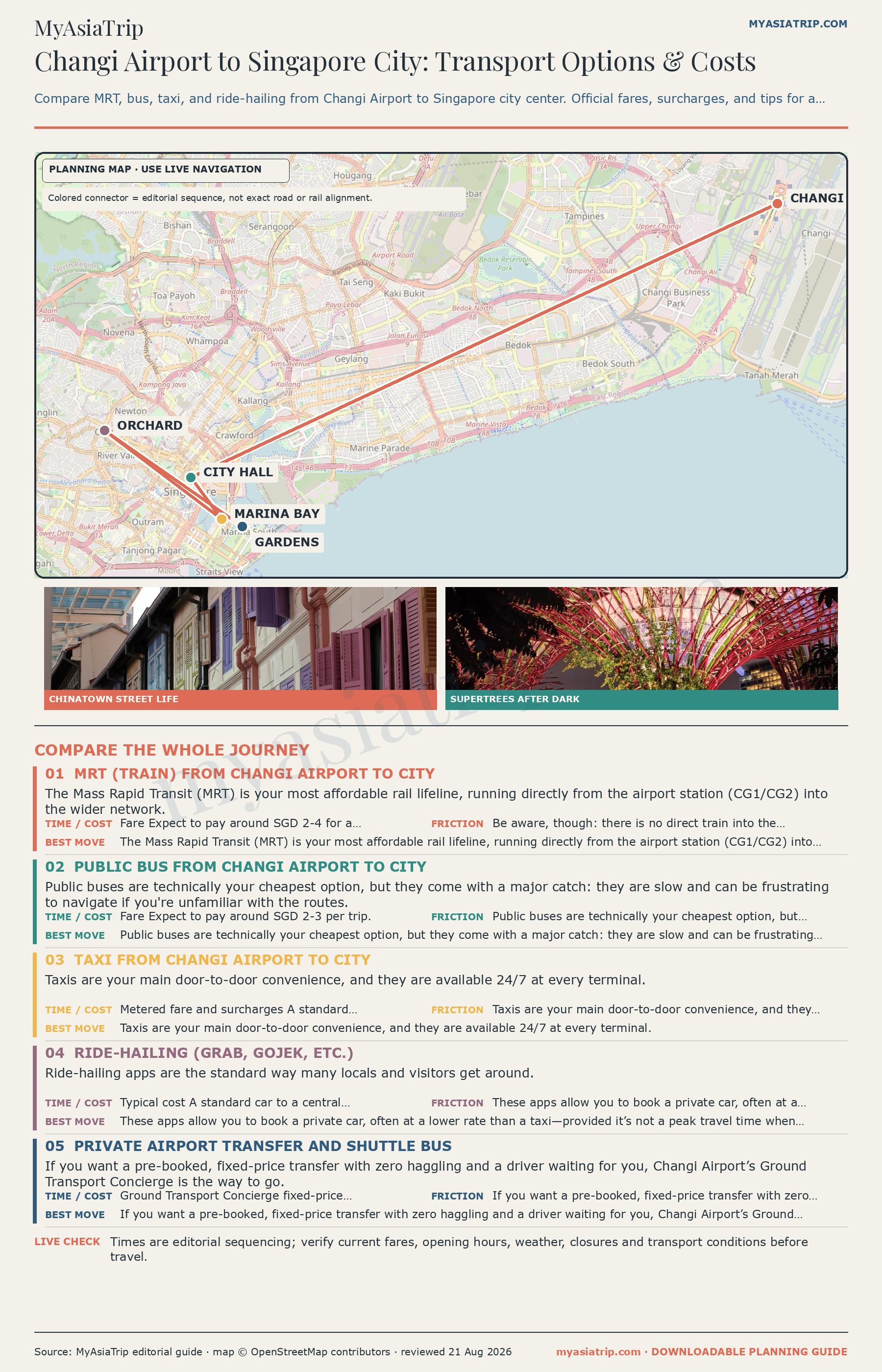
Master comparison of Changi Airport transport options
The table below summarizes the core ground transport modes from Changi Airport to central Singapore districts, with base fares and statutory surcharges verified against Land Transport Authority (LTA) and Changi Airport Group (CAG) standards for 2026.
| Transport Mode | Door-to-Door Time to City | Planning Fare / Cost Basis | Useful Operating Window | Payment Methods Accepted | Luggage & Accessibility | Best Fit For | Main Friction Points |
|---|---|---|---|---|---|---|---|
| MRT (Mass Rapid Transit Train) | 45–60 min (station to station: ~32–42 min) | ~S$2.00 – S$3.00 per adult (SimplyGo distance fare; +S$0.60/day for foreign Mastercard/Visa) | 05:31–23:18 (Mon–Sat); 05:59–23:18 (Sun/PH) | Contactless bank card (Mastercard/Visa), NETS mobile wallet, EZ-Link card, Singapore Tourist Pass. No cash at gates. | Full elevator & step-free access; spacious cars. Challenging with multiple large suitcases during rush hours. | Solo travelers, couples, light packers, budget-conscious visitors arriving during daytime hours. | No direct train to city center; requires transfer at Tanah Merah or Expo; connecting service ends at 23:18 daily. |
| Public Bus (Route 36 & East/North Routes) | 60–90 min (Route 36 to Orchard / City Hall) | ~S$2.00 – S$2.80 card fare; slightly higher for cash | ~06:00–00:00 (varies by route) | Contactless bank card, NETS mobile wallet, EZ-Link. Exact cash accepted on board (no change given). | Low-floor, wheelchair accessible; limited luggage space; difficult with multiple bulky cases. | Budget travelers staying directly along Marine Parade, Suntec, or Orchard bus corridors without transfers. | Slowest option; frequent stops; exposed to expressway traffic; stops located in terminal basements or surface bays. |
| Metered Taxi (Official Taxi Stands) | 25–40 min (direct hotel drop) | Typically S$25.00 – S$45.00 base meter before statutory airport, peak, or midnight surcharges | 24 hours daily | Cash (SGD), major credit/debit cards (Visa, Mastercard, Amex, JCB), local mobile payments (cashless fee may apply). | Dedicated boot/trunk storage; up to 4 passengers (standard sedan) or 6–7 passengers in larger vehicles. | Small groups (2–4), business travelers, families with luggage, arrivals landing after 23:00. | Queues during peak arrival banks; total fare increases significantly during the midnight window (00:00–05:59). |
| Ride-Hailing / Private-Hire App (Grab, Gojek, Tada, CDG Zig, Ryde) | 25–40 min (direct hotel drop) | Dynamic upfront fare shown before booking | 24 hours daily | Payment methods vary by app and account. | Choose a larger vehicle tier for a group or bulky baggage. | Travelers with mobile data who want to compare an upfront fare. | Must walk to a designated pickup door; demand-based pricing can rise during rain and arrival peaks. |
| Pre-Booked Private Airport Transfer | 25–35 min (direct hotel drop) | Fixed quote based on vehicle and inclusions | 24 hours daily (pre-scheduled) | Online advance payment methods vary by provider. | Vehicle size and child-seat options can be requested before payment. | Families, corporate arrivals and groups that value a planned meet-and-greet. | Compare waiting time, delay handling, luggage allowance, child seats and cancellation terms. |
| Ground Transport Concierge (Airport Counter) | 25–35 min (direct hotel drop) | Official fixed counter rate: S$70 (4-seater) / S$75 (6-seater) to one standard Singapore destination | 24 hours daily | Confirm available payment methods at the desk. | Choose the vehicle tier to match passengers and bags. | Walk-up passengers who want a fixed-price airport service. | Higher than many off-peak taxi or app fares; special destinations may cost more. |
| Hotel Shuttle (Property Specific) | Depends on hotel route | Set by the hotel | Limited fixed schedule | Arrange directly with the property. | Vehicle and baggage rules vary. | Guests whose hotel explicitly offers an airport shuttle. | Do not assume a central hotel provides one; confirm schedule, terminal and cost before arrival. |
Airport pick-up service comparison: pre-booked transfers & shuttles
Pre-booking an airport transfer provides a direct, fixed-rate transport option with dedicated vehicle staging, flight monitoring, and meet-and-greet services. This approach suits corporate travelers, families requiring child safety seats, multi-generational groups, and passengers arriving on late-night flights who prefer direct door-to-door transit without queuing.
Under Singapore traffic regulations, private-hire cars (such as standard Grab vehicles) must provide approved child restraints for passengers under 1.35 meters in height, whereas street taxis operate under a statutory exemption. Pre-booking a dedicated transfer allows families to request and confirm compliant child safety seats prior to arrival.
The table below outlines reputable pre-booked transfer and shared shuttle options:
| Airport Transfer Option | Best Fit & Passenger Profile | Service Inclusions & Vehicle Types | Critical Operational Considerations |
|---|---|---|---|
| Shared Changi Hotel Shuttle · Budget Pre-Booked Seat | Solo travelers or couples heading to a listed hotel. | A reserved seat in a shared vehicle with multiple drop-offs. | Confirm hotel coverage, departure window, luggage allowance and child-seat policy on the booking page. |
| Private Changi One-Way Transfer · Luggage-Matched Vehicle | Families, couples or business travelers seeking direct transport. | Private vehicle sized to the selected group tier. | Check waiting time, late-night fees, luggage limits and child-seat selection before paying. |
| 24-Hour Private Transfer · Multiple Vehicle Sizes | Larger families, groups or passengers with oversized luggage. | Several vehicle-capacity tiers. | Confirm the communication method, exact passenger/bag capacity and pickup procedure. |
| Two-Way Private Airport Transfer · Bundled Arrival & Departure | Visitors wishing to secure both arrival and departure transport arrangements before departure. | Coordinated round-trip booking covering initial airport arrival pickup and scheduled hotel departure transfer. | Requires scheduling return hotel pickup accurately; check operator cancellation and modification terms for the return leg. |
| Welcome Pickups Private Transfer · Meet & Greet | International travelers seeking a personalized arrival service. | Driver meet-and-greet with the inclusions shown at booking. | Compare the final quote, waiting policy and cancellation terms with other transfer options. |
Selecting the right transfer baseline for your party
To evaluate whether a pre-booked transfer matches your itinerary, consider these benchmarks:
- Solo traveler or couple with light baggage (1–2 bags): If arriving between 06:00 and 22:00, the MRT or an official metered taxi is generally more economical. A shared shuttle serves as an alternative primarily when traveling to an approved hotel outside train operating hours.
- Family with young children and stroller (3–4 passengers, 3+ suitcases): Compare an MPV with a taxi based on actual baggage volume. Street taxis are exempt from child-restraint rules that apply to private-hire cars; a pre-booked transfer lets you request a suitable child seat in advance.
- Medium to large groups (5 to 12 passengers): A pre-booked vehicle may keep everyone together and avoid paying the airport surcharge on several taxis. Compare the final quote with two cabs rather than relying on a generic group price.
- Walk-Up Ground Transport Concierge Alternative: Travelers who land without a booking and face long taxi lines or heavy app surge pricing can visit the 24-hour Ground Transport Concierge desk in the Arrival Hall of any terminal. The counter offers fixed-rate private transfers across Singapore for S$70 (4-seater sedan) or S$75 (6-seater MPV), providing a reliable price ceiling during severe weather or peak flight banks.
How to take the MRT from Changi Airport to the city: step-by-step
Singapore’s Mass Rapid Transit (MRT) network is fully air-conditioned, frequent, and accessible. Because Changi Airport station operates on a branch line, passengers must understand the ticketing system and transfer points before proceeding to the platforms.
Step 1: Payment and ticket purchase (SimplyGo explained)
Singapore’s public transport network operates under the SimplyGo contactless ticketing framework. Physical single-trip paper tickets are not sold at station counters.
- Contactless Bank Cards and Mobile Wallets (SimplyGo):
- Foreign travelers can tap contactless-enabled Mastercard and Visa credit or debit cards directly at MRT fare gates.
- Mobile wallets (Apple Pay, Google Pay, Samsung Pay) linked to supported cards and NETS contactless cards/wallets are also accepted.
- UnionPay Notice: Foreign UnionPay cards are not supported by the SimplyGo contactless transit gate system; travelers relying on UnionPay must purchase a local stored-value card.
- Card Consistency Rule: Always tap in and tap out with the exact same physical card or mobile device. Tapping in with a physical card and tapping out with a mobile wallet linked to that same card will register as two incomplete journeys, resulting in maximum default fare charges.
- Foreign Card Administrative Fee: Foreign-issued Mastercard and Visa cards incur a Land Transport Authority administrative fee of S$0.60 per usage day, processed as a consolidated charge every few days or after several transactions.
- Stored-Value EZ-Link Cards:
- Travelers without compatible contactless bank cards can purchase an EZ-Link card.
- Purchase Locations at Changi: Available at Changi Recommends counters in the Arrival Halls, the Passenger Service Centre inside the Changi Airport MRT station, or the TransitLink Ticket Office.
- Card cost and top-ups: Check the amount displayed at the sales counter, then top up at compatible station machines or service points. Card fees and included value can change.
- Singapore Tourist Pass (STP):
- Available at the TransitLink Ticket Office within Changi Airport MRT station.
- Offers unlimited travel on standard MRT, LRT, and basic public bus services for 1-day, 2-day, or 3-day durations.
- Compare the current pass price with your likely number of rides; it is convenient for a transit-heavy day but not automatically cheaper for every visitor.
Step 2: Locating the Changi Airport MRT station
The Changi Airport MRT station (CG2) is located underground between Terminal 2 and Terminal 3.
- From Terminal 2 or Terminal 3: Follow directional signs marked “Train to City” or “MRT”. Take the escalators or elevators down to Basement 2 (B2) to access the station concourse, customer service counter, and fare gates.
- From Terminal 1: Take the free automated Skytrain (operating 05:00 to 02:00) to Terminal 2 or Terminal 3 (approx. 3 minutes transit), then take the elevators or escalators down to Basement 2. Alternatively, walk via the Jewel Changi link bridges to T2 or T3 (approx. 5–8 minutes walk).
- From Terminal 4: Take the complimentary terminal shuttle toward Terminal 2, then follow signs to the MRT concourse. Check the live shuttle stop and frequency on arrival and allow extra transfer time.
Step 3: Route, line transfers, and destination strategy
Trains leaving Changi Airport run along a two-stop branch line: Changi Airport (CG2) → Expo (CG1 / DT35) → Tanah Merah (EW4). The train does not run directly through to downtown without a platform transfer.
Select your transfer point according to your destination neighborhood:
| Destination Hotel District | Recommended Transfer Strategy | Key Stations & Route Flow | Approximate Train Time |
|---|---|---|---|
| Bugis / City Hall / Raffles Place / Tanjong Pagar | Transfer at Tanah Merah (EW4) to the East-West Line (Green) | Ride 2 stops to Tanah Merah. Alight and walk across the island platform to Platform B (toward Tuas Link). Ride the East-West Line directly to Bugis (EW12), City Hall (EW13), Raffles Place (EW14), or Tanjong Pagar (EW15). | 32–38 minutes |
| Marina Bay Sands / Bayfront / Chinatown / Little India | Transfer at Expo (CG1 / DT35) to the Downtown Line (Blue) | Ride 1 stop to Expo. Follow signs to the Downtown Line underground platform (toward Bukit Panjang). Ride directly to Little India (DT12), Bugis (DT14), Bayfront (DT16), or Chinatown (DT19). | 35–42 minutes |
| Orchard Road / Somerset / Dhoby Ghaut | Transfer at Tanah Merah (EW4), then transfer at City Hall (EW13 / NS25) | Ride to Tanah Merah, cross platform to the East-West Line, ride to City Hall, cross platform to the North-South Line (Red, toward Jurong East), and alight at Dhoby Ghaut (NS24), Somerset (NS23), or Orchard (NS22). | 42–48 minutes |
| Tiong Bahru / Outram Park / HarbourFront (Sentosa Gateway) | Transfer at Tanah Merah (EW4) to the East-West Line (Green) | Ride to Tanah Merah, cross platform to the East-West Line, and ride directly to Outram Park (EW16) or Tiong Bahru (EW17). (For Sentosa/HarbourFront, change at Outram Park to the North East Line for one stop). | 40–46 minutes |
| Clarke Quay / Robertson Quay | Transfer at Expo (CG1 / DT35) to the Downtown Line, alight at Fort Canning (DT20) | Ride 1 stop to Expo, board the Downtown Line directly to Fort Canning station (DT20), which opens adjacent to the northern side of Clarke Quay and Robertson Quay. | 38–44 minutes |
Tanah Merah transfer tip: Follow the signs for Tuas Link / City when the airport train reaches Tanah Merah (EW4). The westbound East-West Line connection is designed as a simple platform transfer, but always follow the current platform display. Tanah Merah is elevated and can feel warm in the afternoon.
Operating hours & service frequencies
- First Train from Changi Airport:
- Monday to Saturday: 05:31
- Sundays and Public Holidays: 05:59
- Last Connecting Train from Changi Airport:
- 23:18 daily (This departure connects to the final westbound East-West Line train at Tanah Merah toward Tuas Link).
- Later local trains may terminate without a useful city connection; use 23:18 as the planning cutoff and verify the live journey planner.
- Train frequencies: Services are frequent during most of the day but vary by time; check the live departure board rather than planning to an exact interval.
Luggage handling, station navigation, and accessibility
All Singapore MRT stations feature full step-free accessibility, including wide automated fare gates, tactile pavement guides, platform-to-street elevators, and gap-reducing platform screen doors.
- Luggage Considerations: Rolling carry-on bags and backpacks are easy to manage on the MRT. If your group carries multiple large 28-inch suitcases, passing through major downtown interchange stations (like City Hall or Raffles Place) during weekday peak hours (08:00–09:30 and 17:30–19:30) can be challenging due to high commuter volumes.
- Station Exits: Many downtown MRT stations are extensive underground complexes with multiple exits spanning several city blocks. Check which exit number features street elevator access closest to your hotel before leaving the fare gates.
Public bus from Changi Airport to the city: routes & reality
Public buses offer a budget-friendly option serving eastern residential neighborhoods and select central hotel corridors. However, buses make frequent stops, take longer than the MRT, and have limited luggage space.
Payment rules for public buses
Singapore public buses operate under the standard SimplyGo contactless system:
- Card/Mobile Payment (Tap In, Tap Out): Board through the front entrance and tap your contactless bank card, mobile wallet, or EZ-Link card against the reader. When alighting, you must tap out at the exit reader by the middle/rear doors. Failing to tap out results in being charged the maximum possible route fare.
- Cash Payment: Cash fares are accepted. Drop the exact cash fare into the fare box next to the bus captain when boarding.
- Cash Restrictions: Bus captains do not give change. Ask the driver for the correct cash fare; card payment is simpler for transfers.
Bus stops at Changi Airport terminals
- Terminals 1, 2, and 3: Public bus bays are located in the Basement level bus bays of each respective terminal. Follow directional signs marked “Public Buses”.
- Terminal 4: Buses stop at the surface-level bus stop at Car Park 4B (serving Routes 24, 34, 36, and 110). Routes 27, 53, and 858 do not call at T4 directly; passengers departing T4 for those lines should take the free terminal shuttle bus to Terminal 2 or board at the nearby SATS Inflight Catering Centre 1 stop.
Key airport bus routes and geographic corridors
Of the seven public bus routes operating from Changi Airport, only Route 36 travels directly through central tourist and downtown hotel districts.
| Bus Route | Primary Route Corridor & Key Stops | Destination District Profile | Realistic Transit Time to Destination |
|---|---|---|---|
| Bus 36 (Primary Visitor Route) | T4 -> T3 -> T1 -> T2 -> Marine Parade -> Suntec City / Esplanade -> Capitol / City Hall (SMU) -> Dhoby Ghaut -> Somerset -> Orchard Road -> Tomlinson Rd (Loops back via ECP) | Central visitor corridor: Marine Parade hotels, Marina Centre, City Hall cultural district, and the length of Orchard Road. | 60–85 minutes (subject to traffic on the East Coast Parkway and city roads) |
| Bus 24 | Changi Airport -> Upper Changi Rd -> Bedok -> Paya Lebar -> Eunos -> Ang Mo Kio | Eastern suburban and north-central residential towns; connects to the East-West Line at Bedok and Paya Lebar. | 50–75 minutes |
| Bus 27 | Changi Airport -> Tampines -> Hougang Central | Eastern and northeastern residential heartlands. | 45–60 minutes |
| Bus 34 | Changi Airport -> Tampines East -> Punggol Coast | Northeastern residential towns and Punggol digital district. | 45–65 minutes |
| Bus 53 | Changi Airport -> Pasir Ris -> Serangoon -> Bishan | Eastern to central-northern residential corridors. | 60–80 minutes |
| Bus 110 | Changi Airport -> TPE Expressway -> Sengkang Central / Compassvale | Northeastern residential expressway link. | 35–45 minutes |
| Bus 858 | Changi Airport -> Yishun -> Sembawang -> Woodlands | Northern border district and Woodlands checkpoint corridor. | 75–95 minutes |
When to take the public bus
- Recommended: When your accommodation is located along the East Coast / Marine Parade corridor (such as hotels in Katong), which lacks direct airport rail access, or when you are traveling light and prefer a scenic road trip along the coastal East Coast Parkway.
- Not Recommended: For destinations like Chinatown, Marina Bay Sands, Tanjong Pagar, or Sentosa. Public buses do not have dedicated luggage racks, and managing multiple 28-inch suitcases on a crowded bus during commuting hours is inconvenient.
Taxis from Changi Airport: meters, surcharges & taxi stands
Official metered taxis operate 24 hours daily from designated taxi stands at all four passenger terminals. Uniformed airport marshals manage the queues to ensure orderly boarding.
Official taxi stand locations
Follow the overhead “Taxi” signage after clearing baggage claim:
- Terminal 1: Level 1 (L1) Arrival Hall curbside.
- Terminal 2: Level 1 (L1) Arrival Hall curbside.
- Terminal 3: Level 1 (L1) Arrival Hall curbside.
- Terminal 4: Level 1 (L1) Arrival Hall curbside.
Safety Note: Ignore any individuals offering rides inside the terminal arrival halls. Licensed Singapore taxis operate exclusively from official curbside taxi ranks.
Metered fare calculation & statutory surcharges
Singapore taxis operate on a strict electronic meter system based on distance and travel time. Statutory surcharges are added automatically to the digital meter console.
A standard metered taxi to downtown Singapore (City Hall, Marina Bay, Orchard) typically runs between S$25.00 and S$45.00 before applicable statutory surcharges. Statutory surcharges include:
| Surcharge Component | Statutory Rate | Active Operating Hours & Rules |
|---|---|---|
| Changi Airport Location Surcharge (Peak) | + S$8.00 | Daily from 17:00 to 23:59 |
| Changi Airport Location Surcharge (Off-Peak) | + S$6.00 | All other times (00:00 to 16:59 daily) |
| Peak Period Surcharge (LTA) | + 25% of metered fare | Monday to Friday: 06:00 – 09:29 (excluding public holidays) Saturdays, Sundays & Public Holidays: 10:00 – 13:59 Daily: 17:00 – 23:59 |
| Midnight Surcharge | + 50% of metered fare | Daily from 00:00 to 05:59 (Applied to base running meter) |
| Electronic Road Pricing (ERP) charges | Variable, if applicable | Added when the route passes an active ERP charging point. |
Accepted payment methods for taxis
- Cash: Singapore dollars are accepted; carry smaller notes.
- Cards and mobile payments: Availability and processing fees vary by vehicle and fleet. Check the payment logos before boarding or ask the driver before the trip begins.
Ride-hailing & private-hire apps: Grab, Gojek, Tada, CDG Zig & Ryde
Ride-hailing apps are widely used throughout Singapore. Note that Uber does not operate its own consumer ride-hailing service in Singapore, having merged its regional business into Grab in 2018.
Licensed ride-hailing and private-hire platforms operating at Changi Airport include:
- Grab: Offers several vehicle sizes, including family and larger-car options where available.
- Gojek: A mainstream private-hire alternative.
- CDG Zig (ComfortDelGro): Can be used to book taxis and private-hire options shown in the app.
- Tada Mobility, Ryde and Geolah: Additional locally available app choices. Compare the final fare and pickup time on arrival.
Designated ride-hailing pickup doors
Private-hire vehicles are not permitted to pick up passengers at metered taxi stands. You must proceed to the designated pickup doors at each terminal:
- Terminal 1: Basement 1 (B1), Doors 1 through 12
- Terminal 2: Level 1 (L1), Doors 2 through 7
- Terminal 3: Basement 1 (B1), Doors 1 through 5
- Terminal 4: Level 1 (L1), Doors 4 through 8 (Doors 1–3 are reserved for private vehicle pickups)
Pickup timing: Request the car after immigration and baggage claim, when you are close to the designated door. Loading time and cancellation fees vary by platform; confirm the app’s live instructions.
Dynamic pricing comparison: Metered taxi vs. ride-hailing
Ride-hailing applications show a fixed upfront fare prior to booking, inclusive of tolls and airport charges. The relative cost advantage varies depending on real-time demand:
- Normal demand: App fares can be competitive with a taxi and are shown before booking.
- Rain or concentrated flight arrivals: Demand-based pricing can rise quickly. Compare the app quote with the metered taxi queue and the airport’s fixed-price concierge service.
Late-night arrivals (22:30–05:30): after-hours transit options
Arriving late at night requires adjusting your transport plans to account for public transit operating cutoffs.
The 23:18 MRT cutoff
- The last MRT train connecting to the city center departs Changi Airport at 23:18 daily.
- Deplaning, clearing immigration, collecting baggage, and walking to the basement station takes approximately 35 to 50 minutes (longer if taking the shuttle bus from Terminal 4).
- Planning Guideline: If your flight is scheduled to land after 22:15, plan to use road transport (metered taxi, ride-hailing app, or pre-booked transfer). Attempting to catch the 23:18 train with checked luggage after a late touchdown risks missing the final connecting service at Tanah Merah.
Midnight surcharge considerations (00:00 to 05:59)
Between 00:00 and 05:59 daily, metered taxis incur a +50% midnight surcharge on top of the running meter fare.
- A metered journey costs materially more in this window because the 50% surcharge is added to the running meter.
- Ride-hailing platforms adjust base pricing upward in response to reduced late-night vehicle supply.
- For groups of 3 to 6 passengers, walking up to the Ground Transport Concierge desk for a flat-rate S$75 6-seater MPV or pre-booking a private van can cost less than hiring two separate metered taxis.
Audience-based transport recommendations
Use these practical recommendations to select the most suitable transport option based on your travel party and arrival schedule:
1. Solo travelers and couples (Daytime arrival, light baggage)
- Primary Option: MRT using SimplyGo contactless bank card or mobile wallet.
- Cost: ~S$2.00 to S$3.00 per person.
- Rationale: Avoids road traffic, fully air-conditioned, and provides a direct cross-platform transfer at Tanah Merah (East-West Line) or an easy connection at Expo (Downtown Line).
2. Families with young children, seniors, or multiple suitcases (3–4 passengers)
- Primary Option: Official metered taxi or pre-booked private transfer.
- Cost: Compare the metered taxi estimate with a live private-transfer quote; vehicle size and child-seat needs matter more than a generic range.
- Rationale: Eliminates station transfers and luggage handling through crowded areas. Taxis and private MPVs offer trunk space for strollers and luggage, delivering passengers directly to their hotel lobby.
3. Medium and large groups (5 to 12 passengers)
- Primary Option: Pre-booked 13-seater minibus transfer.
- Cost: Request a group quote and compare it with the cost of multiple taxis.
- Rationale: Avoids splitting the party across multiple cabs and paying multiple airport surcharges, providing unified group transport with dedicated luggage space at a low per-person cost.
4. Late-night arrivals (Landing between 22:15 and 05:00)
- Primary Option: Official metered taxi stand or Ground Transport Concierge desk.
- Cost: Metered taxi plus the 50% midnight surcharge, or S$70/S$75 for the airport concierge’s standard 4-/6-seat service to one destination.
- Rationale: Provides immediate, reliable transport when public rail and bus services are closed for the night.
Quick answers
Frequently asked questions
What is the cheapest way to travel from Changi Airport to downtown Singapore?
How much does a metered taxi cost from Changi Airport to the city center?
Is there a direct MRT train from Changi Airport to Orchard or Marina Bay?
Do trains and buses run 24 hours from Changi Airport?
Can foreign tourists tap credit cards on Singapore MRT and buses?
Research notes
Official planning references
We use these primary references for the time-sensitive details relevant to this guide. Rules, prices and operating hours can change, so confirm the live information before you travel.
- Changi Airport — Leaving the Airport
Details to check: Official Changi Airport guidance for train, public bus, taxi stands, ride-hailing pickup doors, and 24-hour Ground Transport Concierge rates; verified 2026-09-10.
- Land Transport Authority — SimplyGo Contactless Bank Cards
Details to check: Official SimplyGo payment rules, foreign card admin fees, and ticketing guidelines; verified 2026-09-10.
- Land Transport Authority — Point-to-Point Transport Taxi Fares
Details to check: Official Singapore taxi fare structure, airport location fees, peak period surcharges, and midnight rates; verified 2026-09-10.
- SMRT — Network Map and First & Last Train Timings
Details to check: Official rail timings, station transfer dynamics, and airport branch operational parameters; verified 2026-09-10.
- Changi Airport — Designated Pick-Up Points
Details to check: Official terminal-by-terminal ride-hailing and private-car pickup doors; verified 2026-09-10.
Guide reviewed 10 September 2026. Confirm live rules, prices and operating details with the linked authority before travel.