Singapore 7-Day Itinerary: A Complete One-Week District & Nature Guide
Plan a balanced one-week Singapore itinerary covering Marina Bay, historic cultural quarters, Sentosa, Mandai wildlife parks, and East Coast dining.


A seven-day stay in Singapore fundamentally changes how you experience the city. Shorter visits—such as a fast-paced 3-day Singapore itinerary or a standard 5-day Singapore itinerary—require tight schedules and aggressive trade-offs, often forcing travelers to pick between Sentosa’s resort attractions and the northern wildlife parks. Having a full week eliminates that compromise. It provides enough room to dedicate full days to major outer destinations, explore historic neighborhood streetscapes during cooler morning hours, and retreat indoors when midday heat and tropical rain arrive.
This seven-day guide is built around distinct geographic blocks linked by Mass Rapid Transit (MRT) and onward island or park transfers. It outlines a complete primary route, followed by specialized modular days for families, nature enthusiasts, food lovers, and pop-culture fans.
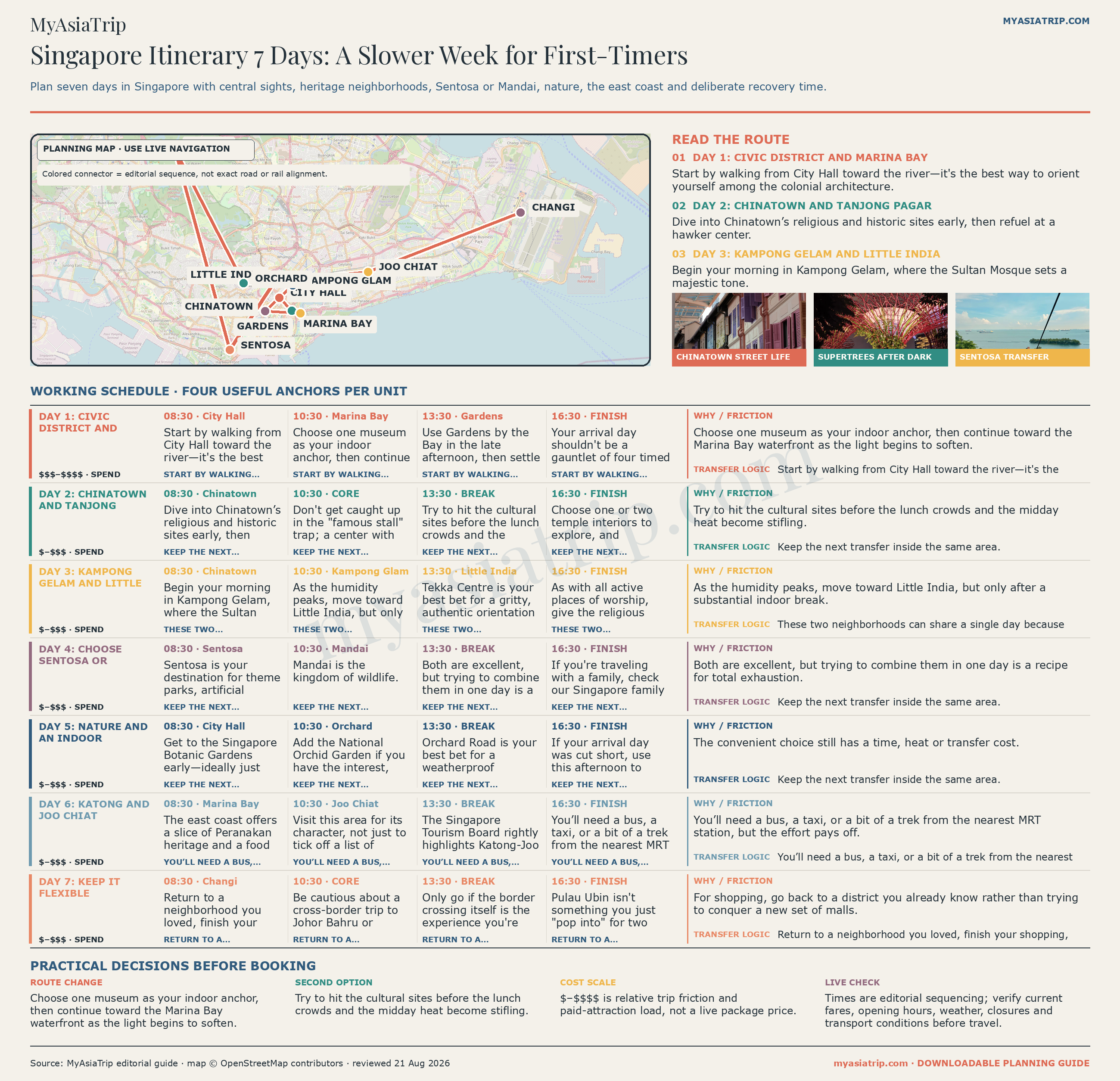
7-Day Singapore Itinerary Overview
The schedule assumes a full first day and a late flight on the final day. An afternoon arrival replaces that day’s morning block; an earlier departure replaces the final afternoon or evening. Hotel check-in, luggage collection and airport transfers sit outside the sightseeing blocks. An airline’s required airport-arrival time takes priority over optional Jewel or city stops.
The table below outlines the geographic anchors, transit hubs, and pacing for a full week in Singapore.
| Day | Focus Area | Morning (08:30–12:30) | Midday & Afternoon (12:30–17:30) | Evening & Night (18:00–21:30) | Primary Transit Station |
|---|---|---|---|---|---|
| Day 1 | Civic District & Marina Bay | City Hall heritage architecture, National Gallery | Indoor break; Cloud Forest & Flower Dome conservatories | Supertree Grove, Marina Bay waterfront skyline | City Hall / Bayfront |
| Day 2 | Chinatown & Historic Enclaves | Buddha Tooth Relic Temple, Telok Ayer shophouse streets | Maxwell Food Centre lunch; Chinatown Heritage walks | Lau Pa Sat satay street dining or Clarke Quay riverfront | Chinatown / Telok Ayer |
| Day 3 | Kampong Gelam & Little India | Sultan Mosque, Arab Street textile rows, Haji Lane | Air-conditioned cafe lunch; Sri Veeramakaliamman Temple, Tekka Centre | Mustafa Centre shopping, Little India curry houses | Bugis / Little India |
| Day 4 | Sentosa Island | USS full-day route OR Oceanarium | Continue USS; Oceanarium route adds lunch and one beach/fort stop | Island dinner; optional evening show | HarbourFront + Sentosa Express |
| Day 5 | Mandai Wildlife Reserve | Transfer; Singapore Zoo (or one alternative park) | Continue the selected park; lunch and rest | Return to the city, or optional Night Safari after dinner | Khatib + Mandai bus |
| Day 6 | Botanic Gardens & Orchard Corridor | Singapore Botanic Gardens & National Orchid Garden | Orchard Road design stores & air-conditioned malls | Emerald Hill heritage shophouses, Newton Food Centre | Napier / Orchard / Newton |
| Day 7 | East Coast, Katong & Departure | Katong & Joo Chiat Peranakan architecture walk | East Coast Road laksa lunch; East Coast Park seaside | Jewel Changi HSBC Rain Vortex & departure gates | Marine Parade / Changi Airport |
Day 1: Civic District, Marina Bay & Waterfront Skyline

The opening day establishes Singapore’s spatial layout, moving from the colonial administrative core around the Singapore River to the modern reclamation zones of Marina Bay.
Morning: Civic District Heritage Walk
Begin at City Hall MRT Station (EW13/NS25). The Civic District holds the highest concentration of Singapore’s preserved 19th- and early 20th-century civic buildings.
- National Gallery Singapore: Occupying the former Supreme Court and City Hall buildings, this complex houses the world’s largest public collection of modern Southeast Asian art. The interior bridges between historical courtrooms and contemporary glass canopies provide comfortable, air-conditioned exploration.
The UOB Southeast Asia Gallery is temporarily closed until late 2027; other exhibitions remain open. The gallery’s visitor information lists the available collections and opening hours.
- The Arts House & Victoria Theatre: Stroll past Old Parliament House toward the white statue of Stamford Raffles at the landing site.
- Crossing to the Bay: Cross the historic Cavenagh Bridge or Anderson Bridge toward Merlion Park. Note that the Merlion sits on the western edge of the bay; walking from here around to the eastern attractions spans roughly 1.5 kilometers of exposed open waterfront.
Afternoon: Gardens by the Bay Conservatories
From Raffles Place, take the North South Line to Marina Bay and change to the Circle Line for Bayfront (DT16/CE1). Alternatively, walk to Downtown station for a one-stop Downtown Line journey, or cross the northern waterfront via Helix Bridge to reach Gardens by the Bay.
- Flower Dome & Cloud Forest: These two cooled conservatories replicate Mediterranean and tropical montane climates. The Cloud Forest features a 35-meter-tall indoor vegetated mountain and waterfall structure. Visiting between 13:00 and 16:30 keeps you shielded from peak outdoor ultraviolet levels. (Note: Conservatory maintenance schedules occur once monthly; check operating notices before visiting).
- Outdoor Gardens & Dragonfly Lake: Free-to-access boardwalks wrap around the lakes, offering views of the conservatory glass roofs against the Marina Bay Sands towers.
Evening: Supertree Grove & Marina Bay Nightscape
As dusk falls around 19:00, the temperature drops slightly.
- Garden Rhapsody at Supertree Grove: The massive vertical gardens light up during coordinated evening sound-and-light performances (typically at 19:45 and 20:45).
- Dining: Grab dinner at nearby casual food courts inside the Shoppes at Marina Bay Sands or nearby waterfront venues.
- Skyline Walk: Stroll along the Marina Bay waterfront promenade to view the financial district skyscrapers across the water.
Day 2: Chinatown, Telok Ayer & Financial District Street Food

Day 2 focuses on early Chinese immigrant history, architectural preservation, and Singapore’s celebrated hawker culture.
Morning: Historic Temples and Traditional Shophouses
Alight at Chinatown MRT Station (NE4/DT19). Morning is the optimal window to explore Chinatown’s active places of worship before heat and foot traffic intensify.
- Buddha Tooth Relic Temple and Museum: A Tang-style Buddhist temple situated on South Bridge Road. The ground floor houses ceremonial halls, while upper levels hold cultural relics. Modest attire covering shoulders and knees is required at the door.
- Sri Mariamman Temple: Singapore’s oldest Hindu temple, located just down the street, featuring an ornate gopuram (entrance tower) adorned with figures of deities and mythological beasts.
- Telok Ayer Street: Walk two blocks east to Telok Ayer, the original shoreline where early immigrants landed. Visit Thian Hock Keng Temple, built in 1842 without a single nail, dedicated to Mazu, the goddess of the sea.
Midday: Hawker Dining at Maxwell and Amoy Street
- Maxwell Food Centre: Located directly opposite the Buddha Tooth Relic Temple, Maxwell is home to renowned stalls serving Hainanese chicken rice, Cantonese porridge, and oyster cakes. Arrive before 12:00 to avoid lunch queues from nearby financial offices.
- Alternative - Amoy Street Food Centre: A multi-level hawker centre on Telok Ayer Street featuring a mix of long-standing traditional noodle stalls and modern Michelin Bib Gourmand recipients. Read more in our comprehensive Singapore food guide and hawker centres guide.
Afternoon: Urban Architecture in Tanjong Pagar
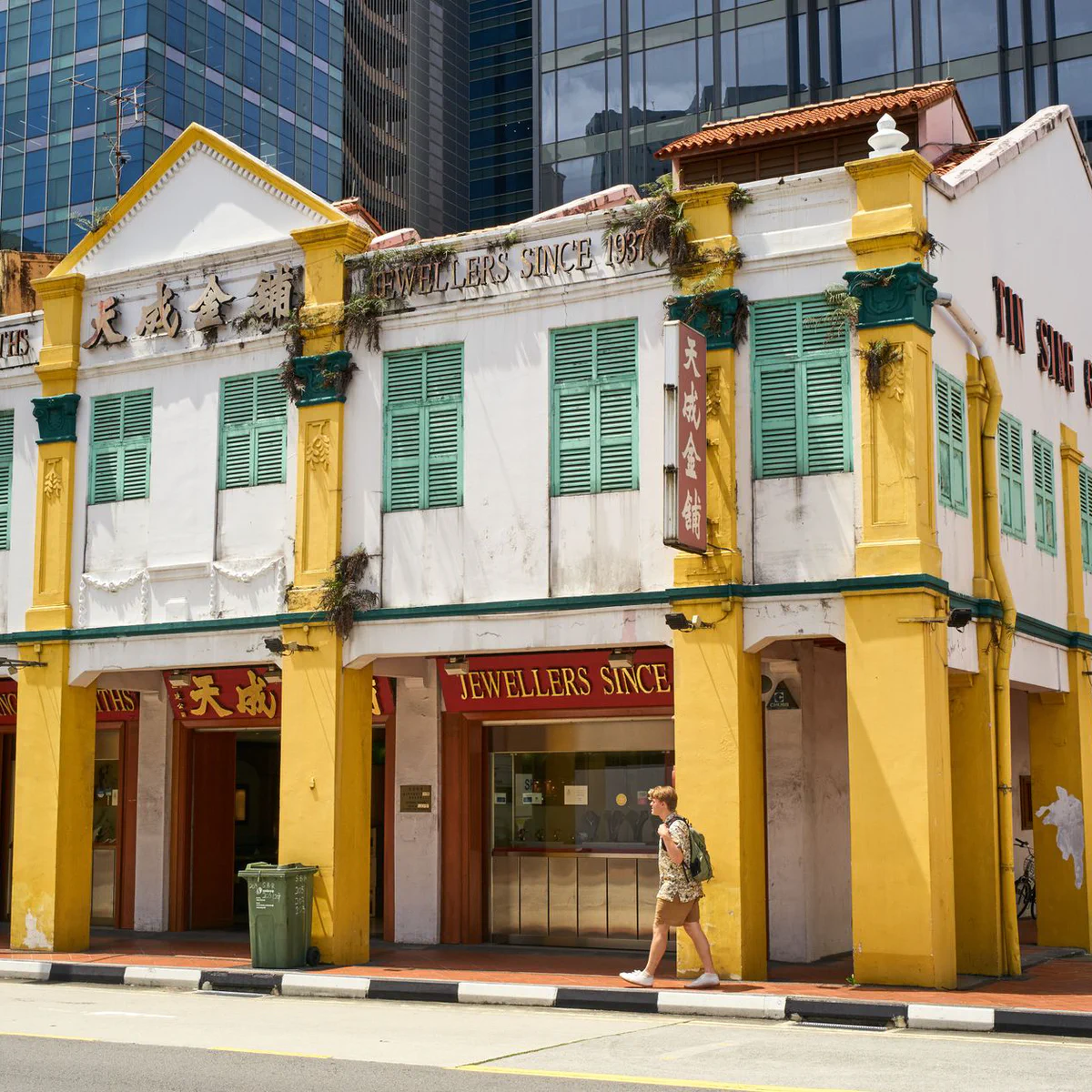
- Duxton Hill & Keong Saik Road: Wander past conserved pastel-colored shophouses now housing independent bookstores, tea salons, and specialty coffee roasters.
- Singapore City Gallery: Situated in the Urban Redevelopment Authority (URA) building on Maxwell Road, this gallery features a massive scale model of central Singapore, illustrating the island’s high-density land reclamation and infrastructure planning.
Evening: Satay Stalls & Riverfront Evening Life
- Lau Pa Sat (Telok Ayer Market): On weekdays at 19:00 (weekends at 15:00), the street adjacent to this Victorian cast-iron market (Boon Tat Street) closes to vehicles and transforms into “Satay Street,” with vendors grilling chicken, mutton, and beef skewers over charcoal mangals on the open asphalt.
- Clarke Quay Promenade: If you prefer riverside bars and illuminated historic bridges, walk north toward Clarke Quay to observe Singapore’s bustling nightlife.
Day 3: Kampong Gelam, Little India & Bugis Arts District
Day 3 explores Singapore’s Malay-Arab trade roots and the vibrant streets of the Indian community.
Morning: Kampong Gelam Heritage & Sultan Mosque
Take the Downtown or East-West Line to Bugis MRT Station (DT14/EW12) and walk five minutes north to Kampong Gelam.
- Sultan Mosque (Masjid Sultan): The focal point of the district, characterized by its massive golden dome accented by glass bottle bases donated by poor devotees during its 1920s reconstruction.
- Bussorah Street & Arab Street: Browse rows of heritage shophouses selling Persian carpets, Indonesian batiks, cane furniture, and non-alcoholic attar perfumes.
- Haji Lane: A narrow pedestrian corridor famous for independent fashion boutiques and colorful wall murals. Best visited in the late morning when storefronts roll up their shutters.
Midday: Middle Eastern Lunch & Indoor Break
- Enjoy murtabak (stuffed pan-fried flatbread) at historic institutions like Singapore Zam Zam on North Bridge Road, or take an air-conditioned break at a cafe along Baghdad Street.
Afternoon: Little India Markets & Temples
Walk west across Rochor Canal, allowing roughly 20–30 minutes from Kampong Gelam or take the Downtown Line from Bugis to Little India MRT Station (DT12/NE7).
- Tekka Centre: A bustling multi-ethnic hub. The ground floor houses one of Singapore’s most diverse wet markets alongside a hawker section famous for South Indian biryani, dosa, and teh tarik.
- Sri Veeramakaliamman Temple: One of Little India’s oldest Hindu temples, dedicated to the goddess Kali. The interior features intricate sculptures and dynamic prayer ceremonies.
- Little India Arcade & Campbell Lane: Pedestrian lanes selling jasmine flower garlands, traditional brassware, spices, and Ayurvedic goods.
Evening: Shopping & Dining in Serangoon Road
- Mustafa Centre: A legendary retail emporium on Syed Alwi Road stocking everything from electronics and cosmetics to rare spices and jewelry across multi-level aisles.
- Dinner: Settle into an authentic South Indian vegetarian restaurant (like Komala Vilas) or North Indian tandoori house along Serangoon Road.
Day 4: Full Day on Sentosa Island

Sentosa is Singapore’s primary offshore leisure hub, offering theme parks, aquariums, and resort beaches. Dedicating a full day ensures you experience its major paid attractions without having to rush.
Morning: Theme Parks & Marine Life
Universal Studios fills the daytime block. Singapore Oceanarium is an alternative anchor, leaving time for lunch and one beach or outdoor attraction; the lists below are choices, not a sequence of every stop. Take the North East or Circle Line to HarbourFront MRT Station (NE1/CC29), head to the top floor of VivoCity mall, and board the Sentosa Express light rail to Resorts World Station.
- Universal Studios Singapore: Southeast Asia’s only Universal Studios park, featuring distinct thematic zones including Ancient Egypt, Sci-Fi City (Battlestar Galactica coasters), and Far Far Away. Arrive at the opening time shown on your visit date’s calendar to complete major rides before afternoon queues peak.
- Alternative - Singapore Oceanarium: Ideal for hot or rainy days, this massive marine park holds marine life across its immersive habitats, anchored by the gigantic Open Ocean viewing tank.
Afternoon: Sentosa Beaches & Outdoor Attractions
Board the free Sentosa Beach Shuttle or walk along the coastal paths.
- Palawan & Siloso Beaches: Palawan features family-friendly suspension bridges and shallow swimming lagoons, while Siloso caters to beach clubs, volleyball, and watersports.
- Skyline Luge Sentosa: A gravity-fueled three-wheeled cart track winding through the rainforest canopy from Imbiah Lookout down to the beach, paired with a scenic open-air Skyride back to the top.
- Fort Siloso: Located on the western tip of Siloso Beach, this is Singapore’s only restored coastal artillery fort, featuring World War II tunnels, gun emplacements, and a scenic canopy skywalk (free admission).
Evening: Island Dining & Waterfront Views
- Dine at beachside bistros on Siloso Beach or head back to the waterfront restaurants at Resorts World Sentosa.
- Returning to Mainland: The Sentosa Express returns to HarbourFront, where you can connect directly back to central MRT lines. Detailed logistics can be found in our dedicated Sentosa island guide.
Day 5: Mandai Wildlife Reserve — Zoo Day and Alternative Parks
Located in Singapore’s northern catchment area, the Mandai Wildlife Reserve houses world-renowned zoological parks set in naturalistic rainforest landscapes.
Morning: Singapore Zoo
Singapore Zoo fills the main daytime route, with lunch and an afternoon break. River Wonders and Bird Paradise below are alternative daytime parks. A second wildlife day can replace Day 6 shopping for visitors who want to explore another park in depth. Take the North South Line to Khatib (NS14) and change to Mandai’s M2 bus. The first departure from Khatib is 08:30; buses generally run every 15 minutes, with wider late-night intervals. The zoo and River Wonders are at Mandai East; Bird Paradise is at Mandai West.
- Singapore Zoo: Renowned for its “open-concept” moated enclosures, the zoo allows close views of wildlife without visual cage bars. Key exhibits include the Fragile Forest biodome (free-ranging lemurs and flying foxes) and the Great Rift Valley of Ethiopia. The zoo opens at 08:30; arriving on the first Khatib bus means entering later. Animal activity and feeding sessions vary by exhibit.
Alternative Daytime Park: River Wonders
- River Wonders: Located immediately adjacent to the zoo, this river-themed wildlife park features the Giant Panda Forest (housing Kai Kai and Jia Jia) and the Amazon Flooded Forest, a massive freshwater aquarium exhibit displaying manatees and arapaimas. The enclosed, climate-controlled panda complex provides a welcome cooling break during midday heat.
Alternative Full-Day Park: Bird Paradise
- Bird Paradise: Relocated to Mandai, this state-of-the-art avian park features eight expansive walk-through aviaries mimicking global biomes, from African rainforests to Australian eucalyptus groves. Rest pavilions offer breaks between aviaries, though much of the visit remains outdoors in tropical heat.
Optional Evening: Night Safari Tram & Trails
- Night Safari: The world’s first nocturnal zoo currently opens from 18:00 to midnight (last entry 23:15). After a daytime park, it adds a substantial evening outing; allow dinner and rest first, or replace one city evening with a separate Night Safari visit.
- Walking Trails: Pangolin, Leopard, East Lodge and Tasmanian Devil are the four current trails; the Safari Adventure Tram offers a complementary view of the larger habitats.
- For complete pricing and timing breakdowns, consult our Singapore Zoo & Mandai guide.
Day 6: Singapore Botanic Gardens & Orchard Road Corridor
Day 6 combines UNESCO World Heritage botanical landscapes with Singapore’s premier retail, dining, and design district.
Morning: Singapore Botanic Gardens
Take the Thomson-East Coast Line to Napier MRT Station (TE12) or the Circle/Downtown Line to Botanic Gardens MRT Station (CC19/DT9).
- Tanglin Gate to National Orchid Garden: Entering via the southern Tanglin Gate (Napier Station) leads past historic heritage trees, the Swan Lake, and lush fern valleys.
- National Orchid Garden: Located in the core of the park, this ticketed area displays an extensive collection of orchid species and hybrids, including the celebrity orchid garden and the air-conditioned Cool House.
- Rain Forest Trail: This central garden trail explores a remnant of primary tropical rainforest. It lies near the Nassim entrance, rather than at the northern MRT exit; continuing to Botanic Gardens station involves more walking.
Afternoon: Orchard Road Retail & Architectural Hub
From Napier, take the Thomson-East Coast Line two stops to Orchard (NS22/TE14). From Botanic Gardens station, change from the Downtown Line to the North South Line at Newton.
- Shopping & Lifestyle Malls: Explore iconic retail complexes such as ION Orchard, Design Orchard (featuring homegrown Singaporean designers), and Takashimaya. Underground pedestrian networks connect the major malls, allowing you to walk long stretches in air-conditioned comfort.
- Emerald Hill Conservation Area: Turn into Emerald Hill Road just off Orchard Road to view an enclave of Chinese Baroque terrace houses dating back to the early 1900s, shaded by rain trees.
Evening: Newton Food Centre, with Fort Canning as an Alternative
- Fort Canning Park: Take the MRT to Fort Canning (DT20) or Dhoby Ghaut (NS24/NE6/CC1). Walk the historic hill that once served as the seat of 14th-century Malay rulers and British military headquarters during WWII (including the underground Battlebox command bunker). This replaces the Newton evening and can pair with dinner near Clarke Quay.
- Dinner at Newton Food Centre: Board the North South Line to Newton (NS21/DT11). Famous for chili crab, sambal stingray, and grilled satay, Newton offers an open-air courtyard hawker atmosphere.
Day 7: Katong, Joo Chiat, East Coast & Changi Departure
The final day focuses on Peranakan cultural heritage along the eastern coastline before transitioning smoothly to Changi Airport.
Morning: Peranakan Architecture in Katong & Joo Chiat
Take the Thomson-East Coast Line to Marine Parade MRT Station (TE26) or Tanjong Katong (TE25).
- Koon Seng Road Shophouses: Famous for their ornate ceramic wall tiles, pastel plaster facades, and carved wooden shutters, these 1920s terrace houses showcase Peranakan Chinese architectural fusion.
- East Coast Road Heritage Stores: Browse traditional Nonya beadwork, antique kebaya garments, and heritage bakeries selling pineapple tarts and glutinous rice cakes (kueh).
Midday: Authentic Nonya Lunch
- Settle into a traditional eatery along East Coast Road for authentic Katong Laksa (rice noodles in spicy coconut curry broth eaten solely with a spoon) or visit a Peranakan kitchen for ayam buah keluak (chicken braised in indigenous black nut sauce).
Afternoon: East Coast Park Coastal Walk
- East Coast Park: Walk south through underpasses to Singapore’s longest coastal park. Rent a shared bicycle to cruise along the shoreline path, or relax beneath the casuarina trees while watching cargo ships anchored in the Singapore Strait.
Late Afternoon & Evening: Jewel Changi Airport Experience
From the East Coast, allow around 30–45 minutes by taxi including pickup, or longer by public transport, before Changi Airport. This is a planning allowance; the exact park exit, luggage collection and traffic affect the journey.
- Jewel Changi (Landside): Accessible to the public before passing immigration, Jewel features the 40-meter-tall HSBC Rain Vortex—the world’s tallest indoor waterfall—surrounded by the four-story Shiseido Forest Valley.
- Departing Singapore: Retrieve hotel luggage before heading east unless it is already with you or stored at the airport. Add any Jewel visit to the airline’s recommended airport-arrival allowance, including the walk to your terminal. The Terminal 3 Butterfly Garden is airside and only fits when boarding time and terminal access allow.
Thematic Alternative Routes & Modular Day Blocks
A week-long itinerary provides flexibility to swap whole days based on personal interests. Use the modular blocks below to customize your schedule.
                  ┌─────────────────────────────────────┐
                  │      7-Day Core Schedule            │
                  └──────────────────┬──────────────────┘
                                     │
         ┌───────────────────────────┼───────────────────────────┐
         │                           │                           │
         ▼                           ▼                           ▼
┌──────────────────┐       ┌──────────────────┐       ┌──────────────────┐
│  Family/Kids     │       │ Nature/Adventure │       │ Pop Culture/Art  │
│  - Science Centre│       │ - Pulau Ubin     │       │ - Marina Bay     │
│  - Jacob Ballas  │       │ - MacRitchie     │       │   (Conan Trail)  │
│  - Sentosa Rides │       │   TreeTop Walk   │       │ - ArtScience Mus.│
└──────────────────┘       └──────────────────┘       └──────────────────┘
Alternative A: The Family & Children Route
Families traveling with younger kids can replace heavy walking days with focused, interactive destinations:
- Science Centre Singapore & Snow City (Jurong East): Over 1,000 interactive science exhibits, an Omni-Theatre planetarium, and an indoor sub-zero snow play chamber.
- Children’s Garden at Gardens by the Bay: A dedicated free water play park with hydro-vaults, stepping springs, and jungle treehouses. The water-play area has separate opening days: normally Thursday–Sunday and public holidays, with school-holiday variations.
- Jacob Ballas Children’s Garden: Located at the north end of Singapore Botanic Gardens, designed specifically for children with suspension bridges, sensory trails, and treehouse slides. The water-play area has separate opening days: normally Thursday–Sunday and public holidays, with school-holiday variations. It normally closes on Mondays except public holidays; adult entry normally requires accompanying a child, with unaccompanied adults directed to the service desk.
- Detailed family pacing tips are covered in our Singapore family itinerary.
Alternative B: The Nature & Off-Grid Explorer
For travelers who prefer raw biodiversity over urban malls, one of the following full-day routes replaces Day 6:
- Pulau Ubin & Chek Jawa Wetlands: Boats leave Changi Point Ferry Terminal for Pulau Ubin, with waiting time as well as the crossing to allow for. Rent a bicycle for island roads, then explore the wetland boardwalks on foot. NParks has announced a partial Coastal Loop closure from 15 September 2026; the island notices describe access changes.
- MacRitchie Reservoir & TreeTop Walk: A 11-kilometer hiking loop through dense secondary rainforest leading to a 250-meter free-standing suspension bridge suspended between two forest canopy peaks. The bridge closes on Mondays except public holidays, and last entry is 16:45; the full hike is much longer than the bridge crossing.
- Sungei Buloh Wetland Reserve: A mangrove reserve in northwest Singapore known for migratory shorebirds, resident mudskippers, monitor lizards, and estuarine crocodiles.
Alternative C: The Pop-Culture & Modern Architecture Trail
- Detective Conan “The Fist of Blue Sapphire” Route: Replace the Day 1 museum morning with Merlion Park and Marina Bay Sands for a film-inspired waterfront day. The producer’s synopsis confirms the Singapore setting and Merlion scene. A paid SkyPark visit is separate from the hotel’s guest-only infinity pool.
- Southern Ridges Architectural Walk: Mount Faber and Henderson Waves offer a focused walking route. The wider Southern Ridges network mixes paths, stairs and bridges; Forest Walk has had repair closures, so any onward extension depends on the current NParks route notices.
Where to Stay: Choosing Your Accommodation Base
For a seven-day stay, choosing the right neighborhood minimizes repetitive transit transfers. Detailed hotel recommendations are available in our guide on where to stay in Singapore.
                           [Orchard Road]
                           (Shopping & Hub)
                                 │
                   ┌─────────────┴─────────────┐
                   │                           │
            [Bugis / Bras Basah]         [City Hall]
            (Art, Culture, Transit)     (Central Heritage)
                   │                           │
                   └─────────────┬─────────────┘
                                 │
                        [Chinatown / CBD]
                        (Food & Direct MRT)
                                 │
                                 ▼
                         [Sentosa Island]
                         (Resort & Beach)
- City Hall & Marina Centre (Best for First-Time Convenience):
- Why stay here: Intersection of the North South (Red) and East West (Green) lines. Major museums, colonial sights, and the Marina Bay waterfront are within walking distance.
- Bugis & Bras Basah (Best for Culture & Budget Range):
- Why stay here: Served by the Downtown (Blue) and East West (Green) lines. Excellent access to casual dining, street markets, and heritage shophouses.
- Chinatown & Tanjong Pagar (Best for Dining & Nightlife):
- Why stay here: Immediate access to major hawker centres, cocktail bars, and the North East, Downtown, and Thomson-East Coast lines.
- Sentosa Island (Best for 2-Night Resort Add-Ons):
- Consideration: If you want dedicated resort time, consider splitting your stay (5 nights in the city centre + 2 nights on Sentosa). Commuting daily from Sentosa to the mainland incurs extra transit time.
Essential Travel Logistics for a One-Week Trip
Public Transit & Payment
- Contactless Payment: SimplyGo accepts supported contactless Visa and Mastercard cards, including eligible cards in Apple Pay or Google Pay. A foreign-issued Visa or Mastercard incurs a S$0.60 administration fee per day of use, separate from any issuing-bank charges. Tap in and out with the same card or device for each journey; a phone and its physical card count separately.
- Navigating the Lines: MRT lines are color-coded and numbered sequentially. Journey times between adjacent central stations rarely exceed 2–3 minutes. Review comprehensive transport details in our guide to getting around Singapore.
- Airport Connections: Changi Airport rail journeys require a transfer at Tanah Merah for the East West Line or Expo for the Downtown Line. See our airport to city transport guide.
Tropical Weather Pacing
- Daily Temperature & Rain Cycles: Singapore sits 1 degree north of the equator. Temperatures consistently reach 31–33°C (88–91°F) with relative humidity above 75%. Thunderstorms occur frequently in the mid-afternoon.
- Schedule Management: Plan outdoor walking trails and botanical gardens for early morning (08:00–11:00) or late afternoon (after 16:30). Reserve air-conditioned galleries, shopping arcades, and cooled conservatories for midday hours. Check seasonal trends in our best time to visit Singapore guide.
Budgeting & Entry Practicalities
- Cost Planning: A week in Singapore can range from budget-friendly (staying in boutique hotels and dining exclusively at hawker centres) to luxury resort experiences. Detailed expense breakdowns are available in our Singapore travel cost overview.
- Entry Requirements: Foreign visitors entering Singapore generally need a passport valid for at least six months and an SG Arrival Card submitted within the three-day window including arrival day. Airside transit passengers who do not clear immigration are exempt from SGAC; ICA also lists exemptions for Singapore residents entering through land checkpoints. The card is free and is not a visa. ICA entry requirements explain eligibility and exemptions; our Singapore entry guide covers the wider process.
By organizing your seven days into cohesive geographic districts and respecting the tropical climate, you can experience Singapore’s diverse heritage, modern architecture, world-class wildlife conservation, and culinary traditions at a comfortable, rewarding pace.
Quick answers
Frequently asked questions
Is seven days too long for a trip to Singapore?
Where should you base yourself for a one-week Singapore itinerary?
Research notes
Official planning references
We use these primary references for the time-sensitive details relevant to this guide. Rules, prices and operating hours can change, so confirm the live information before you travel.
- ICA — SG Arrival Card
Details to check: Three-day window including arrival day, exemptions, free submission; card is not a visa. Checked 2026-09-10.
- Changi — Airport transport
Details to check: Airport rail transfers and indicative taxi journey/cost. Door-to-door buffers in the itinerary are planning estimates. Checked 2026-09-10.
- SimplyGo — Contactless bank cards
Details to check: Supported payment methods and S$0.60 daily foreign Visa/Mastercard administration fee. Checked 2026-09-10.
- LTA — Rail network
Details to check: Station/line relationships. Walking and transfer allowances are planning estimates. Checked 2026-09-10.
- Gardens by the Bay — Opening hours
Details to check: Conservatory closures, outdoor hours and Children’s Garden opening days. Checked 2026-09-10.
- Gardens by the Bay — Garden Rhapsody
Details to check: Standard light-show times and ticketed-event exceptions. Checked 2026-09-10.
- National Gallery — Visitor information
Details to check: 10:00 opening; UOB Southeast Asia Gallery closure until late2027; other exhibitions remain open. Checked 2026-09-10.
- NParks — Fort Canning Park
Details to check: Wheelchair access from Cox Terrace roundabout. Checked 2026-09-10.
- Singapore Botanic Gardens — Visitor information
Details to check: Entrance/station geography; additional walking within the gardens. Checked 2026-09-10.
- RWS — Singapore Oceanarium
Details to check: Current attraction name; removed inherited S.E.A. Aquarium animal/habitat counts. Checked 2026-09-10.
- RWS — Universal Studios Singapore
Details to check: Date-dependent hours and ride restrictions; use the suggested full-day allocation as a planning recommendation. Checked 2026-09-10.
- Marina Bay Sands — Family visits
Details to check: Spectra standard20:00/21:00 shows, Friday/Saturday additional22:00 show. Checked 2026-09-10.
- Lau Pa Sat — Satay Street
Details to check: Weekday19:00/weekend15:00 opening. Checked 2026-09-10.
- Mandai — Night Safari
Details to check: Current18:00 opening, midnight close,23:15 last entry and four current trails. Checked 2026-09-10.
- Mandai — Getting to the reserve
Details to check: M2 Khatib first departure08:30, frequency and East/West drop-offs. Checked 2026-09-10.
- TMS — The Fist of Blue Sapphire
Details to check: Singapore setting and Merlion role; unsupported scene-by-scene claims removed. Checked 2026-09-10.
- Meteorological Service Singapore — Climate
Details to check: Typical day/night temperature ranges, not a forecast. Checked 2026-09-10.
- NParks — Pulau Ubin notices
Details to check: Partial Chek Jawa Coastal Loop closure announced from15 September2026. Checked 2026-09-10.
- NParks — Hello MacRitchie
Details to check: Monday closure except public holidays and16:45 last entry. Checked 2026-09-10.
- NParks — Jacob Ballas Children’s Garden
Details to check: Monday closure except public holidays and adult-entry restrictions. Checked 2026-09-10.
- NParks — Telok Blangah Hill Park
Details to check: Southern Ridges is mixed terrain; no promise of an uninterrupted elevated route or reopening. Checked 2026-09-10.
Guide reviewed 10 September 2026. Confirm live rules, prices and operating details with the linked authority before travel.