Singapore 1-Day Itinerary: Best Single-Day Routes for First-Timers, Layovers & Theme Days
Plan the perfect one day in Singapore with realistic hourly routes for first-timers, stopovers, families, and theme days, plus MRT, luggage, and transit tips.


Singapore is one of the easiest global hubs to explore on a tight schedule. Thanks to its compact urban geography, an air-conditioned Mass Rapid Transit (MRT) network that reaches almost every district, and pedestrian-friendly waterfronts, a single well-structured day can cover centuries-old heritage shophouses, authentic street cuisine, and futuristic waterfront architecture.
Whether you have a full 24 hours in the city, an overnight stay between long-haul flights, or a daytime layover, making the most of a single day requires balancing travel logistics with real walking stamina. The routes below keep sights within walkable clusters, account for transit time and luggage, and offer clear replacements for different travel styles.
If you are planning a longer stay across Southeast Asia or expanding your route, you can compare this plan with our 2-day itinerary, 3-day itinerary, 5-day itinerary, or 7-day itinerary.
Layover Feasibility: Calculating Real City Hours from Changi Airport
A common pitfall during a Singapore stopover is confusing total transit time with usable sightseeing time. While Singapore’s efficient airport and transit system streamline the process, getting into the city involves several fixed steps.
Example: 8 hours between flights (planning allowance, not guaranteed transit times)
├── Arrival formalities and baggage: 90 min
├── Airport-to-city transfer: 60 min
├── One city neighborhood, including food: 90 min
├── Return transfer: 60 min
└── Airport check-in, security and boarding allowance: 180 min
Understanding Your Usable Time Window
- Short connections: The terminal transit areas offer gardens and dining without entering Singapore. Jewel Changi Airport is landside: visiting it requires eligibility to enter Singapore and enough time for immigration and the return to your departure terminal.
- A longer daytime layover: The example above leaves only 90 minutes in the city. Actual usable time depends on baggage, immigration, traffic and the airline’s check-in deadline; a single waterfront or Chinatown stop fits that window better than the full route below.
- A full sightseeing day: The signature route runs from 08:30 to 21:30, excluding airport journeys. An overnight stay only supplies that window when flight times allow it. A nine-hour connection does not.
Entry Requirements and Baggage Storage
Foreign visitors entering Singapore generally need a passport valid for at least six months and an SG Arrival Card submitted within the three-day window including arrival day. Airside transit passengers who do not clear immigration are exempt from SGAC; ICA also lists exemptions for Singapore residents entering through land checkpoints. The card is free and is not a visa. ICA entry requirements explain eligibility and exemptions; our Singapore entry guide covers the wider process.
Changi Airport and Jewel offer paid left-baggage services. The location must match the area you can access—landside or transit—and a self-transfer may also involve collecting checked luggage. To plan the onward transfer, review how to get from Changi Airport to the city.
The Signature 1-Day Itinerary: Heritage, Civic District & Marina Bay

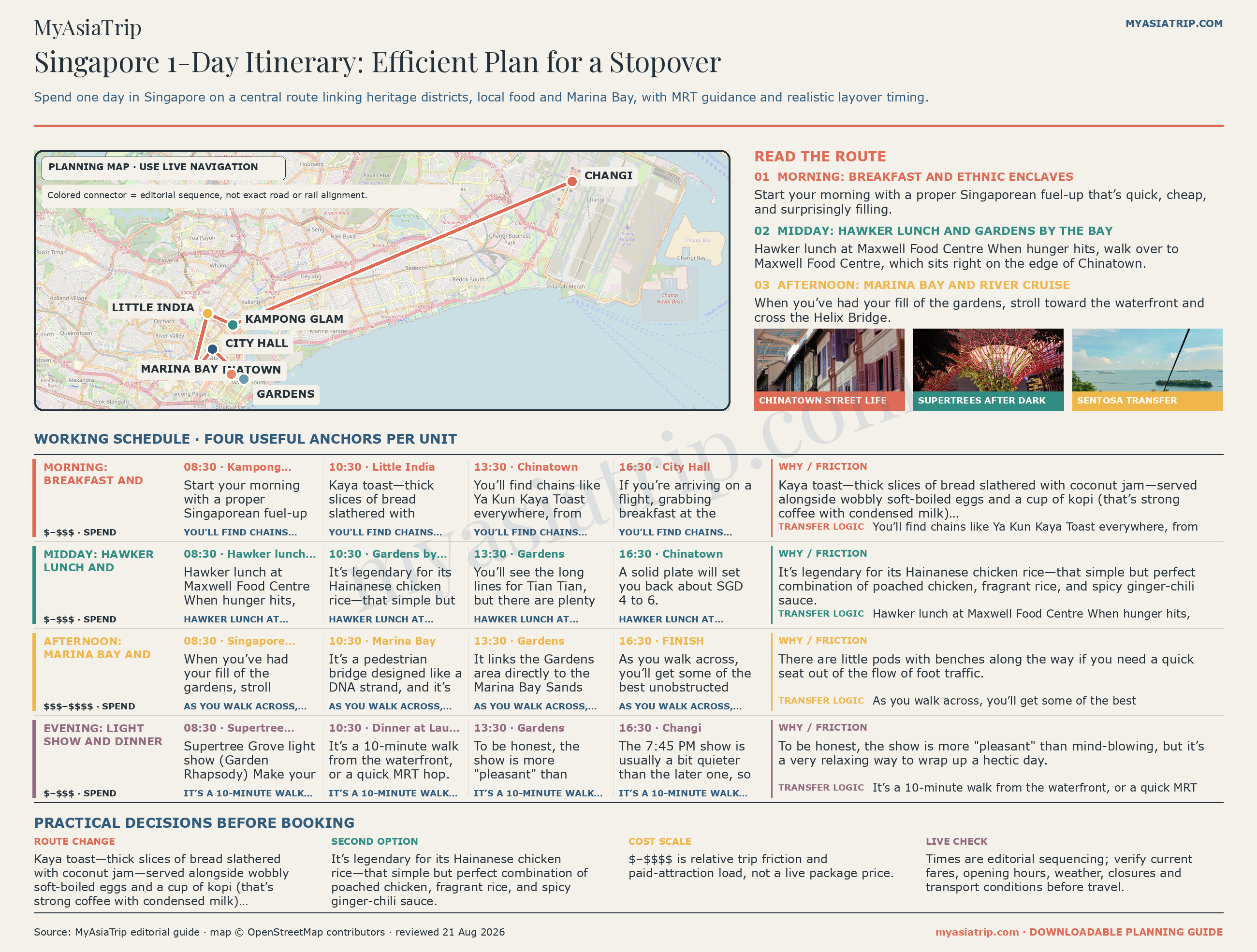
This balanced signature route is designed for first-time visitors and travelers with a full day (approximately 8:30 AM to 9:30 PM). It groups sights by proximity to minimize backtracking and pairs outdoor morning walks with air-conditioned indoor breaks during the heat of the afternoon.
Morning (08:30 – 11:30)
  Traditional Kaya Toast Breakfast ──> Chinatown Heritage Streets & Buddha Tooth Relic Temple
                                          │
Midday (11:45 – 15:30)                    ▼
  Maxwell Food Centre Hawker Lunch ──> Civic District (National Gallery or Fort Canning Park)
                                          │
Afternoon & Evening (16:00 – 21:30)        ▼
  Gardens by the Bay: One Conservatory ──> Marina Bay Waterfront ──> Lau Pa Sat Satay Street
Morning: Traditional Kaya Toast and Chinatown Heritage (8:30 AM – 11:30 AM)
Begin your morning around 8:30 AM with a classic Singaporean breakfast: charcoal-grilled or toasted bread spread with kaya (a fragrant coconut and pandan jam) and thick slices of cold butter, paired with two soft-boiled eggs seasoned with dark soy sauce and white pepper, alongside a cup of hot kopi (coffee brewed with condensed milk). Outlets such as Ya Kun Kaya Toast or Tong Ah Eating House offer classic settings to experience this breakfast staple.
Following breakfast, explore the historic core of Chinatown:
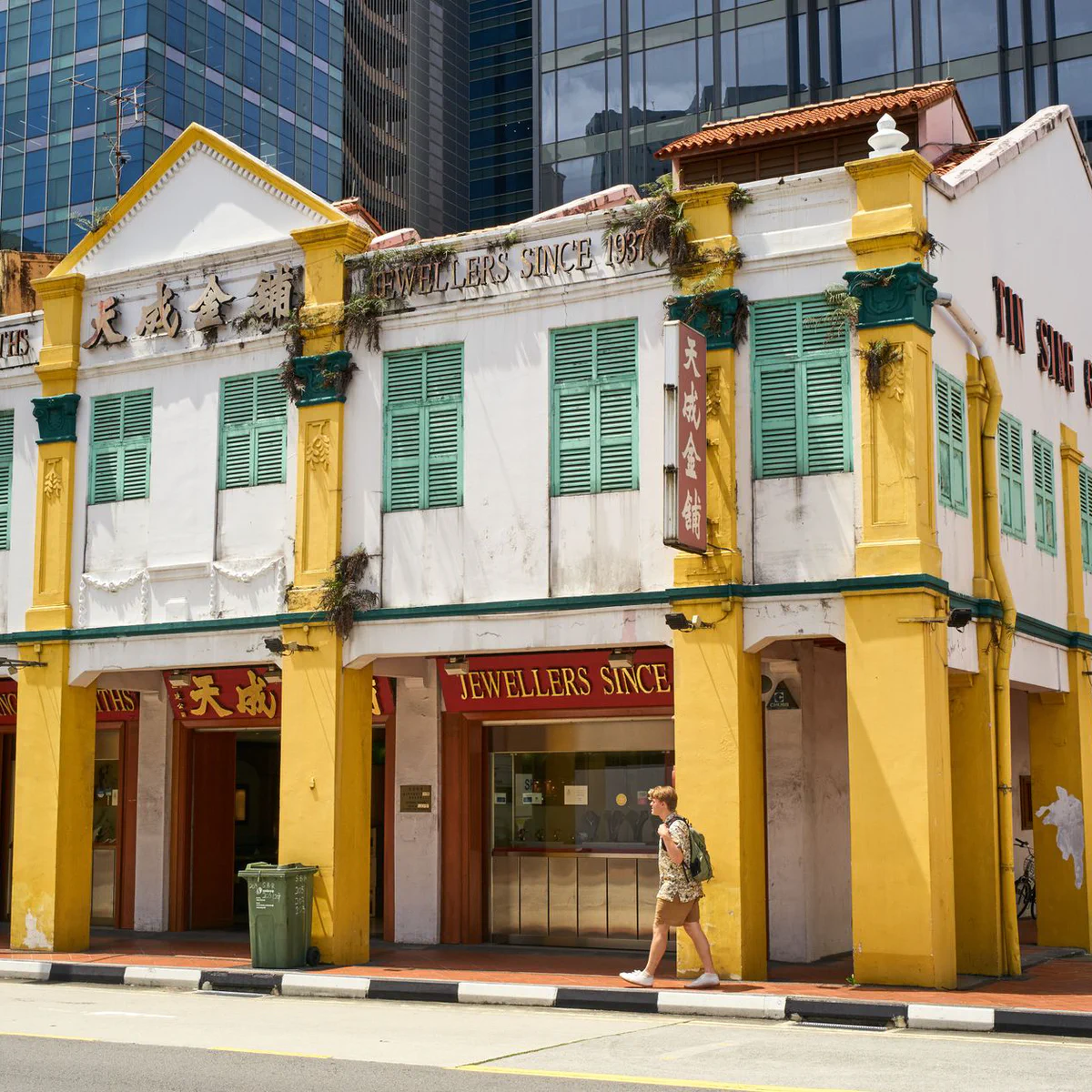
- Chinatown Street Scene: Walk along Pagoda, Temple, and Trengganu Streets, admiring the restored two- and three-story shophouses with ornate plasterwork and louvered shutters.
- Buddha Tooth Relic Temple and Museum: Located along South Bridge Road, this Tang-style Buddhist temple houses sacred relics; the tooth-relic stupa is on the fourth floor. Dress respectfully, with shoulders and knees covered.
- Sri Mariamman Temple: Just a three-minute walk away on South Bridge Road stands Singapore’s oldest Hindu temple, famed for its towering gopuram covered with vibrant sculpted deities, mythological figures, and sacred animals.
The compact layout of Chinatown makes it straightforward to explore on foot within two hours without rushing.
Chinatown Walking Segment
[Chinatown MRT Station] ──> Pagoda Street Shophouses ──> Sri Mariamman Temple ──> Buddha Tooth Relic Temple
(Walking distance depends on the lanes chosen; allow for crossings and thresholds)
Midday: Hawker Lunch at Maxwell and the Civic District (11:45 AM – 3:30 PM)
Just across South Bridge Road from the Buddha Tooth Relic Temple sits Maxwell Food Centre, one of Singapore’s best-known hawker venues.
Hawker Lunch Order Strategy at Maxwell
├── Main: Hainanese Chicken Rice (Tian Tian or Ah Tai Chicken Rice)
├── Side: Crispy oyster cake (Fuzhou Oyster Cake) or Chee Cheong Fun
└── Drink: Freshly pressed sugarcane juice with lemon or iced calamansi
Arriving just before the peak weekday office lunch rush (around 11:45 AM) makes it easier to secure a table. Familiarize yourself with local etiquette using our guide to Singapore hawker centres and explore regional dishes through our comprehensive Singapore food guide.
After lunch, a taxi connects Maxwell with the Civic District. By rail, Chinatown to Clarke Quay is one stop on the North East Line, followed by a walk toward the gallery or Fort Canning. Shenton Way station lies in the financial district, not the Civic District.
- Option A: National Gallery Singapore: Housed within the former Supreme Court and City Hall buildings, this world-class institution showcases Southeast Asian modern art within grand neoclassical halls linked by modern glass bridges. The indoor galleries provide an air-conditioned retreat during the hottest part of the day.
The UOB Southeast Asia Gallery is temporarily closed until late 2027; other exhibitions remain open. The gallery’s visitor information lists the available collections and opening hours.
- Option B: Fort Canning Park: For those interested in historic greenery, explore the elevated grounds of Fort Canning. Walk among 14th-century Malay royal history markers and colonial relics like the Battlebox. Wheelchair access is via the drop-off at Cox Terrace roundabout, according to NParks; other paths include slopes and steps.
Late Afternoon & Evening: Gardens by the Bay, Marina Bay Waterfront & Lau Pa Sat (4:00 PM – 9:30 PM)

By 4:00 PM, reach Gardens by the Bay via Bayfront MRT. From City Hall, the rail route involves a change at Marina Bay; from Fort Canning, the Downtown Line reaches Bayfront directly. The conservatories are a further walk inside the park.
Gardens by the Bay & Waterfront Flow
[Bayfront MRT] ──> Cloud Forest OR Flower Dome (16:00–18:00)
                       │
                       ▼
            Garden dining break & Supertree Grove (18:00–19:30)
                       │
                       ▼
         Garden Rhapsody Light Show (19:45–20:00)
                       │
                       ▼
Bayfront MRT to Downtown, then walk; optional Lau Pa Sat dinner from about 20:45
The Cooled Conservatories
Choose either Flower Dome or Cloud Forest for this afternoon window. The Cloud Forest features a 35-meter-tall indoor mountain covered in lush epiphytes, misting systems, and elevated walkways, while the Flower Dome houses botanical species from Mediterranean and semi-arid regions. Visiting both fits more comfortably when the conservatories replace the Civic District afternoon block.
Visitor Note: The conservatories schedule monthly routine maintenance closure days (dates vary by conservatory). Check the Gardens by the Bay official schedule before finalizing your date. Also note that the outdoor dining area Satay by the Bay has an announced closure from October 1, 2026 for redevelopment, making downtown hawker centers your primary evening dining recommendation.
Evening Light Show & Waterfront Views
Step outside into the Supertree Grove as dusk falls. At 7:45 PM (and repeated at 8:45 PM), the trees come alive during the free 15-minute Garden Rhapsody light and music performance. Viewing from the ground plaza provides an expansive, panoramic perspective without requiring ticket purchases for the elevated OCBC Skyway.
Special ticketed events may change access to Supertree Grove; the official show calendar lists exceptions.
Following the light show, walk toward the Marina Bay Sands promenade via the Bayfront connection for skyline views across the bay. Helix Bridge lies north of the resort, toward Marina Centre, rather than between the gardens and Marina Bay Sands.
Dinner on Satay Street (Lau Pa Sat)
Conclude your evening at Lau Pa Sat, a Victorian cast-iron market pavilion in the financial district. From 7:00 PM on weekdays and 3:00 PM on weekends, Boon Tat Street beside the market is closed to vehicles and transformed into an open-air “Satay Street.” Vendors grill skewers of chicken, mutton, beef, and prawns over open charcoal pits, served alongside peanut dipping sauce, cucumbers, and ketupat (pressed rice cakes). It offers a vibrant, memorable finale to a full day of sightseeing.
Alternative 1-Day Itineraries Tailored to Specific Travel Focuses
If your travel party has specific priorities—such as traveling with young children, seeking outdoor thrills, or focusing on distinct cultural pockets—consider these alternative routes.
Alternative 1-Day Themes
├── Route B (Resort & Family Focus): Sentosa Island, Universal Studios & Beach Front
├── Route C (Culture, Nature & Nightlife): Little India, Botanic Gardens & Clarke Quay Thrills
└── Route D (Architecture & Pop-Culture): Marina Bay Sands, ArtScience & Conan Landmarks
Route B: Sentosa Island & Coastal Fun (Theme Parks & Beaches)

For travelers looking to spend a dedicated resort day or traveling with kids, dedicate the entire day to Sentosa Island. For broader multi-day family ideas, see our Singapore family itinerary.
Sentosa Island Single-Day Schedule
Park opening – late afternoon: Universal Studios Singapore (date-specific hours)
Alternative daytime route: Singapore Oceanarium + lunch + one beach or Luge stop
18:00 – 20:30: Siloso Beachfront Dining or Wings of Time Night Show
- Morning to Mid-Afternoon: Arrive at Resorts World Sentosa via the Sentosa Express monorail from VivoCity or by walking across the Sentosa Boardwalk. Spend the morning at Universal Studios Singapore, prioritizing popular zones like Sci-Fi City, Ancient Egypt, and Far Far Away.
- Alternative daytime anchor: Singapore Oceanarium offers marine habitats and its vast Open Ocean viewing window. This replaces the Universal Studios day; lunch and one beach or Skyline Luge stop fill the remaining afternoon.
- Evening: Dine at the casual beachside restaurants along Siloso Beach or catch the Wings of Time multimedia water and laser show on the coast before taking the monorail back to mainland Singapore.
Route C: Heritage, Botanic Greenery & Clarke Quay Thrills
This route combines traditional ethnic enclaves, lush UNESCO-listed botanical gardens, and evening entertainment along the Singapore River.
Heritage, Nature & River Route Flow
08:30 – 11:00: Little India Cultural Walk & Tekka Centre Market
11:30 – 15:00: Singapore Botanic Gardens (National Orchid Garden & Picnic/Cafe Lunch)
15:30 – 18:00: Garden cafe / hotel rest before the riverfront evening
18:30 – 21:30: Clarke Quay Waterfront, Slingshot Thrill Ride & Evening Drinks
- Morning in Little India: Start at Tekka Centre to observe the bustling wet market and enjoy a breakfast of roti prata and teh tarik. Walk down Serangoon Road to admire the intricate tower sculptures of Sri Veeramakaliamman Temple and explore traditional spice, garland, and textile shops.
- Midday at Singapore Botanic Gardens: Take the Downtown Line MRT to Botanic Gardens MRT Station. Stroll through the lush tropical garden grounds established in 1859 and visit the National Orchid Garden, known for its extensive orchid collections. Note that the park spans two distinct MRT stations: Botanic Gardens Station serves the northern Bukit Timah entrance, while Napier Station on the Thomson-East Coast Line provides direct access to the southern Tanglin Gate.
- Alternative morning in Kampong Glam: Sultan Mosque, Haji Lane and Arab Street replace the Little India morning for travelers drawn to the golden dome, boutiques and perfumeries.
- Evening at Clarke Quay & Slingshot: Head to Clarke Quay along the Singapore River. Adventurous travelers can experience the Slingshot Singapore, an extreme bungee catapult ride that launches riders up to 70 meters into the air at speeds reaching 160 km/h (subject to operator height and safety requirements). Afterwards, relax at the riverside bistros and sample the city’s nightlife using our guide to Singapore nightlife.
Route D: Modern Architecture & Pop-Culture Highlights
Singapore’s skyline and urban design have captured international pop-culture recognition, notably featuring prominently in the animated film Detective Conan: The Fist of Blue Sapphire as well as Crazy Rich Asians.
Modern Architecture & Landmark Route
09:30 – 12:30: Marina Bay Sands SkyPark OR ArtScience Museum
12:30 – 14:30: Merlion Park & Heritage Fullerton Hotel Promenade
15:00 – 17:30: Waterfront cafe / hotel rest; optional second indoor attraction
18:00 – 21:00: Waterfront Promenade Sunset & Spectra Light-and-Water Show
- Marina Bay Sands & ArtScience Museum: Begin at the lotus-shaped ArtScience Museum, which hosts permanent digital art exhibitions like Future World alongside rotating global showcases. Alternatively, head up to the Marina Bay Sands SkyPark Observation Deck for 360-degree views across the Singapore Strait and urban core.
- Merlion Park & Civic Waterfront: Walk along the waterfront promenade to Merlion Park to view the iconic 8.6-meter water-spouting statue set against the backdrop of the financial district skyscrapers.
- Shopping alternative: Orchard Road and Emerald Hill can replace the Marina Bay afternoon and evening, combining modern retail architecture with restored heritage houses.
- Spectra Light Show: Return to the Marina Bay waterfront at 8:00 PM or 9:00 PM to watch Spectra, a free 15-minute outdoor light and water show featuring dancing fountain jets, colorful visual projections, and orchestral music across the bay.
Where to Stay for a 24-Hour Visit
When spending a single night in Singapore, your choice of neighborhood should match your schedule and arrival/departure times. For a comprehensive neighborhood-by-neighborhood review, see our full guide on where to stay in Singapore.
1-Day Accommodation Zones
├── Marina Bay / Civic District: Best for panoramic views and walking proximity to major sights
├── Bugis / Chinatown: Best for budget-to-midrange boutique hotels and direct MRT lines
└── Changi Airport / Jewel: Best for early morning departures and brief transit layovers
- Marina Bay & Civic District: Ideal for travelers seeking luxury accommodations and iconic skyline views. Civic District hotels suit museum visits; hotels on the Marina Bay Sands side are closer to Gardens by the Bay. Waterfront walking distances depend on the hotel location.
- Bugis & Chinatown: Excellent for boutique heritage hotels and mid-range stays. Both areas offer MRT connections to the airport with required transfers and feature a wealth of dining options right outside hotel lobbies.
- Changi Airport & Jewel: If you arrive late in the evening and depart early the following morning, staying in on-site transit hotels (airside) or landside hotels connected to Changi terminals avoids transferring luggage into the city center.
Practical Logistics: Transit, Climate & Payments
To ensure a seamless one-day visit, keep these practical fundamentals in mind:
Essential Daily Logistics Summary
├── Transport: Contactless Visa/Mastercard, Apple Pay or Google Pay directly at MRT fare gates
├── Weather: Constant daytime highs usually 31–33°C heat, high humidity, sudden afternoon thunderstorms
├── Payments: Credit cards widely accepted; keep SGD 20–30 in cash for traditional hawker stalls
└── Timing: Allow 3 hours prior to departure for international flights when leaving the city
Public Transportation (MRT & Busses)
SimplyGo accepts supported contactless Visa and Mastercard cards, including eligible cards in Apple Pay or Google Pay. A foreign-issued Visa or Mastercard incurs a S$0.60 administration fee per day of use, separate from any issuing-bank charges. Tap in and out with the same card or device for each journey; a phone and its physical card count separately. More route details are in our getting around Singapore guide.
Managing Weather and Clothing
Singapore is located just 1 degree north of the equator, with steady temperatures ranging between 23°C and 33°C (79°F–90°F) and humidity often exceeding 80%. Short, intense afternoon thunderstorms occur frequently throughout the year.
- Wear lightweight, breathable fabrics and comfortable walking shoes.
- Carry a compact umbrella in your day bag. If heavy rain begins while you are outdoors, head into nearby MRT stations, connected underground shopping concourses, or climate-controlled venues like the Gardens by the Bay conservatories.
- Check seasonal climate nuances before packing via our guide on the best time to visit Singapore.
Currency, Tipping and Travel Costs
The local currency is the Singapore Dollar (SGD). While digital and card payments are accepted almost everywhere, some older stalls in hawker centers remain cash-only. Carrying SGD 20 to 50 in small bills ensures you can order street snacks without issue. Tipping is not customary in Singapore; many sit-down restaurants add a service charge, often 10%, with GST where applicable to your final bill. To budget for meals, attractions, and transit, refer to our Singapore travel cost breakdown.
1-Day Itinerary Schedule Comparison
The table below summarizes the four distinct one-day itineraries, allowing you to select the schedule that matches your travel priorities.
| Itinerary Route | Target Travel Style | Morning (08:30 – 12:00) | Afternoon (12:30 – 17:30) | Evening (18:00 – 21:30) | Key Logistical Anchor |
|---|---|---|---|---|---|
| Signature First-Timer Route | First-time visitors with a full day | Kaya toast; Chinatown streets and temples | Maxwell lunch; one Civic District stop; one conservatory from 16:00 | Garden dining break;19:45 light show; optional Lau Pa Sat dinner | North East / Downtown MRT links; walking or taxi |
| Route B: Resort & Family | Families, theme-park fans | Sentosa transfer; USS or Oceanarium | Continue USS, or Oceanarium + lunch + one outdoor stop | Beach dinner; optional Wings of Time | Sentosa Express; island shuttles |
| Route C: Culture & Nature | Culture, greenery and riverfront evenings | Little India OR Kampong Glam | Botanic Gardens, lunch and rest | Clarke Quay; optional Slingshot; dinner | Downtown Line; taxi if preferred |
| Route D: Architecture & Pop Culture | Architecture and film fans | SkyPark OR ArtScience Museum | Merlion waterfront; lunch and rest | Waterfront dinner and Spectra | Bayfront / Downtown; walking |
Planning Next Steps
A single day in Singapore provides a rewarding overview of the city-state’s dynamic neighborhoods, world-class dining, and lush garden spaces. If your flight schedules allow you to extend your stay or you decide to return for a longer vacation, explore our in-depth guides to build out a broader travel plan:
- 2-Day Singapore Itinerary — Adds dedicated time for Sentosa or cultural districts.
- 3-Day Singapore Itinerary — The optimal duration for exploring both urban and resort highlights.
- 5-Day Singapore Itinerary — Ideal for families exploring Mandai wildlife parks and diverse neighborhoods.
- 7-Day Singapore Itinerary — A comprehensive, relaxed journey across all regional attractions.
Research notes
Official planning references
We use these primary references for the time-sensitive details relevant to this guide. Rules, prices and operating hours can change, so confirm the live information before you travel.
- ICA — SG Arrival Card
Details to check: Three-day window including arrival day, exemptions, free submission; card is not a visa. Checked 2026-09-10.
- Changi — Airport transport
Details to check: Airport rail transfers and indicative taxi journey/cost. Door-to-door buffers in the itinerary are planning estimates. Checked 2026-09-10.
- Changi — Transit guide
Details to check: Immigration eligibility for landside excursions. Layover arithmetic is a planning example, not an airport guarantee. Checked 2026-09-10.
- SimplyGo — Contactless bank cards
Details to check: Supported payment methods and S$0.60 daily foreign Visa/Mastercard administration fee. Checked 2026-09-10.
- LTA — Rail network
Details to check: Station/line relationships. Walking and transfer allowances are planning estimates. Checked 2026-09-10.
- Gardens by the Bay — Opening hours
Details to check: Conservatory closures, outdoor hours and Children’s Garden opening days. Checked 2026-09-10.
- Gardens by the Bay — Garden Rhapsody
Details to check: Standard light-show times and ticketed-event exceptions. Checked 2026-09-10.
- Gardens by the Bay — Satay by the Bay
Details to check: Closure from1 October2026 retained from Gemini after verification. Checked 2026-09-10.
- National Gallery — Visitor information
Details to check: 10:00 opening; UOB Southeast Asia Gallery closure until late2027; other exhibitions remain open. Checked 2026-09-10.
- NParks — Fort Canning Park
Details to check: Wheelchair access from Cox Terrace roundabout. Checked 2026-09-10.
- Singapore Botanic Gardens — Visitor information
Details to check: Entrance/station geography; additional walking within the gardens. Checked 2026-09-10.
- RWS — Singapore Oceanarium
Details to check: Current attraction name; removed inherited S.E.A. Aquarium animal/habitat counts. Checked 2026-09-10.
- RWS — Universal Studios Singapore
Details to check: Date-dependent hours and ride restrictions; use the suggested full-day allocation as a planning recommendation. Checked 2026-09-10.
- Marina Bay Sands — Family visits
Details to check: Spectra standard20:00/21:00 shows, Friday/Saturday additional22:00 show. Checked 2026-09-10.
- Lau Pa Sat — Satay Street
Details to check: Weekday19:00/weekend15:00 opening. Checked 2026-09-10.
- Meteorological Service Singapore — Climate
Details to check: Typical day/night temperature ranges, not a forecast. Checked 2026-09-10.
Guide reviewed 10 September 2026. Confirm live rules, prices and operating details with the linked authority before travel.